Recruiterflow Alternatives: What Staffing Agencies Can Switch To
 Suvam Moitra
 ·Oct 19, 2026·11 min read

Key Takeaways
- 1Seven tools cover the main reasons agencies leave Recruiterflow: Bullhorn, Loxo, Crelate, JobAdder, Manatal, Zoho Recruit and HireBound. Pick by the gap you can name.
- 2Recruiterflow says 2,100+ search firms use it and rates itself 4.8/5 on G2 and Capterra (vendor site, 19 October 2026), so many agencies should stay.
- 3A CRM helps a recruiter work faster, while an agent-led platform runs first-touch outreach and screening itself. Decide which of the two your agency needs.
- 4HireBound data shows a 64% WhatsApp response rate in India against about 12% for email, so channel coverage comes first for agencies recruiting in India.
- 5Test one live mandate for two weeks and compare recruiter hours per submitted candidate, reply rate by channel and time to first submission.
The right Recruiterflow alternative depends on what you want to replace: the CRM, your job-board reach, or the hours recruiters spend on outreach, screening and scheduling. Seven options cover those cases: Bullhorn, Loxo, Crelate, JobAdder, Manatal, Zoho Recruit and HireBound.
This guide is written for agency owners and delivery heads. HireBound is one of the options compared. Vendor details come from each vendor’s own website as of 19 October 2026 and are attributed to the vendor.
Want agents to handle sourcing, screening and scheduling for your agency? See how HireBound works →
Why Do Staffing Agencies Look for Recruiterflow Alternatives?
Agencies rarely leave a recruiting CRM because of its quality. The work around the CRM outgrows it, and four reasons come up most often.
- The recruiters still do the repetitive work. A CRM stores candidates and tracks stages, while calling, chasing and scheduling still fall to people.
- Channel coverage. Candidates in India answer on WhatsApp and phone far more than on email.
- Job-board reach. Agencies that post widely want one place to publish and to collect applicants.
- Tool sprawl. Some agencies want sourcing, CRM and outreach in one system instead of three.
Each reason points to a different kind of alternative. The diagram below maps the three main gaps to the options that address them.
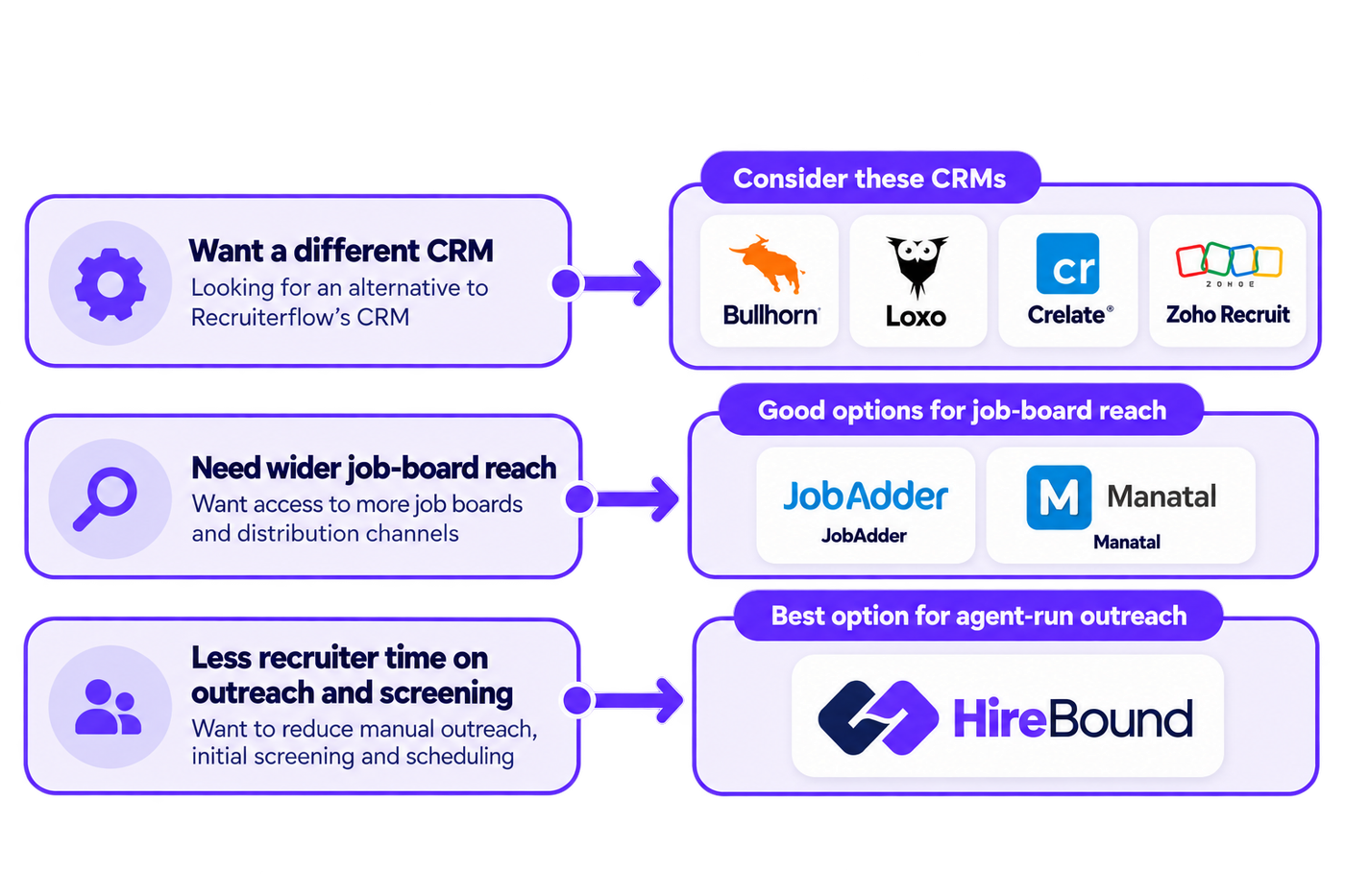
Naming the gap first keeps the search short.
What Does Recruiterflow Do Well?
Recruiterflow describes itself on its homepage as an AI-native ATS and CRM for executive search, recruiting and staffing firms. It says that 2,100+ search firms trust it globally and that it is rated 4.8/5 on G2 and Capterra (vendor site, 19 October 2026). Those are its own claims.
Its feature set is broad. The ATS and CRM sit in one system, campaigns run across email, LinkedIn and phone in one flow, and reports include goals and leaderboards.
Its AIRA layer adds natural-language search, a call notetaker, candidate sourcing, job-change alerts and an “Ask AIRA” assistant. Recruiterflow says AIRA has 36 agents built in.
For an agency that wants a mature CRM with sequences and sales automation, that is a strong base. It is the reference point for every option below.
Who Should Not Switch From Recruiterflow?
Stay if Recruiterflow already fits how your agency works. A migration costs weeks of recruiter attention, and a good CRM is hard to improve on by replacing it.
Stay if these describe you:
- Your business is relationship-led search. If recruiters win mandates by phone and network and place a few senior candidates a quarter, CRM depth and clean client records matter most.
- You recruit mainly on LinkedIn and email. Recruiterflow’s campaigns are built around that motion.
- Your team is small and happy. If recruiters rate the tool well and the numbers are fine, a new platform will not add much.
- Your constraint is clients, not candidates. More automation will not fill a thin mandate pipeline.
Staying does not rule out an add-on. Some agencies keep their CRM and add an agent layer for outreach and screening, which is covered below.
How Should You Choose a Recruiterflow Alternative?
Choose criteria that describe your week, then score every option against the same list. The table below sets out seven that matter for a staffing agency recruiting at volume in India.
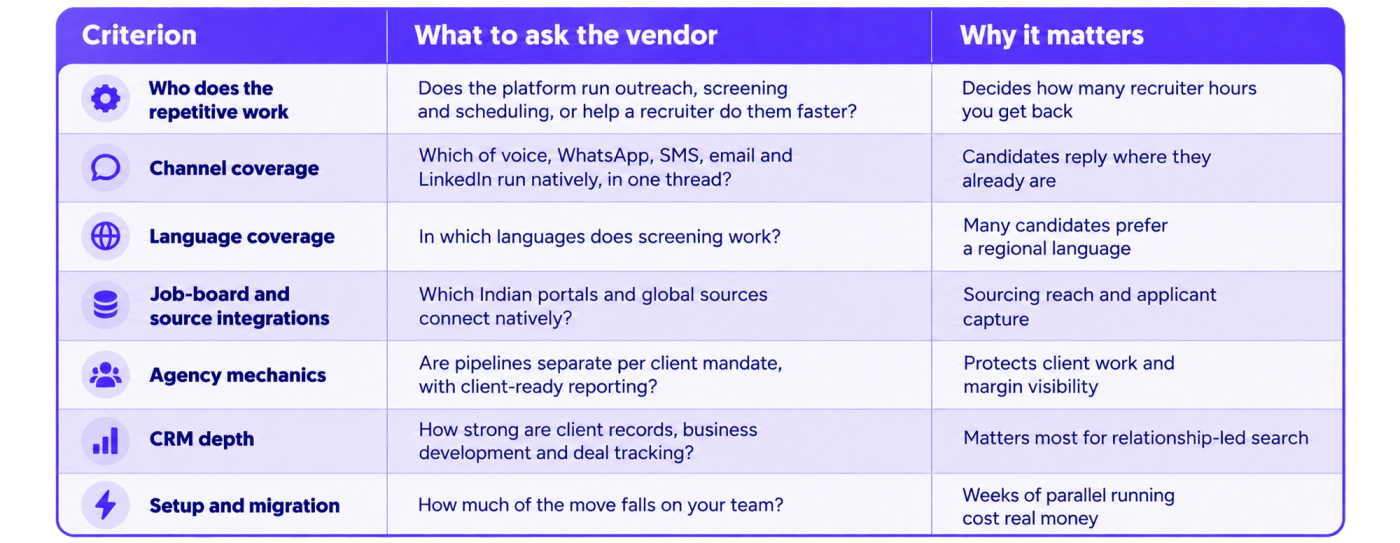
Weight the rows to match your agency. Relationship-led firms will put CRM depth first, and volume-led firms will put channel coverage and who does the repetitive work first.
If you are unsure whether your gap is a CRM problem or an ATS problem, our guide to recruitment CRM vs ATS explains the difference.
What Are the Best Recruiterflow Alternatives?
Seven options follow, each described from the vendor’s own website and grouped by what they are built to do. The order is not a ranking.
Bullhorn
Bullhorn calls itself the AI recruitment ATS and CRM powering 10,000+ staffing agencies (vendor site, 19 October 2026). It serves small agencies, midsize firms and enterprise recruiters, with ATS and CRM in one system.
Its AI layer, Amplify, includes a chat assistant, “Digital Workers” for sourcing, screening and outreach, and search and match. Bullhorn says it has 300+ pre-integrated marketplace partners and an open API.
Best for: Established agencies that want a large integration ecosystem. Our guide to Bullhorn alternatives for staffing agencies covers how it compares with the wider market.
Loxo
Loxo describes itself as a talent intelligence platform that combines sourcing, CRM, ATS, outreach and AI agents in one system (vendor site, 19 October 2026). It claims a native sourcing database of 850 million people, and it lists a separate sales CRM for business development.
Its AI includes sourcing agents, a candidate submittal agent, a notetaker and an outreach assistant, along with multi-channel sequences.
Best for: Direct-hire and executive-search firms that want sourcing data inside the ATS. Our Loxo alternatives guide goes further.
Crelate
Crelate says it unifies sourcing, recruiting CRM and applicant tracking with agentic AI, and that 1,500+ recruiting teams use it (vendor site, 19 October 2026). Its Discover agent searches a database it describes as up to 1 billion people.
It also lists bulk email and text campaigns, 100+ integrations, an open API, and onboarding tools built around US employment forms.
Best for: Recruiting teams that want sourcing, CRM and onboarding in one place.
JobAdder
JobAdder presents itself as an intelligent recruitment platform for growing agencies, covering ATS, CRM, marketing and analytics (vendor site, 19 October 2026). It says a job ad can be written once and posted to multiple boards, and that it connects to more than 200 job boards globally.
Its AI layer, Adder Intelligence, produces candidate summaries and relevancy ratings. JobAdder also lists 100+ integrations and ISO 27001 certification.
Best for: Perm and temp agencies that want wide job-board reach in a simple interface.
Manatal
Manatal describes itself as AI recruitment software for recruitment agencies, headhunters and HR teams (vendor site, 19 October 2026). It combines an ATS with a recruitment CRM, and its AI scores candidate profiles against job requirements.
It says jobs can be posted to 2,500+ channels, and it names Naukri among its job-board integrations. It also lists branded career pages and an AI interviewer for video interviews.
Best for: Agencies and in-house teams that want wide multiposting and AI-scored profiles in one tool.
Zoho Recruit
Zoho Recruit calls itself all-in-one recruitment software for HR teams and staffing agencies (vendor site, 19 October 2026). It includes an ATS and a candidate relationship management platform, plus Zia, an AI assistant for job descriptions, emails, sourcing and shortlisting.
It cites 75+ job boards, workflow automation through Blueprints and Custom Functions, portals for clients and vendors, and 200+ integrations. Our Zoho Recruit vs HireBound comparison shows how the two differ.
Best for: Agencies already on Zoho tools that want an all-in-one ATS and CRM.
HireBound
HireBound is an AI recruiting platform in which agents carry out recruiting tasks. Four agents cover sourcing, screening, scheduling and evaluation, and they work across Voice AI, WhatsApp, SMS and email.
For agencies, the pieces that matter most are these:
- Engagement where candidates reply. HireBound data shows a 64% WhatsApp response rate in India, against about 12% for email.
- Voice screening in 14 Indian languages. The Screening Agent runs structured calls with adaptive questions, live scoring, a recording and a transcript, then books the interview.
- Scheduling without back-and-forth. The Scheduling Agent collects availability during screening, books the interview and sends reminders.
- Agency mechanics. Pipelines are separate for each client mandate, with a multi-client workspace, client-ready dashboards, and views of revenue, margin and recruiter productivity.
- Indian job boards. Naukri, Shine, Apna and WorkIndia integrate with the platform, alongside sources such as LinkedIn and your own candidate pool.
HireBound has powered 8 million+ candidate conversations, and 60+ recruiting teams in India run on it. One recruitment firm with 150+ recruiters cut sourcing-to-scheduling time by 40% and saved 2 hours per recruiter daily. That result belongs to that firm. Recruiters using HireBound handle 3× more candidates per day than with a manual process.
HireBound is built to automate the manual work around an existing ATS or CRM. An agency can keep its CRM for client records and add HireBound for outreach, screening and scheduling.
Best for: Agencies recruiting at volume in India, where candidate engagement and recruiter capacity are the constraint.
What Changes for Agencies Recruiting in India?
Three things differ from the global default, and each affects which tool fits.
First, the channel. WhatsApp and phone are where Indian candidates reply, so an outreach tool built mainly around email and LinkedIn reaches only part of your pool. The chart below shows the gap.
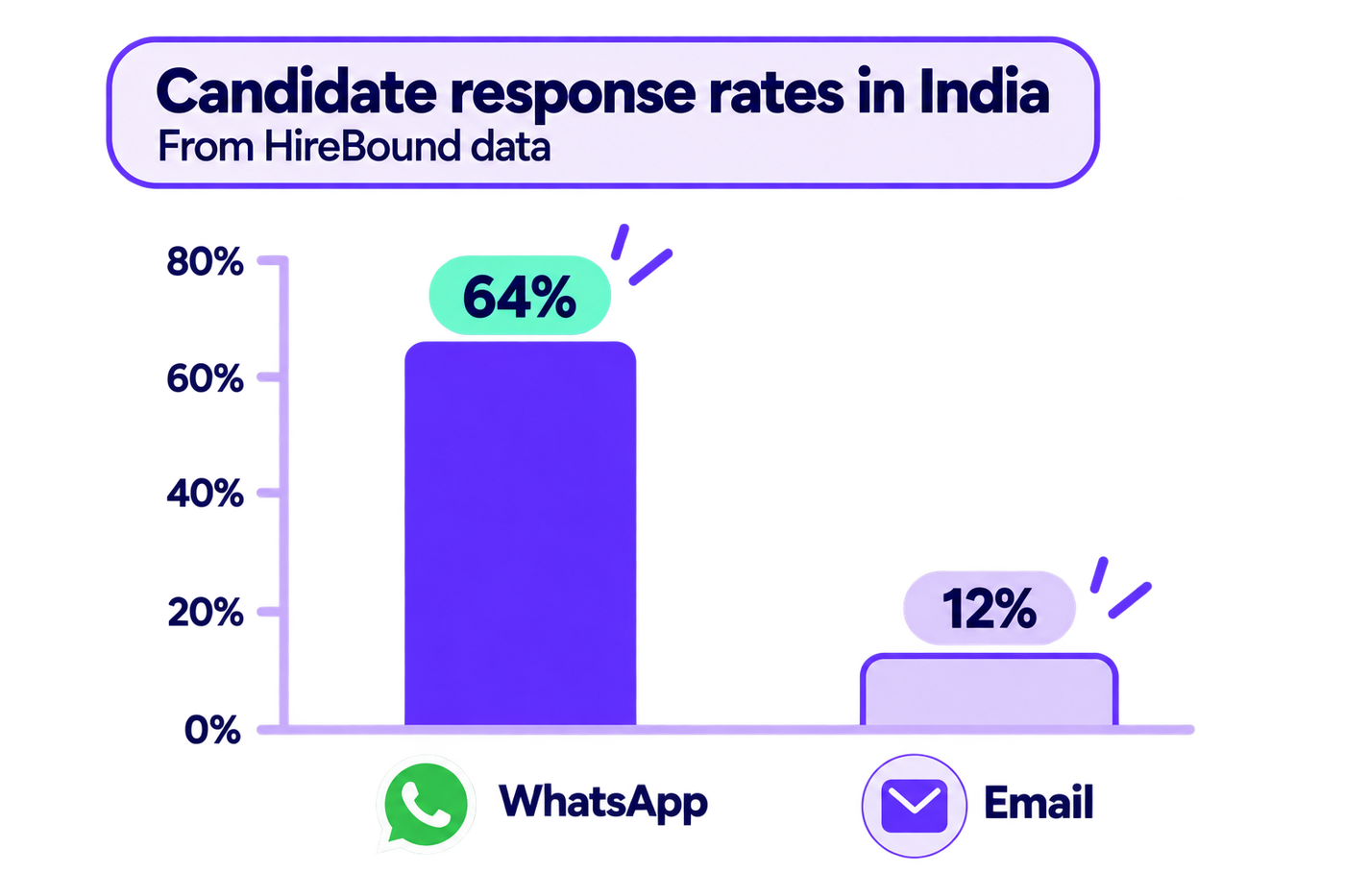
A message that is never opened cannot start a screening conversation.
Here is an illustrative example with assumed numbers. An agency contacts 500 candidates a week across its volume mandates. At the HireBound rates above, that is about 320 replies on WhatsApp against about 60 by email. Your own mix of roles will move those rates, so use the example to size the gap and not to forecast results.
Second, language. Many frontline and mid-level candidates are more comfortable in Hindi, Tamil, Telugu, Bhojpuri or another regional language than in English. A screening call in the candidate’s language reaches people an English-only workflow filters out.
Third, the market. The Indian Staffing Federation’s Flexi-Staffing Employment Trends Report for Q1 2026-27 shows overall staffing employment demand up 7.5% year on year. Its members added 1.14 lakh new formal flexi jobs over the last four quarters and represent 1.95 million formal flexi workers (accessed 19 October 2026). Growth like that rewards agencies that can fill more roles without adding recruiters at the same rate.
Consent also matters. India’s Digital Personal Data Protection Act, 2023 requires consent, or another use the Act specifically permits, before personal data is processed. Check how each outreach tool records consent for every channel it uses.
What Does Migrating From Recruiterflow Involve?
A move has four parts, and each takes recruiter time.
- Export. Candidate records, notes, client data and activity history need to leave in a usable format. Confirm the export format before you sign anything new.
- Mapping. Match your stages, custom fields and mandate structure to the new system, so reports still make sense.
- Parallel run. Keep both systems live for one or two mandates, so no client record is orphaned.
- Retraining. Recruiters usually need about a week of daily use before their speed returns.
An add-on layer that works around your CRM needs far less migration, because the CRM and its records stay where they are. That is why some agencies test an agent layer first and decide about the CRM afterwards.
What Should You Ask Any Vendor Before Switching?
Whichever direction you take, put the same questions to every vendor and write the answers down. Vague answers in a demo become expensive surprises in month three.
- What can I export, and in what format? Candidate records, notes, client data and activity history should all leave cleanly if you ever move again.
- Which channels are native? Ask to see WhatsApp and calling working in a live account, not on a slide.
- How is consent captured and stored for each channel? This matters under India’s data protection rules and under client contracts that cover candidate data.
- What does a recruiter still do by hand? Ask for a day-in-the-life walkthrough for one mandate, step by step.
- What does setup involve, and who does it? Get data import, training and support in writing.
A vendor that answers these plainly is easier to trust than one that answers yes to everything.
Which Recruiterflow Alternative Fits Which Agency?
Match the tool to your constraint instead of to a ranking. The table pairs common agency situations with the option that usually suits them.
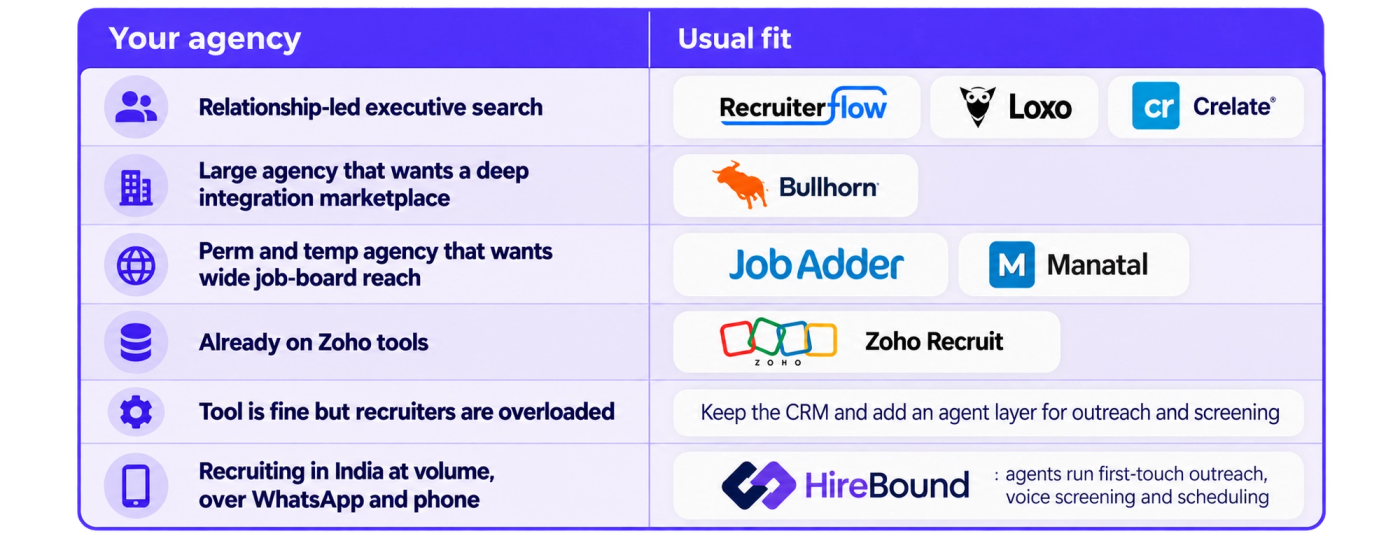
These are scenarios, not rankings. Most agencies fit more than one row. A 15-recruiter agency may be relationship-led on its search mandates and volume-led on its contract mandates, so it can test each separately.
How Do You Test a Recruiterflow Alternative Before You Switch?
Run a short, real test instead of watching demos. Two weeks is enough to see the difference.
- Pick one live mandate. Choose a role with at least 50 candidates in the funnel so volume effects show.
- Record your baseline. Note recruiter hours on outreach, screening and scheduling, and the reply rate by channel, before you change anything.
- Run the same role on the new workflow. Keep the recruiter, the client and the brief the same.
- Compare three numbers. Hours of recruiter time per submitted candidate, reply rate by channel, and time from brief to first submission.
- Count migration cost. Include data import, retraining and the weeks both systems run in parallel.
If the new tool does not beat your baseline on at least two of the three numbers, do not switch. Also ask each vendor for a reference agency of similar size recruiting in India, and speak to its delivery head about what took longest to set up.
Ready to test an agent-led workflow on one of your live mandates? Talk to HireBound about a pilot →
Our Recommendation
Recruiterflow is a well-regarded CRM, and many agencies should stay on it. Switch when you can name the gap: a different CRM shape, wider job-board reach, or recruiters spending their week on work that agents can do.
Apply one decision rule. If most of your recruiters’ week goes on chasing replies, making first screening calls and arranging interviews, weigh agent-run outreach and multilingual screening most heavily. Test HireBound on one live mandate. If most of it goes on client relationships and business development, weigh CRM depth most heavily and compare Recruiterflow with Bullhorn, Loxo and Crelate.
A mixed setup is also valid. Some agencies keep their CRM for client management and send only their high-volume mandates through an agent-led workflow. That lets you test candidate engagement without moving your client records.


