High-Volume Recruiting: Process, Tools and Benchmarks
 Suvam Moitra
 ·Nov 27, 2026·8 min read

Key Takeaways
- 1High volume recruiting is a throughput problem: you work backwards from a joining target through every stage's drop-off to find how many candidates you must contact.
- 2In the illustrative example below, 200 joiners need about 4,200 candidates contacted, because each stage loses 15% to 60% of the people who enter it.
- 3Screening and scheduling are the two stages where recruiters become the bottleneck, so they are the first to automate; interviews and offer decisions stay human.
- 4Track eight numbers weekly, starting with time to first contact and interview show-up rate, because a drop in either shows up in joiners two to three weeks later.
- 5In India, WhatsApp gets a 64% response rate against about 12% for email, so the first contact channel matters as much as the tool behind it.
High volume recruiting is the practice of filling many similar roles in a short window, usually dozens to thousands of hires per campaign. It works as a funnel: you set a joining target, estimate the drop-off at each stage, and contact enough candidates to survive that drop-off. The process, the tools and the metrics all follow from that.
This guide explains how the process runs, how to size the funnel, what each tool layer must do, and which numbers to watch. If you run these campaigns often, see how HireBound supports recruiters at scale: explore the AI recruiting platform.
What Is High Volume Recruiting?
High volume recruiting, also called volume hiring or high-volume hiring, covers campaigns where one team fills a large number of near-identical roles. Typical examples are contact centre agents, retail associates, delivery partners, warehouse staff, nurses and campus intake batches.
The roles differ in pay and skill, but the recruiting problem is the same. You have a deadline, a large applicant pool, and a recruiter team that cannot call everyone.
Bulk hiring is the common Indian term for the same idea. For a drive-planning view built around India's cities and statutory checks, read the bulk hiring in India process guide. This post covers the operating model, the tool stack and the metrics that apply to any market.
How High Volume Recruiting Differs From Normal Hiring
Normal hiring optimises for the best person for one role. High volume recruiting optimises for enough qualified people, on time, at a stable quality bar.
That changes what matters:
- Speed beats depth. A candidate who is not contacted within hours often accepts another offer.
- Consistency beats judgement. Fifty screeners asking different questions produce incomparable results, so questions and pass marks are fixed in advance.
- Process beats heroics. One strong recruiter cannot absorb a spike. A repeatable workflow can.
- Attrition is part of the plan. You expect candidates to drop at every stage and plan for it.
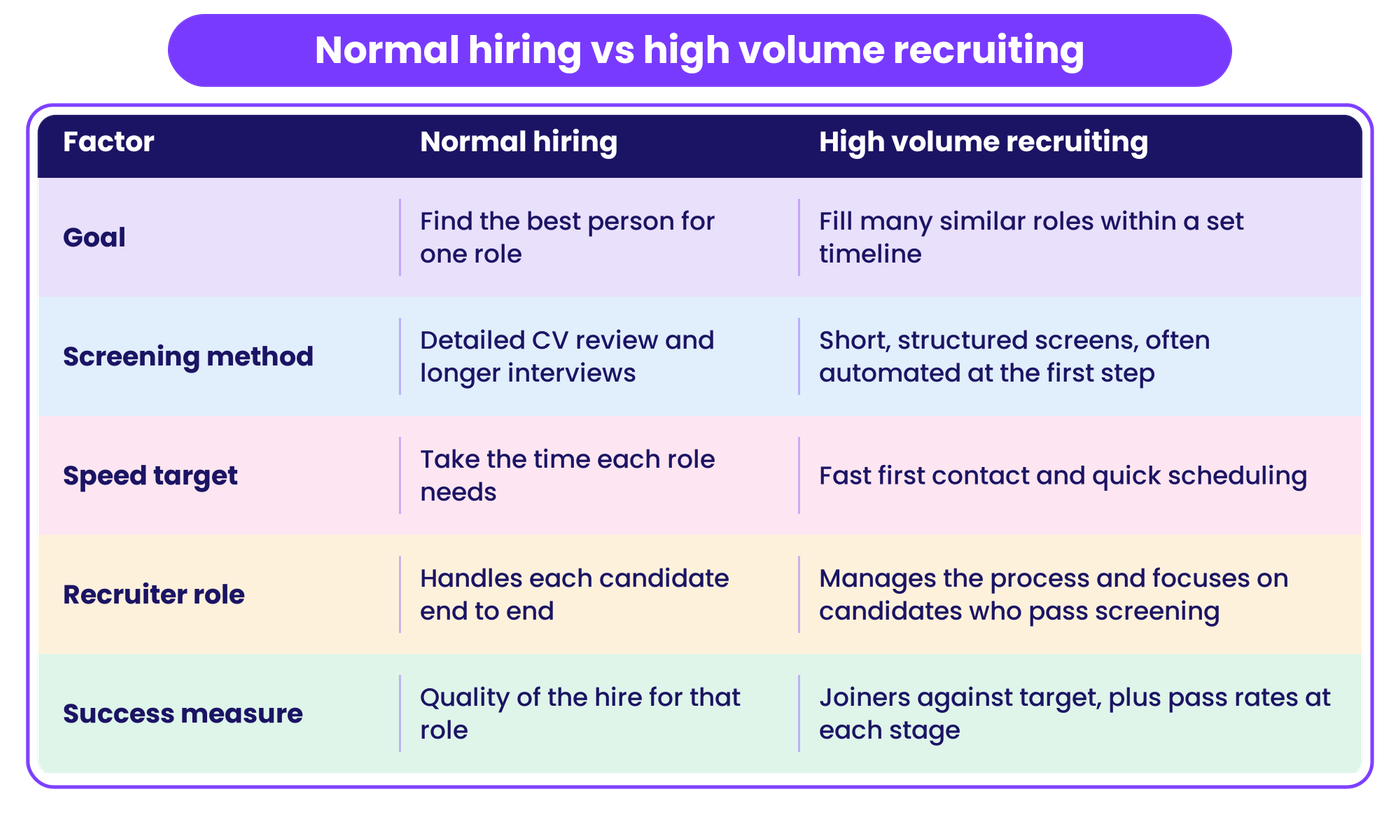
A volume campaign runs like an operation, not like a series of individual searches.
Who Does What: The Operating Model
A volume campaign has four roles, and they can sit with one person in a small team.
- Campaign owner. Sets the target, timeline and quality bar, and reports progress daily.
- Sourcing and outreach. Fills the top of the funnel from job boards, referrals, past applicants and walk-ins.
- Screening and scheduling. Qualifies candidates against fixed criteria and books interviews.
- Closers. Run interviews, make offers and chase documents until joining day.
The mistake is making the same recruiters do all four. Closers get buried in screening calls, and offers go stale. Split the work by stage, and automate the repetitive stages first.
The High Volume Recruiting Process, Stage by Stage
Most campaigns follow the same seven stages.
- Brief. Define role, location, shift, pay, joining date and the headcount target.
- Source. Pull from job boards, your ATS database, referrals and local channels.
- Contact. Reach every candidate quickly, on the channel they answer.
- Screen. Ask the same short set of qualifying questions and score the answers.
- Schedule. Book interview slots, confirm them and send reminders.
- Interview and select. Run structured interviews with a scorecard.
- Offer and join. Send offers, collect documents and keep candidates warm until day one.
Each stage has its own drop-off. The next section turns those drop-offs into a plan.
The Funnel Math: How Many Candidates You Need
Work backwards from the joining target. Take each stage's pass rate, divide, and you get the candidates needed at the top.
The table below uses illustrative rates for a 200-hire contact centre campaign. These are planning assumptions, not industry benchmarks. Replace them with your own last three campaigns.
Add a buffer on top of the result. Plan for 10% to 15% more candidates than the math says, because a single bad week at any stage can cost you the joining date. The buffer figure is a planning habit, not a published benchmark.
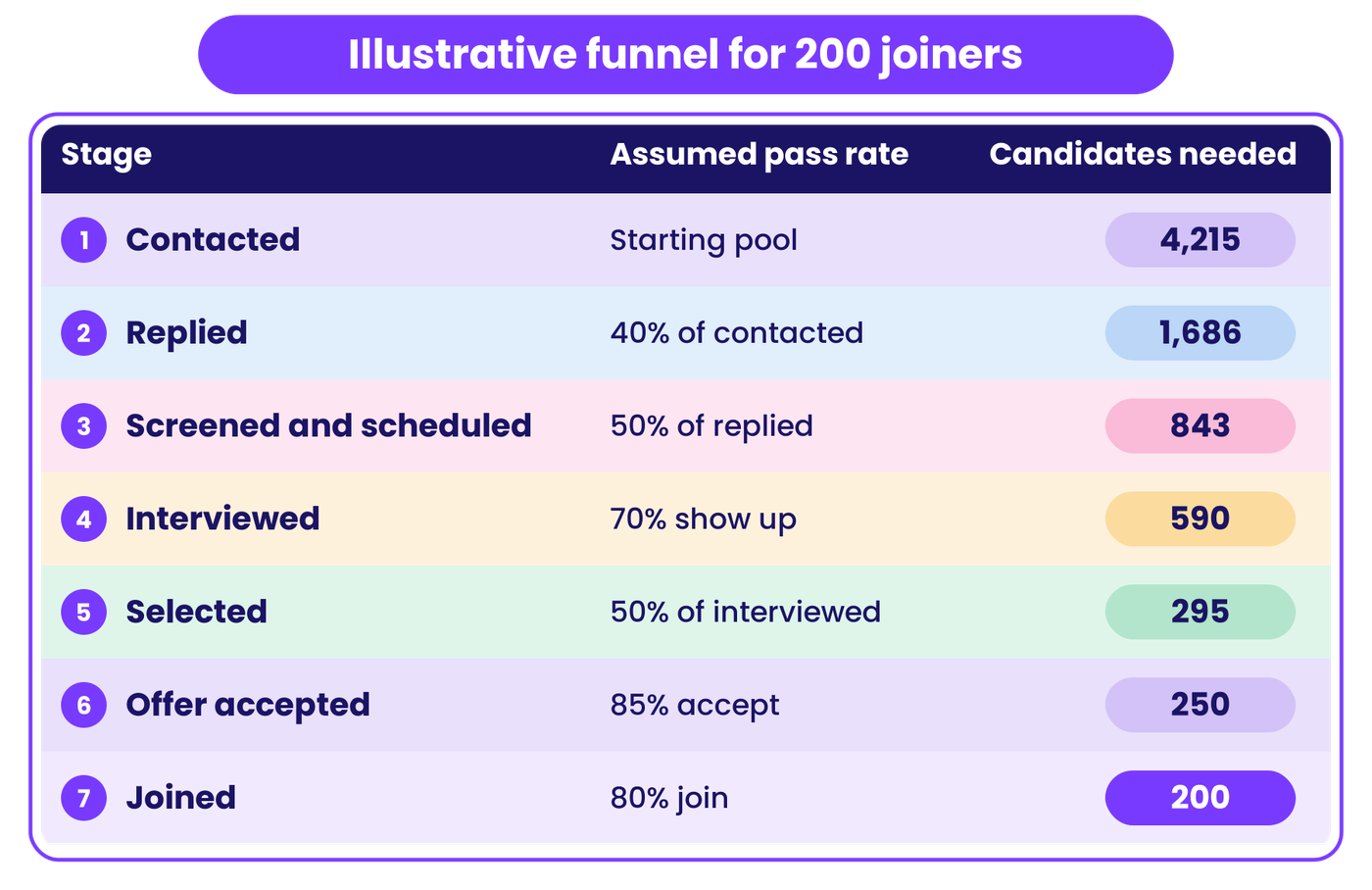
Working backwards, 200 joiners need about 4,200 candidates contacted. Every stage that loses 30% or more is a place to look for gains.
Now add recruiter time. If a recruiter completes about 40 screening calls a day (an assumption), screening 1,686 replies takes about 42 recruiter-days. That is the bottleneck, and it is why screening is the first stage to automate.
How to Screen and Schedule Without Creating a Queue
Screening and scheduling are repetitive, rule-based and time-sensitive. That makes them the best fit for automation.
For screening, keep to five or six questions that test hard requirements: location, shift availability, language, notice period or start date, and one role-specific skill. Score every answer the same way. Send only candidates who clear the bar to a human.
A contact centre screen might ask:
- Which city and area do you live in, and can you reach our office by 9 a.m.?
- Which shift can you work: day, evening or night?
- Which languages can you speak and write at work?
- Can you join within 15 days?
- Have you worked in a customer-facing role before, and for how long?
Each answer maps to a pass, hold or reject rule that you set before the campaign starts. Rules written in advance keep results comparable across hundreds of candidates and across recruiters.
For scheduling, let candidates pick from open slots instead of waiting for a recruiter to call back. Confirm the slot immediately and send reminders. Our guide on reducing candidate drop-off covers the reminder pattern in detail.
Language matters in India. A screening call in the candidate's own language gets more complete answers than one in a second language. HireBound's Voice AI screens in 14 Indian languages.
Keeping Candidates From Dropping Off
Drop-off is the quiet cost of volume. The fixes are simple.
- Contact fast. Reach candidates within hours of applying, not days.
- Use the channel they answer. In India, WhatsApp gets a 64% response rate against about 12% for email, according to HireBound's own figures.
- Set expectations early. State pay, shift and location up front so nobody is surprised at the interview.
- Remind twice. Send a reminder the day before and the morning of the interview.
- Stay in touch after the offer. Gaps between offer and joining are where most no-shows form.
For frontline roles in particular, see the blue collar hiring guide for document checks and joining-day tactics.
The Tool Stack for High Volume Recruiting
A volume campaign needs five tool layers. You can buy them as one platform or connect separate tools. What matters is that data flows between them without re-entry.
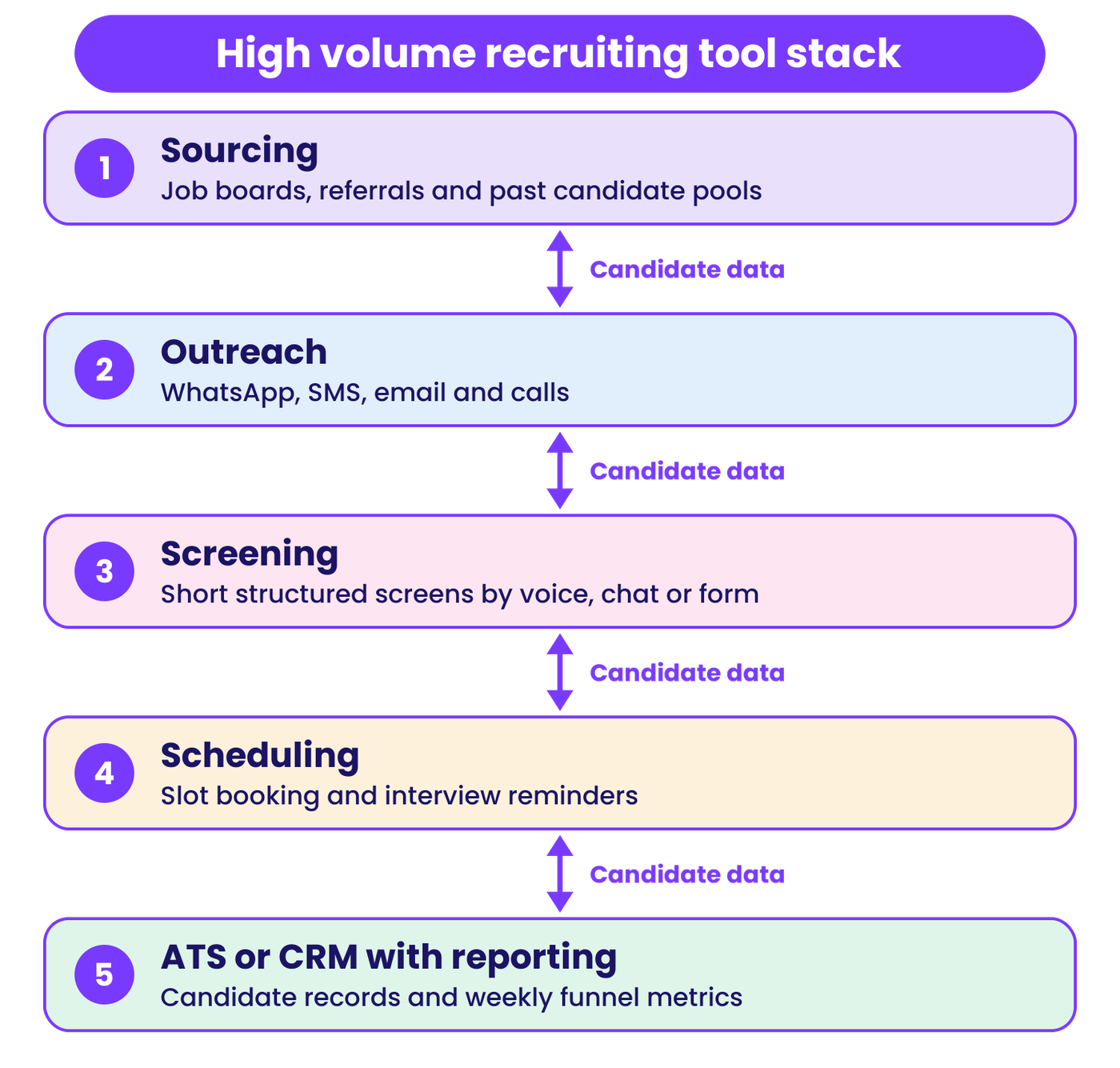
The layers must share one candidate record, or recruiters spend the saved time copying data.
What each layer must do
- Sourcing. Pull candidates from several sources into one pool and remove duplicates.
- Outreach. Message across voice, WhatsApp, SMS and email, with follow-ups that run without manual effort.
- Screening. Ask fixed questions, in the candidate's language, and score the answers.
- Scheduling. Offer live slots, confirm, remind and reschedule without a recruiter.
- ATS or CRM. Hold one record per candidate, track stage changes and produce campaign reports.
What to Look For When Choosing Tools
Compare tools on how they behave at volume, not on feature lists. Run a small pilot with a real campaign and test these points.
- Concurrency. Can it contact and screen hundreds of candidates at the same time?
- Consent and opt-outs. Does it record consent and honour opt-outs automatically?
- Language coverage. Does it work in the languages your candidates use?
- Hand-off quality. When a candidate qualifies, does the recruiter get the answers, the score and the reasoning?
- Integration. Can it write back to your ATS and read from your job boards?
- Reporting. Can you see stage-by-stage drop-off for the live campaign, not a monthly export?
If a vendor cannot show these in a pilot, do not count the claim.
Compliance and Candidate Data
High volume recruiting means handling large amounts of personal data, often phone numbers and identity documents. In India, the Digital Personal Data Protection Act, 2023 sets rules on consent and purpose for processing personal data, and its 2025 Rules are being phased in. Check current commencement dates with your counsel. Treat consent capture and retention limits as campaign requirements, not afterthoughts.
For contract and frontline roles, also check statutory registrations and background verification before joining day. Your legal or compliance team owns the current thresholds. Build the checks into the campaign plan so they do not delay joining.
Metrics to Track During a Campaign
Review these eight numbers weekly, or daily in the last two weeks before joining. The table shows how to calculate each and what a drop tells you.
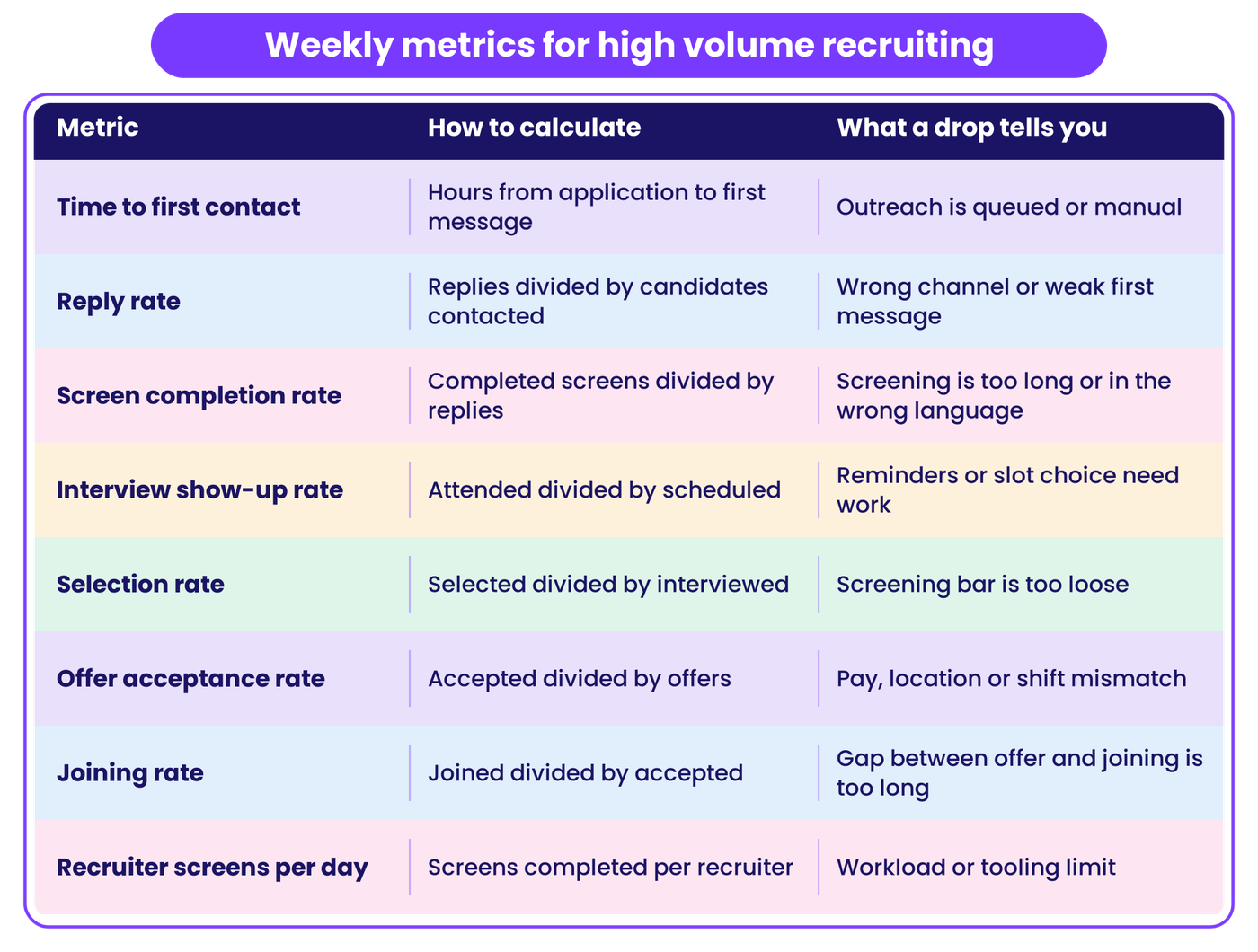
Use the last three campaigns as your baseline. A change of more than five points in one week is worth investigating, because earlier-stage drops reach joiners two to three weeks later.
When Automation Is Not the Answer
Automation helps with repetitive stages. It is a poor fit when:
- Hiring is under about 20 people, where a recruiter's calls are faster than building a workflow.
- The role needs a long, judgement-heavy assessment, such as senior leadership.
- Your pay, shift or location details are not ready, because automation scales a weak offer as quickly as a strong one.
In these cases, fix the offer or the brief first. Then decide what to automate.
Where HireBound Fits in High Volume Recruiting
HireBound's AI agents handle the repetitive stages of a volume campaign: outreach across voice, WhatsApp, SMS and email, screening against your criteria, and interview scheduling. Recruiters review the evidence and make every selection and offer decision. Recruiters using HireBound handle 3× more candidates per day than with a manual process.
Campaign setup, matching, offers, e-signatures, onboarding and compliance tracking are covered for teams running campaigns end to end. See how HireBound's bulk hiring solution works for high-volume employers.
Planning a volume campaign? Share your headcount and timeline, and we will show how the stages above would run: talk to the HireBound team.
Conclusion: A Simple Rule for High Volume Recruiting
Start from the joining target and work backwards through every stage's drop-off. That tells you how many candidates to contact and where recruiter time will run out. Automate the repetitive stages, keep humans on interviews and offers, and watch eight numbers every week.
If you have only one change to make, speed up the first contact. Everything downstream improves when candidates hear from you within hours.


