SMS Recruiting: Where Text Messages Fit in Modern Hiring
 Suvam Moitra
 ·Nov 27, 2026·7 min read

Key Takeaways
- 1SMS recruiting uses text messages for short, time-sensitive candidate messages such as confirmations, reminders and nudges, and it works without an app.
- 2Business SMS in India runs under TRAI's TCCCPR 2018 on the DLT platform, and a February 2025 amendment, per Khaitan & Co's summary, added annual self-certification of headers and templates.
- 3NSO's 2025 telecom survey found 86.3% of households had internet access at home, so some candidates may not see data-only messages in time.
- 4HireBound data shows a 64% WhatsApp response rate in India against about 12% for email, so hold conversations on WhatsApp and keep SMS for alerts.
- 5Ask for consent once at application, name each channel, record it and honour opt-outs, because India's DPDP Act, 2023 requires consent or another permitted use.
SMS recruiting, also called text recruiting, is the use of text messages to reach candidates at set points in hiring, such as application receipt, interview confirmation, reminders and nudges. SMS arrives on the lock screen, needs no app and works without a data connection, which makes it a dependable channel for short, time-sensitive messages.
This guide covers where SMS fits in hiring, which messages suit it, how India's TRAI rules apply, and how to run SMS beside WhatsApp, voice and email. It is written for recruiters and TA leads who contact many candidates.
Want candidate messages sent on the right channel at the right time? See how HireBound works →
What Is SMS Recruiting?
SMS recruiting means using the short message service for candidate communication. The message goes to the candidate's mobile number and is read on the phone's default messaging screen.
The channel is short by design. It carries a few lines of text and a link, not a CV, a photo or a long reply. That limit shapes what it is good for.
Our guide to WhatsApp recruiting covers the channel that carries conversations. This post covers SMS and where it earns its place.
Where Does SMS Fit Across the Hiring Funnel?
SMS fits the moments where a short message has to be seen quickly. The table maps common stages to the message and the reason SMS suits it.
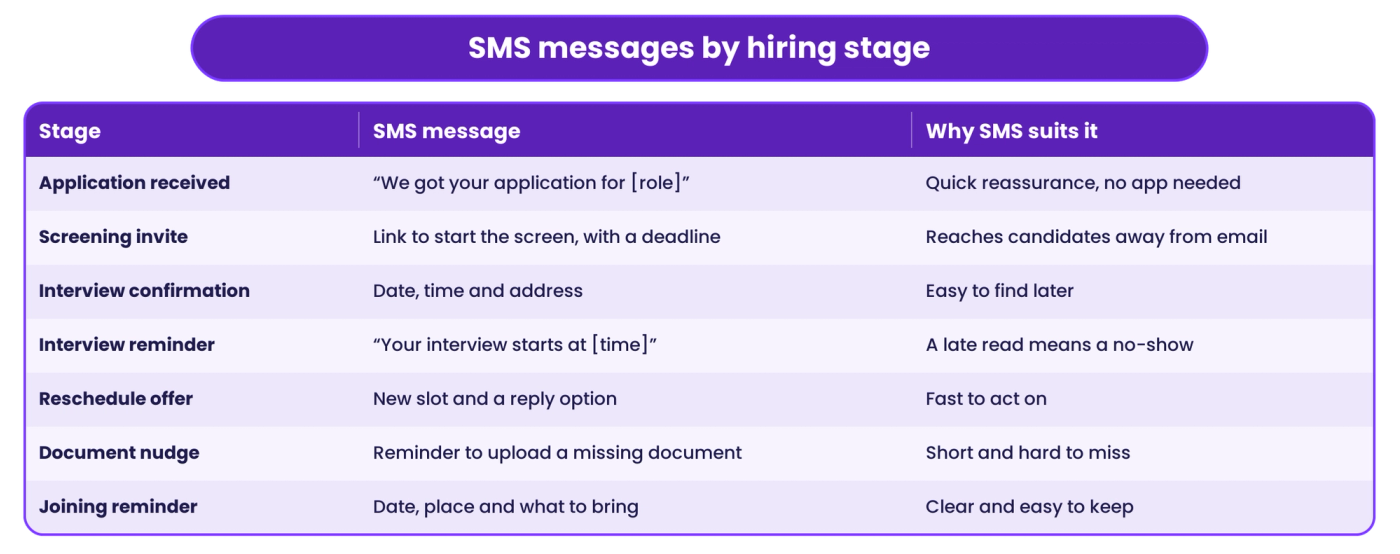
Each message is short, tied to a time and asks for one action.
Which Recruiting Messages Work Best on SMS?
Short, specific, action-led messages work best. Three templates show the pattern. Replace the bracketed items, and register each template with your provider before you send.
- Interview reminder: "Hi [Name], your interview for [role] with [Company] is at [time] on [date] at [place]. Reply YES to confirm or NO to reschedule."
- Screening nudge: "Hi [Name], your screening for [role] at [Company] closes on [date]. Open [link] to answer four short questions."
- Document reminder: "Hi [Name], we still need your [document] for [role] at [Company]. Please upload at [link] by [date]."
Each names the company, the role and one next step. A message that does all three is easier to act on than a vague "please contact us".
Do not put a pitch in these messages. A job pitch is promotional, and promotional messages face stricter rules, as the TRAI section below explains.
How Does Consent Work for SMS and Other Channels?
Every channel needs permission, and the rules differ by channel. For SMS, TCCCPR builds consent into the registration framework. For WhatsApp, Meta's developer documentation says a business must have opt-in permission that states the person agrees to receive messages and names the business (Meta, WhatsApp opt-in documentation). It also says business-initiated messages must use approved templates.
For personal data in general, India's Digital Personal Data Protection Act, 2023 requires consent, or another use the Act specifically permits, before personal data is processed. The DPDP Rules, 2025 were notified in November 2025, with most obligations phased in over 18 months.
In practice, ask for consent once, at application. Name each channel you will use, such as SMS, WhatsApp and calls, and record when and how the candidate agreed. Honour opt-outs on every channel.
What Do TRAI Rules Mean for SMS Recruiting?
Business SMS in India runs under the Telecom Commercial Communications Customer Preference Regulations (TCCCPR) of the Telecom Regulatory Authority of India. TRAI notified them in July 2018 and phased in the DLT provisions during 2019. Senders register their identity, message headers and content templates on the operators' DLT (distributed ledger technology) platform.
The diagram below shows the sequence.
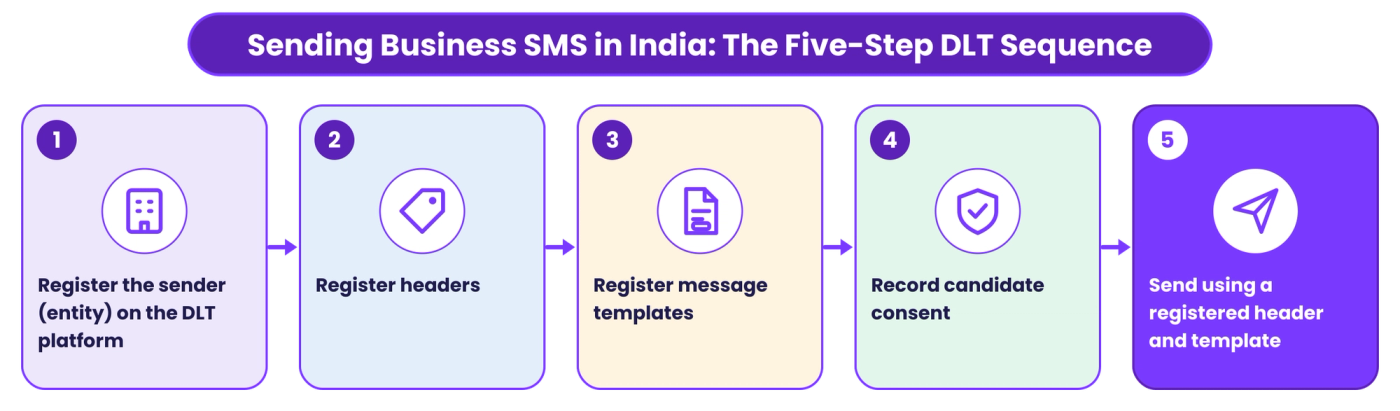
Enforcement has tightened. In February 2023, TRAI directed access providers to reverify registered headers and message templates. A second amendment in February 2025 added annual self-certification of headers and templates. It also treats a message that mixes promotional content into a service or transactional message as promotional, according to Khaitan & Co's summary of the amendment.
For recruiters, three points follow:
- Register templates before the first campaign, and ask your provider how each is classified.
- Keep reminders and confirmations free of pitch language.
- Plan for annual re-certification of your headers and templates.
Many recruiting messages fall between categories. A reminder about an interview the candidate booked looks like a service message, while a cold job pitch looks promotional. Confirm each template's category with your provider.
What Are the Limits of SMS Recruiting?
SMS suits alerts and not conversations. A text is short, so it cannot carry a long explanation, a CV or a voice note.
Registered templates also fix much of the wording in advance, with room for only a few variable fields such as the name and the time. That works well for reminders and poorly for a detailed reply to a candidate's question.
Setup takes time, because headers and templates must be registered before the first campaign. SMS suits a standing process more than a one-off drive next week.
One-way alerts can draw no reply, so you may not learn whether they helped. Ask for a one-word reply where you need confirmation.
How Does SMS Recruiting Work in India?
India's reach and volume make SMS a useful backstop. The National Statistics Office's Comprehensive Modular Survey: Telecom 2025, run from January to March 2025, found that 86.3% of households had internet access within their premises. That figure counts home internet and says nothing about a phone's mobile data, so treat it only as a rough sign that some households lack home internet.
Candidates in frontline roles may share a phone, change numbers or run out of data. SMS reaches a phone that has network coverage, without needing data.
Hiring volume adds to the case. ManpowerGroup's Employment Outlook Survey for Q4 2026 covered 3,055 employers in India and found that 65% plan to increase staffing between October and December. At that volume, a missed reminder is costly.
HireBound data shows a 64% WhatsApp response rate in India, compared with about 12% for email. Treat WhatsApp as the default for conversation, and use SMS for alerts and fallbacks.
How Do You Run SMS With WhatsApp, Voice and Email?
Use each channel for what it does best, and let silence move a candidate to the next one. A simple order works for most teams: WhatsApp for the conversation, SMS for alerts and fallbacks, voice for a quick check, email for documents and formal letters.
Here is an illustrative example with assumed numbers. A team books 300 interviews for Monday and sends a WhatsApp reminder on Sunday evening. By 7 am, 45 candidates have not read it. The team sends each of them a short SMS an hour before the interview and calls those who stay silent.
The 45 is an assumption, so measure your own unread rate. The sequence below shows the order.
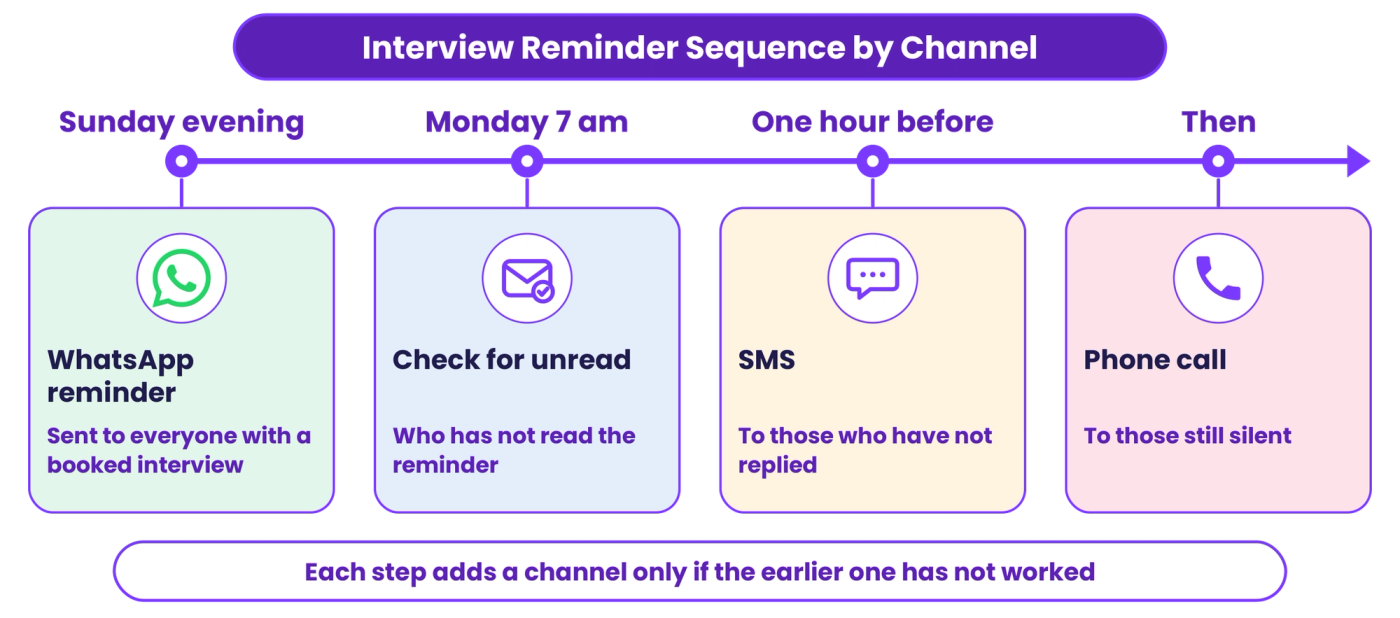
The sequence adds channels only when the earlier one has not worked, which avoids messaging everyone three times.
Our guide to why candidates drop off shows where silence costs you the most.
Which Numbers Show SMS Is Working?
Track a few numbers each month, and compare SMS-reminded candidates with those who were not.
- Delivery rate: Share of messages that reached the phone. If it moves the wrong way: check header and template registration.
- Confirmation rate: Share who reply YES to a reminder. If it moves the wrong way: shorten the message or change the timing.
- No-show rate, reminded vs not: Whether SMS reduces missed interviews. If it moves the wrong way: review timing and wording.
- Opt-out rate: Whether messages feel unwelcome. If it moves the wrong way: reduce frequency and tighten the content.
- Template rejections: Whether your templates meet the rules. If it moves the wrong way: rewrite and re-register.
A falling no-show rate with a stable opt-out rate means the channel is working.
Where Does HireBound Fit?
HireBound supports Voice, WhatsApp, SMS and email in one workflow. Its SMS channel is built for time-sensitive outreach, reminders, confirmations, verification and candidate nudges, and replies from every channel land in one unified inbox. The Scheduling Agent collects availability and books interviews with automatic reminders.
HireBound has powered 8 million+ candidate conversations, and 60+ recruiting teams in India run on the platform.
Want reminders and nudges to move across channels on their own? Talk to HireBound about outreach →
Conclusion: A Decision Rule for SMS Recruiting
Use SMS for short, time-bound messages, register your templates early, ask for consent at application and move conversations to WhatsApp.
Apply one rule. If your recruiters lose candidates to missed reminders and unread messages, add SMS as the alert and fallback channel. If most of your contact is long conversations and documents, put your effort into WhatsApp and email.


