Interview Evaluation: How to Reach Faster Hiring Decisions
 Tanmey Goswami
 ·Nov 26, 2026·9 min read

Key Takeaways
- 1Interview evaluation rates interview evidence against set criteria and combines it into a decision, and slow evaluation delays offers.
- 2SHRM's 2026 Recruiting Executives Benchmarking puts median time-to-fill at 39 days for nonexecutive roles, so days lost between interview and decision matter.
- 3Have each interviewer submit a scored scorecard alone before the debrief, then review each criterion separately, as Kahneman, Sibony and Sunstein recommend in Noise (2021).
- 4Record what the candidate said or did, not impressions, and hold a debrief of about 30 minutes with a decision rule agreed in advance.
- 5Use evaluation software to collect scorecards, send reminders and flag disagreement, and keep people on the final decision.
Interview evaluation, sometimes called candidate assessment after the interview, is the process of rating what a candidate showed against set criteria, then combining those ratings into a hiring decision. Done well, it is quick and fair: every interviewer scores alone, records evidence, and the debrief settles only the real disagreements.
This guide covers how to run each step, what evaluation software can automate, and which numbers show that decisions are getting faster. It is written for recruiters and hiring managers who run multi-round interviews.
Want interview scoring collected and compared for you? See how HireBound works →
What Is Interview Evaluation?
Interview evaluation starts when the interview ends. It covers three things: how each interviewer records their view, how those views are combined, and how a decision is reached.
Many teams run the interview well and the evaluation badly. Feedback arrives days late, notes are impressions, and the debrief becomes a debate about who liked the candidate.
Structure helps here as much as it does in the interview itself. Sackett, Zhang, Berry and Lievens report a mean validity of .42 for structured interviews and .19 for unstructured ones in the Journal of Applied Psychology (Sackett et al., 2022). Scoring against set criteria is part of that structure.
The diagram below shows the flow from interview to decision.
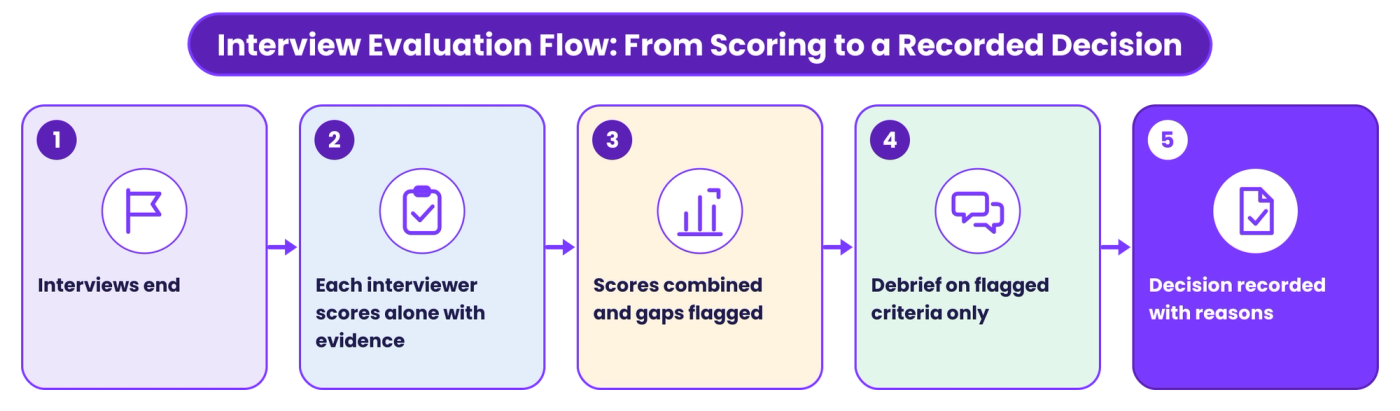
The debrief comes after the scores, which keeps it short and keeps it about evidence.
Why Do Hiring Decisions Slow Down After the Interview?
Decisions slow down because the evidence is slow, vague or scattered. Three causes are common.
- Late feedback. Interviewers submit scorecards days after the interview, or only after a reminder.
- Vague notes. "Seemed good" gives the debrief nothing to work with, so it turns into opinion.
- Group anchoring. The most senior or most confident person speaks first and the rest follow.
SHRM's 2026 Recruiting Executives Benchmarking puts the median time-to-fill at 39 days for nonexecutive roles. Every day between the last interview and the decision adds to that number, and a candidate with other offers may not wait.
Our guide to why candidates drop off shows where in a process candidates disappear, including after the final interview.
What Does a Fast, Fair Evaluation Look Like?
A fast, fair evaluation follows a fixed timeline and a fixed method. The list below sets out a timeline you can adapt. The times are targets to agree with your team, not benchmarks.
- Interview ends: the interviewer starts the scorecard.
- Within 24 hours: the interviewer submits the scorecard, scored alone, with evidence.
- After all scorecards are in: the recruiter or software combines scores and flags disagreements.
- Within 48 hours: the hiring manager runs a 30-minute debrief on flagged criteria only.
- Same day as the debrief: the hiring manager records the decision, with reasons.
The structure removes waiting. Nobody has to chase, and the debrief covers only the criteria where reviewers disagree.
How Do You Run Independent Scoring Before the Debrief?
Each interviewer scores alone, before they see anyone else's view. They rate each criterion on the same scale and write the evidence behind each number.
Kahneman, Sibony and Sunstein describe the logic in Noise (2021). Their mediating assessments protocol breaks a decision into separate assessments, keeps them independent of one another, and reviews each one separately in the meeting. Independence matters because group discussion can pull everyone toward the first confident opinion.
Our structured interview scorecard template gives scorecards you can use for this step.
What Evidence Should Interviewers Record?
Interviewers should record what the candidate said or did, and keep their own interpretation separate. Evidence lets another person check the score. An impression does not.
The table shows the difference.
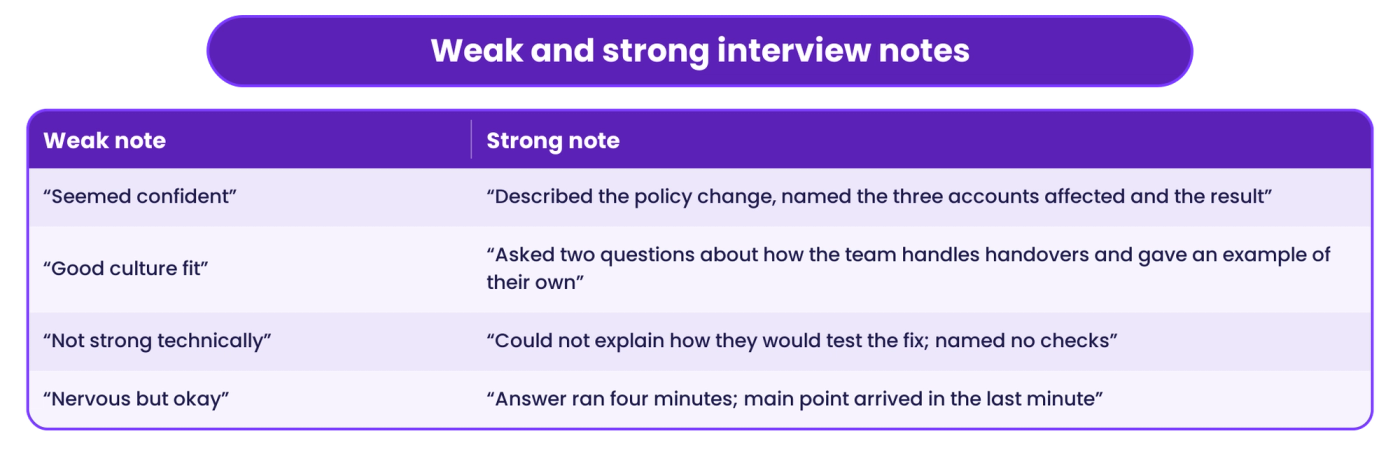
A strong note names a behaviour and can be checked against the candidate's own words.
Ask interviewers to write the note first and the score second. That order keeps the number tied to the evidence.
How Do You Run a 30-Minute Debrief?
A debrief should settle disagreement and avoid repeating the interview. Thirty minutes is enough when the scores are in beforehand.
- Agree the decision rule up front. For example, a candidate needs an average of 3.5 or more, and no criterion below 3.
- Show combined scores. Put each criterion's scores side by side.
- Discuss one criterion at a time. Start with the largest gaps, and ask interviewers to cite their evidence.
- Let the least senior speak first. That limits anchoring on senior opinions.
- Apply the rule and record the decision. Write the reasons in two sentences.
If the rule gives a clear answer, stop. If it does not, name the one question that would settle it, and decide who will answer it and when.
What Should the Decision Rule Say?
A decision rule turns scores into a yes, a no or a next step, and it should be written before the first interview. It protects the team from reasoning backwards from a decision they already want.
A useful rule covers four points:
- The threshold. For example, an average of 3.5 or more across criteria.
- The floors. For example, no criterion below 3 for must-have skills.
- The tie-break. What happens when two candidates are close.
- The owner. Who makes the final call, usually the hiring manager.
The numbers are examples, so set them for your role. If a candidate meets the threshold and the floors, offer. If not, decline or ask the one open question and decide.
How Do You Handle Disagreement in the Debrief?
Start with the evidence behind each score. Two interviewers who differ by two points may have seen different parts of the interview.
Ask each person to state what the candidate said or did. Then check the anchor: does that behaviour match a 2 or a 4? If the anchor is clear, the group often settles quickly. If it is not, rewrite it for the next round.
Do not average away a serious concern. A floor breach, such as a candidate who cannot do a must-have task, counts even when other scores are high.
If the group cannot agree, name the one fact that would settle it, assign someone to find it and set a deadline of one working day.
What Should Candidates Hear After the Interview?
Tell candidates what happens next and when. Silence after a final interview is one of the points where candidates disappear.
Send a short message after each interview: thanks, the next step and a date by which they will hear. Keep to the date. If the decision slips, say so before the date passes. Give candidates one named contact for questions while they wait.
Decline messages matter too. A short, respectful note leaves the candidate able to apply again. Our guide to panel and one-on-one interviews covers how interview format changes the evidence you have to weigh.
What Mistakes Slow Interview Evaluation?
Six mistakes cause most of the delay.
- No deadline for scorecards. Without one, the slowest interviewer sets the pace.
- Free-text feedback only. Without a scale, nobody can compare candidates.
- Scoring after the debrief. Numbers then follow the room instead of the evidence.
- Too many interviewers. Each extra person adds a scorecard to chase.
- A decision rule invented in the meeting. The team argues about the rule and the candidate at once.
- No owner for the decision. Everyone waits for someone else to call it.
Fix the first and last mistakes first. A named owner and a deadline remove most of the waiting.
How Do You Evaluate When Interviewers Are in Different Locations?
Spread-out panels need more structure. Interviewers in different cities cannot catch each other in a corridor, so the process has to carry what a corridor chat would.
Share the scorecard and the anchors before the first interview. Ask each interviewer to submit scores through the same form, with the same deadline, and hold the debrief on a short video call. Put the combined scores on screen, so everyone sees the same view.
Time zones matter less in India than in global hiring, but city offices, shift patterns and travel still make live debriefs hard to arrange. A fixed debrief slot each day, held only when scorecards are in, avoids rescheduling.
How Does Evaluation Software Help?
Evaluation software removes the chasing and the arithmetic. It does not replace the judgment. Four jobs suit software well.
- Collecting scorecards with automatic reminders, so none is late.
- Combining scores by criterion and weight, and flagging gaps between reviewers.
- Keeping evidence with the candidate record, so the debrief starts from the notes.
- Logging the decision and the reasons, which helps audit and helps new hiring managers learn.
The people keep three jobs: setting the criteria, judging the flagged gaps and making the decision.
The infographic below sorts the tasks.
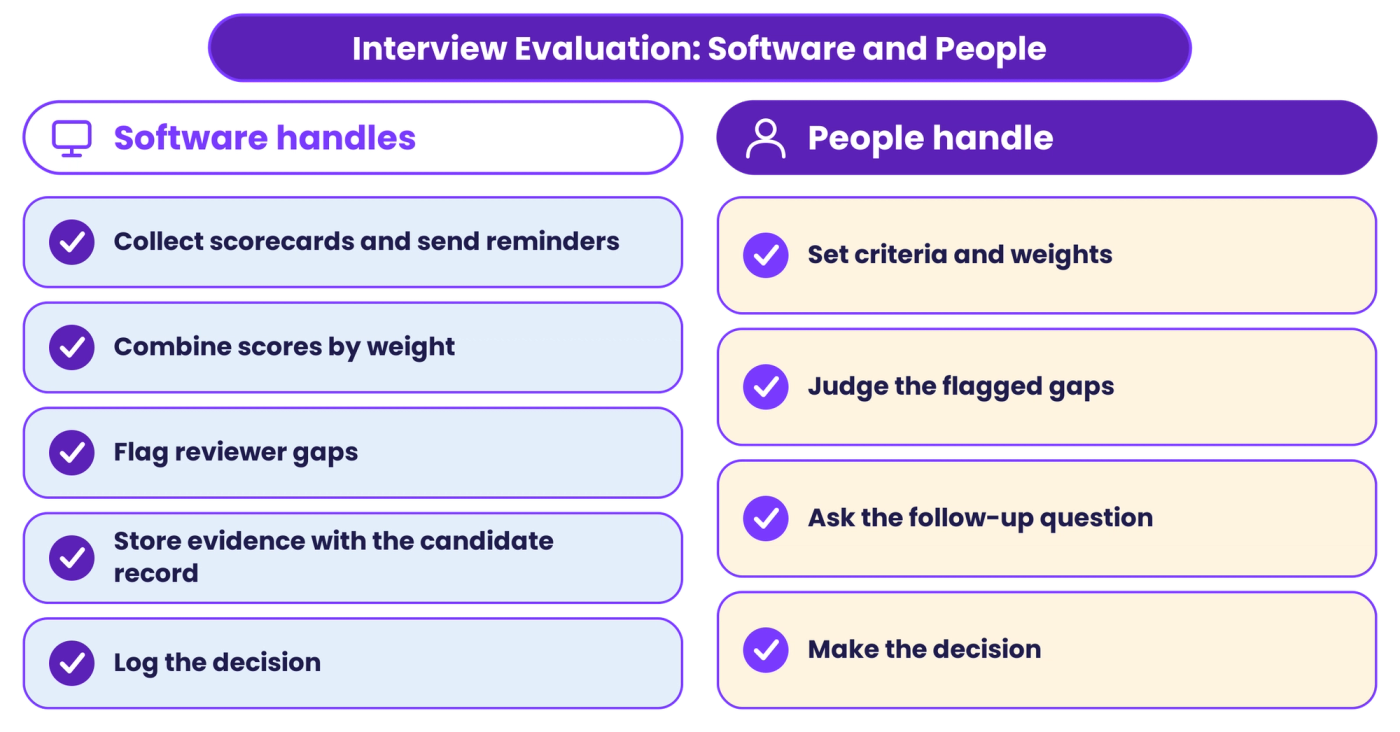
When the left column runs automatically, the right column gets more of everyone's time.
How Does Interview Evaluation Work in India?
Multi-round hiring and high volume make evaluation speed matter in India. ManpowerGroup's Employment Outlook Survey for Q4 2026 covered 3,055 employers in India and found that 65% plan to increase staffing between October and December. Slow decisions risk losing candidates who hold other offers.
Two practical points apply.
First, notice periods. Candidates often have to serve a notice period before joining, so a decision delayed by a week can push a start date back by a week. Move the decision as soon as the evidence is in, and tell the candidate the same day.
Second, consent. India's Digital Personal Data Protection Act, 2023 requires consent, or another use the Act specifically permits, before personal data is processed. If you record interviews or store notes, tell candidates and record their agreement.
HireBound data shows a 64% WhatsApp response rate in India, compared with about 12% for email. Use the same channel to tell candidates what happens next, so the wait after the interview does not turn into silence.
Which Numbers Show Decisions Are Getting Faster?
Track a few numbers each month, and compare them across roles.
- Hours from interview to scorecard. Aim to shorten the longest gaps first.
- Days from final interview to decision. This is the number candidates feel.
- Share of debriefs that finish in 30 minutes. A low share points to weak notes or unclear criteria.
- Offer acceptance rate. A slow decision can reduce it.
- Reviewer agreement. Large gaps mean the criteria or anchors need work.
If days to decision fall and offer acceptance holds or rises, the process is working.
Where Does HireBound Fit?
HireBound's Evaluation Agent runs an AI-driven telephonic interview round for initial screening, cross-questions candidates dynamically and scores technical skills, communication and culture fit. It produces a scorecard, an assessment report, a Candidate Match Score covering overall fit, skills, experience and culture fit, and a comparative ranking for decision support. Recruiters and hiring managers keep the final decision.
HireBound has powered 8 million+ candidate conversations, and 60+ recruiting teams in India run on the platform.
Want scorecards, rankings and evidence in one place? Talk to HireBound about evaluation →
Conclusion: A Decision Rule for Interview Evaluation
Score alone, record evidence, combine scores before the meeting and debrief only on the gaps. Agree the decision rule before the first interview.
Apply one rule. If decisions wait on late scorecards and long debriefs, fix the timeline and the notes first. If they already move quickly, spend your effort on the quality of the criteria.


