How to Start a Recruitment Agency in India: Setup, Clients and Cash Flow
 Tanmey Goswami
 ·Nov 26, 2026·8 min read

Key Takeaways
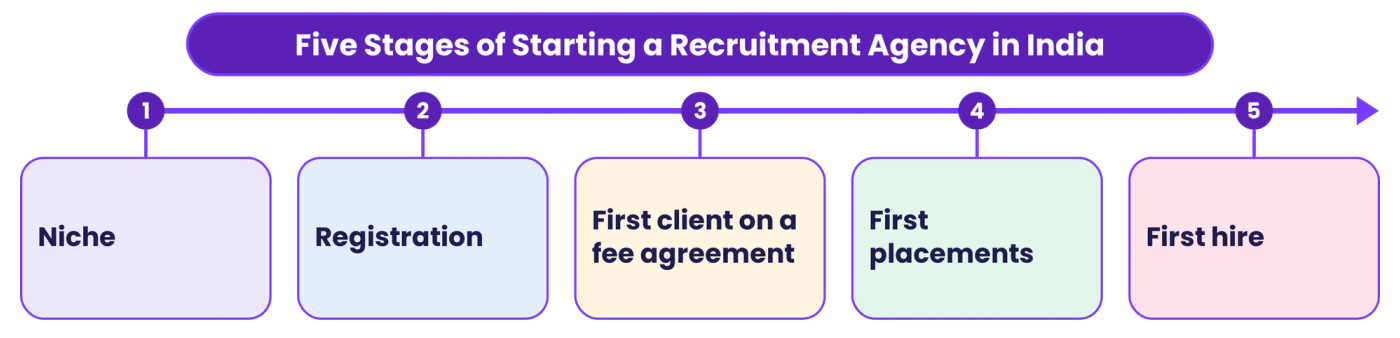
- 1To start a recruitment agency in India, pick one niche, register the business and the offices, sign a first client on a written fee agreement, and place a few candidates yourself before you hire anyone.
- 2Three registrations come up most often: an entity (proprietorship, LLP or company), a state Shops and Establishments registration, and GST once service turnover crosses the limit, which is ₹20 lakh in most states.
- 3Recruiting Indians for jobs abroad is a separate case. It needs a Registration Certificate from the Protector General of Emigrants under the Emigration Act, 1983, and recruiting without one is an offence under the Act.
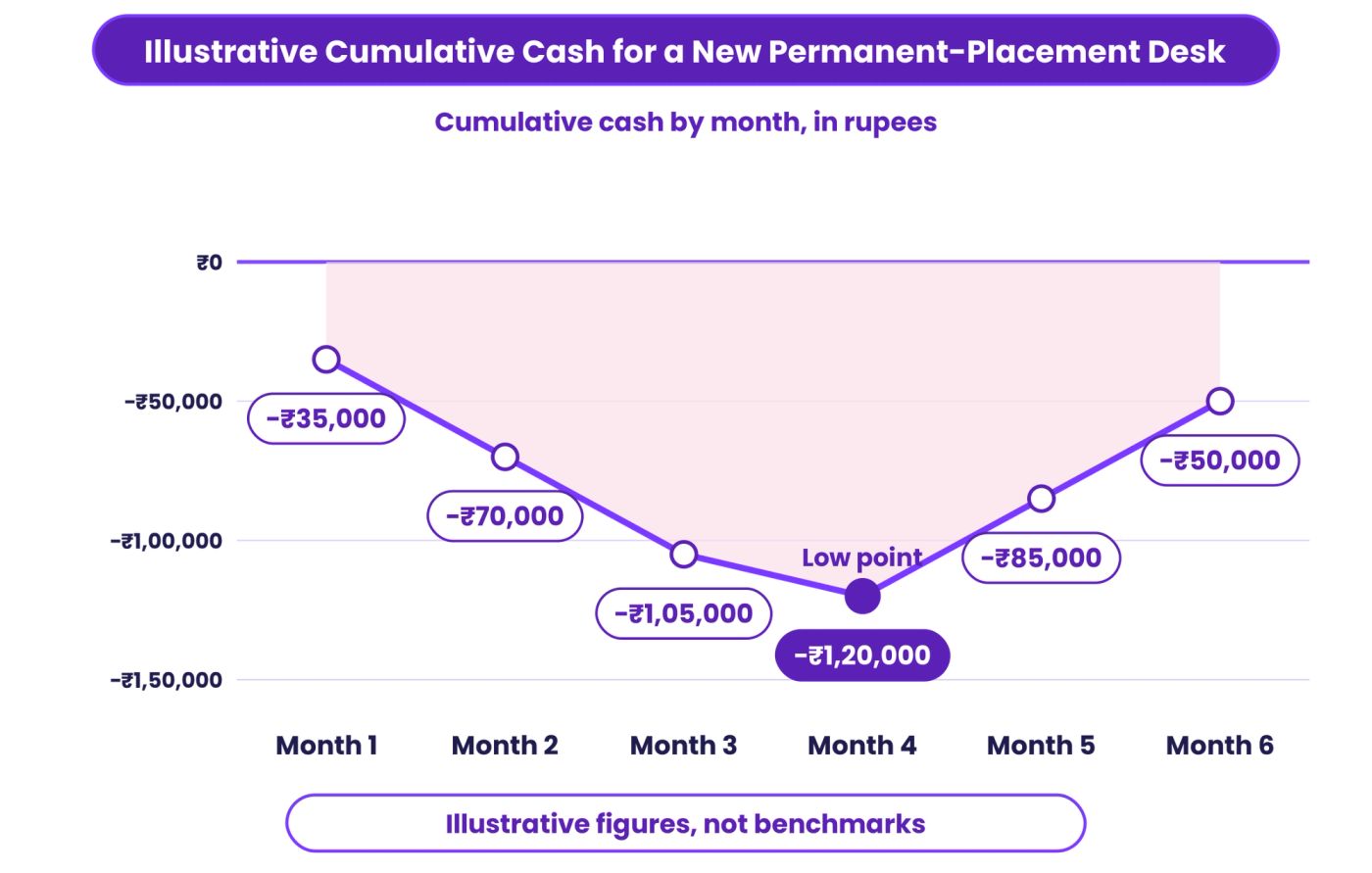
- 4In the illustrative example below, an agency that bills ₹3.5 lakh by month four still has its cash low point of minus ₹1.2 lakh in that month, because clients pay about two months after joining.
- 5HireBound's own data from recruiter campaigns shows a 64% WhatsApp response rate in India against about 12% for email, which matters for agencies sourcing in tier-2 and tier-3 cities.
To start a recruitment agency in India, choose one niche, register the business and your office, sign a first client on a written fee agreement, and place a few candidates yourself before you hire a recruiter. The usual early problem is cash: a placement is billed on joining and paid weeks later.
This guide is the India version of our general guide to starting a staffing agency. It covers the registrations to check, the niches that work, how agencies earn, where first clients come from, and a six-month cash example. All figures in the examples are illustrative.
Already running an agency and want each recruiter to handle more candidates? Explore the HireBound AI recruiting platform.
India Setup at a Glance
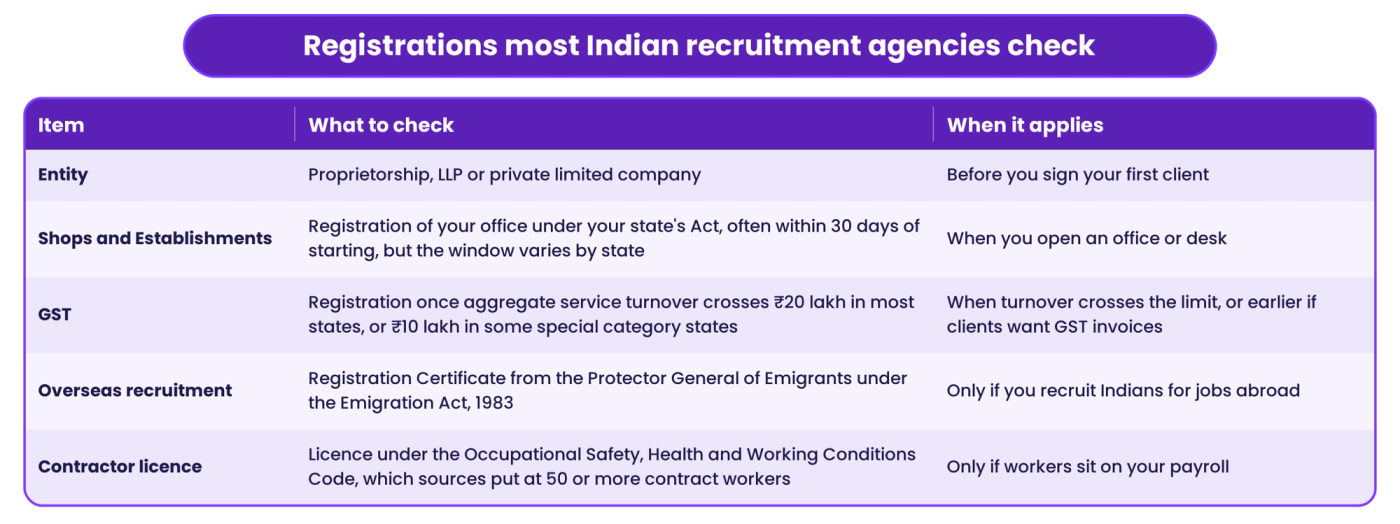
Rules differ by state and by the kind of work you do, so treat this as a checklist of questions for your chartered accountant or lawyer. It is not legal advice, and you should confirm current terms on each official portal.
Choose an Entity
A sole proprietorship is the quickest to start, since you can often begin with a bank account and a GST registration. A limited liability partnership needs at least two partners and separates your personal assets from the business. A private limited company takes longer to set up and costs more to maintain, but corporate clients and lenders often find it easier to trust.
Many founders start as a proprietorship to test demand and move to an LLP or company once they have two or three steady clients. Your accountant can tell you what the switch costs in your situation.
Register Your Office Under Your State's Law
Most states require an office that employs people to register under the state Shops and Establishments Act. Registration is usually filed with the state labour department, often within about 30 days of starting operations, though the window and the form differ by state.
Check two things before you rent space. First, whether your state accepts a home address or a shared desk. Second, whether your state has any separate rule for placement or employment agencies. Do not assume the answer from another state.
GST
GST registration becomes mandatory when your aggregate turnover from services crosses ₹20 lakh in most states. A lower limit of ₹10 lakh applies in some north-eastern and other special category states, and sources differ on which ones, so confirm the figure for your state on the GST portal.
Many agencies register before they reach the limit. Corporate clients want GST invoices, and you can claim credit on what you pay for tools and rent. Remember that GST on your fee is collected from the client and passed to the government, so it is not income.
Overseas Recruitment Is a Separate Case
If you plan to place Indians in jobs abroad, you need a Registration Certificate from the Protector General of Emigrants under the Emigration Act, 1983 (the Ministry of External Affairs cites Sections 11 and 12 for granting it). Recruiting for overseas jobs without one is an offence under the Act. Applications run through the eMigrate portal. The Ministry of External Affairs explains the role of the office on its Protector General of Emigrants page.
Fees, validity and service-charge limits have changed over the years, so check the current terms on the portal before you apply. If you only recruit for Indian employers, this does not apply to you.
Contract Staffing Adds Payroll Compliance
If workers sit on your payroll and you bill the client for them, you take on provident fund, ESI and payroll compliance. The Occupational Safety, Health and Working Conditions Code came into force on 21 November 2025. Check the contractor-licence rules and headcount trigger under the Code before you grow.
Permanent placement avoids most of this, which is why it is the easier model to start with.
Pick a Niche Before You Pick a Client
A niche lets you speak to the same hiring managers repeatedly and learn what a good profile looks like. A generalist desk starts every search from zero.
Use three tests. Do you understand the roles well enough to screen for them? Do employers in that segment hire repeatedly? Can you reach candidates through channels you already use?
Niches that fit many Indian founders include:
- IT and engineering roles in one city, such as Pune or Bengaluru.
- BFSI and sales roles, where hiring is steady and volumes are high.
- BPO and customer support, where volume is high and notice periods are short.
- Blue-collar and frontline hiring, such as warehouse, delivery and retail staff.
- Healthcare roles, such as nurses and lab technicians.
Pick one. You can widen later.
How Recruitment Agencies Earn in India
Agencies earn in three common ways.
A permanent placement fee is a percentage of the hire's annual CTC, charged once when the candidate joins. A retainer pays you to run a search, usually for senior or hard-to-fill roles, and is often split across stages. Contract staffing bills a rate per worker and keeps the difference between the rate and the worker's cost.
Percentages and replacement terms vary by role and client, so we do not quote a standard rate here. The recruitment agency fee percentage guide explains the common structures.
Whatever model you choose, charge the employer and put three things in writing: when the fee becomes payable, what counts as a joining, and what happens if the hire leaves early. A verbal fee becomes a discount at invoice time.
Find Your First Clients
Ten good conversations with hiring managers are enough to start.
- Former colleagues who now manage teams. They are your warmest leads.
- Companies in your niche that post the same role every few weeks. They have a standing problem.
- Founders and small teams without an HR function.
- Introductions from your first client, once you have placed someone.
Offer a small mandate, two or three roles, on a fee agreement. Do not discount to win the first client. Narrow the scope instead, such as one role family or one location.
Be honest about timelines. Promise a first shortlist, not a joining date. Joining depends on notice periods and offers, which you do not control.
Sourcing Beyond the Metros
Candidate supply is often better outside the big cities, and clients struggle to reach it. Tier-2 and tier-3 cities have large pools of graduates and experienced workers, many of whom do not check email or job boards daily. Our guide on sourcing in tier-2 and tier-3 cities covers channels and local partners in detail.
Three habits help a small agency here:
- Reach candidates on WhatsApp first. HireBound's own data from recruiter campaigns shows a 64% response rate on WhatsApp against about 12% for email.
- Speak the candidate's language. A call or message in the candidate's own language gets fuller answers than one in a second language. HireBound's Voice AI screens in 14 Indian languages.
- Respect consent. Under India's Digital Personal Data Protection Act, 2023, keep a record of why and how you contacted each candidate. The rules were notified in November 2025, and some obligations apply later, so check the current dates.
A Six-Month Cash Example
Cash flow is where new agencies get hurt, so work it out before you start.
Assumptions: a permanent-placement desk with one founder who takes no salary from the business at first. The average hire has a CTC of ₹6,00,000, and the fee is 8.33% of annual CTC, about ₹50,000 before GST. The client pays about two months after the candidate joins. Fixed costs are ₹35,000 a month for tools, internet, a shared desk and accounting. In month four the founder hires a recruiter, which adds ₹30,000 a month. These are illustrative figures, not market averages.
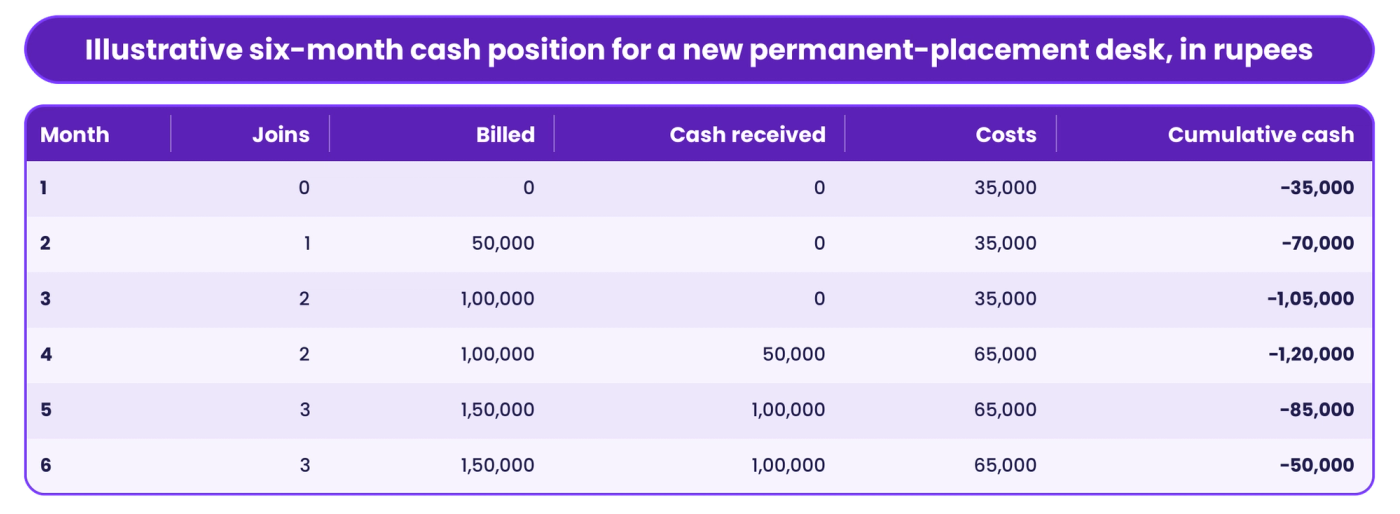
By month four the agency has billed ₹3.5 lakh, yet it has received only ₹50,000 and its cash position is at its lowest, minus ₹1.2 lakh. The desk is busy and still short of cash. Monthly cash turns positive month by month from month five, and the cumulative position recovers as earlier invoices are paid.
Keep a reserve of at least three months of fixed costs, invoice on the day of joining, and delay a hire until the roles justify it, because a recruiter's salary starts before the fees they earn arrive.
Tools a Small Agency Needs
A small agency needs one place where candidates, clients and roles live, and a fast way to reach candidates.
- A recruiting CRM or ATS that keeps every candidate, role and client conversation in one record.
- Sourcing through your network, job boards and a searchable database.
- Outreach on phone, WhatsApp and email, since candidates answer on different channels.
- Scheduling that fixes interviews without a long exchange of messages.
- Invoicing and accounting through whatever your accountant already uses.
Buy tools after your first placement, not before. A spreadsheet is enough to learn your process. When you want a lean desk to handle more roles, an AI recruiting platform for staffing agencies can take on sourcing, outreach, screening and scheduling. HireBound reports that recruiters handle about three times more candidates per day than with a manual process.
Mistakes to Avoid
- Taking any role from any client. A role outside your niche costs hours and rarely closes.
- Working without a written fee agreement.
- Hiring two recruiters at once. Add one, measure what they close in 60 days, then decide.
- Counting a fee as earned before the replacement window ends.
- Registering late and issuing invoices without GST once you cross the limit.
- Mixing permanent and contract work before you have a process for either.
Your First 90 Days
- Days 1 to 30: choose a niche, set up the entity, register your office, draft your fee agreement and talk to ten hiring managers.
- Days 31 to 60: sign one or two clients, source for their roles yourself and make your first submissions.
- Days 61 to 90: close your first placements, send the first invoice and review which step lost the most candidates.
Decide on a first hire only after that review. By then you will know whether the bottleneck is roles, candidates or your own hours.
Starting an agency and want to see how AI agents can handle outreach, screening and scheduling while you keep the client relationship? Talk to the HireBound team.


