TCS Hiring Process: NQT, Interview Rounds and Offer Stages
 Tanmey Goswami
 ·Oct 30, 2026·6 min read

Key Takeaways
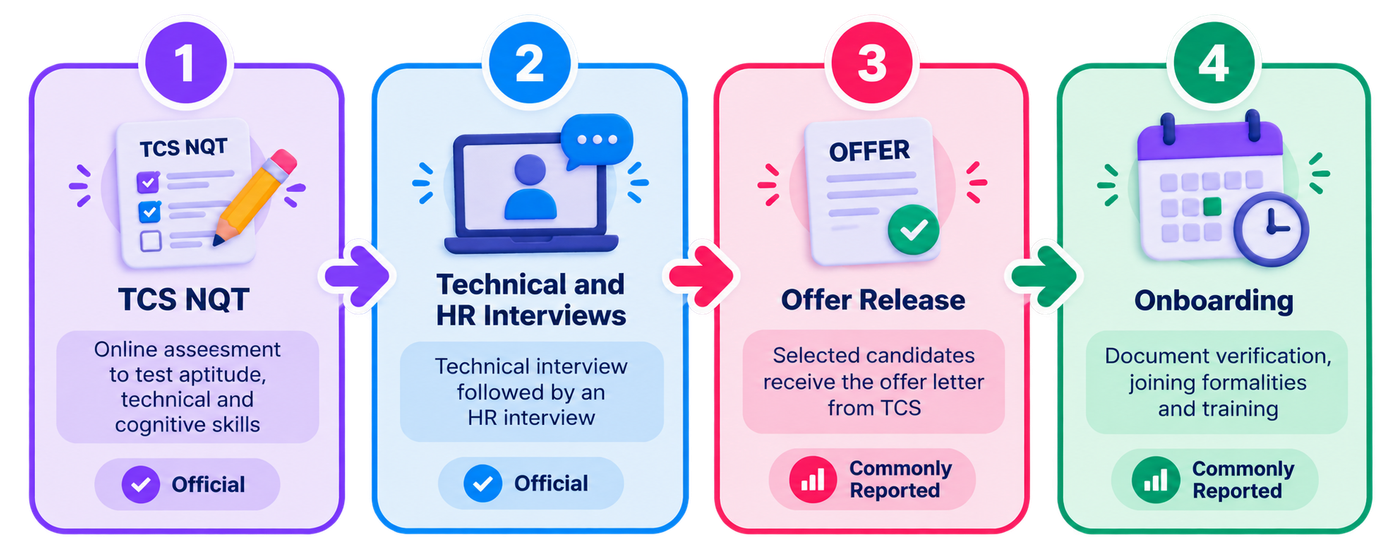
- 1The TCS hiring process for freshers usually starts with the TCS National Qualifier Test (NQT), an ability test that TCS iON conducts, followed by interviews, an offer and onboarding.
- 2TCS iON states that an NQT score stays valid for 2 years, that retakes are allowed and that the highest score counts.
- 3TCS iON does not arrange interviews. A score only helps once you apply to a company, and the final selection depends on the recruiter.
- 4The TCS iON NQT page lists three cognitive sections (verbal, reasoning and numerical), and the IT variant adds a coding assessment.
- 5Interview rounds, timelines and bond terms vary by role and batch. Check the current TCS careers page and your offer documents for the details that apply to you.
The TCS hiring process for freshers usually runs in four stages: an ability test (the TCS National Qualifier Test, or NQT), interviews, an offer, and onboarding. TCS iON conducts the NQT. It does not run interviews or make hiring decisions. Experienced hires usually apply to specific openings instead.
This guide labels each step as official, meaning TCS or TCS iON states it publicly, or commonly reported, meaning it comes from candidate accounts and can change by batch. If you hire at scale yourself, see how HireBound supports recruiters running high-volume pipelines: explore the AI recruiting platform.
Processes change. The TCS careers page is the source of truth, and this guide is general information rather than an official TCS statement.
What Is the TCS NQT?
TCS iON describes the National Qualifier Test as “an Ability Test that assesses a candidate’s competencies and skills”. TCS iON is the exam conducting organisation. It publishes your score to you, and the score is shared only with companies that you apply to and that request it.
So the NQT is a shared screening test that several companies can use, and each one runs its own selection after that. TCS iON states that it does not arrange interviews.
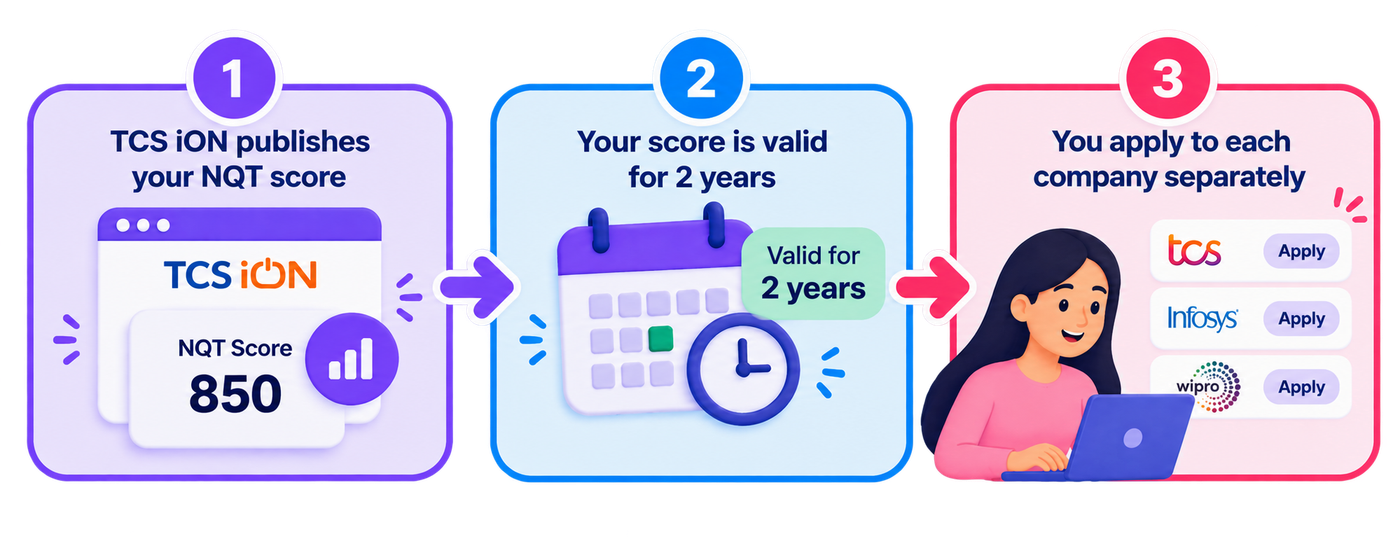
The score is also reusable. TCS iON states that it stays valid for 2 years from the date of result publishing. Retakes are allowed, and the highest score counts.
The NQT Test Sections
The TCS iON NQT page lists three cognitive sections: Verbal Ability, Reasoning Ability and Numerical Ability. Verbal covers grammar, usage and reading comprehension. Reasoning covers pattern recognition, logical and spatial reasoning. Numerical covers number systems, arithmetic, basic statistics and data interpretation.
The IT variant adds an advanced coding and programming assessment. TCS describes its own hiring tests and role categories on its careers pages, and these can differ from the general NQT. Check the current TCS careers page for the structure that applies to your drive.
Section timings, question counts and cut-offs change between sessions. Check the instructions for the session you book, and do not rely on numbers from forums.
How to Apply After the Test
TCS iON states that candidates apply separately on each company’s own portal. A score alone does not place you in a queue. Companies then apply their own selection process and eligibility rules, so read the criteria on the TCS careers page for your graduation year and degree before you apply.
Academic and degree conditions can differ by variant and drive. Confirm them on the current TCS careers page for the exact variant and batch you register for. Candidates who miss a cut-off can retake the test and reuse the best score within the 2-year window.
A practical order works well:
- Pick the NQT variant that matches your degree and target role.
- Book a session and read the instructions for that session.
- Apply on the TCS careers portal once your score is out.
- Keep your marksheets and degree certificates ready for the later stages.
The TCS Hiring Process, Stage by Stage
Here is the full path. The first three rows come from the TCS iON NQT page. The later rows come from candidate experience or need a check against TCS’s current pages, so treat them as typical rather than fixed.
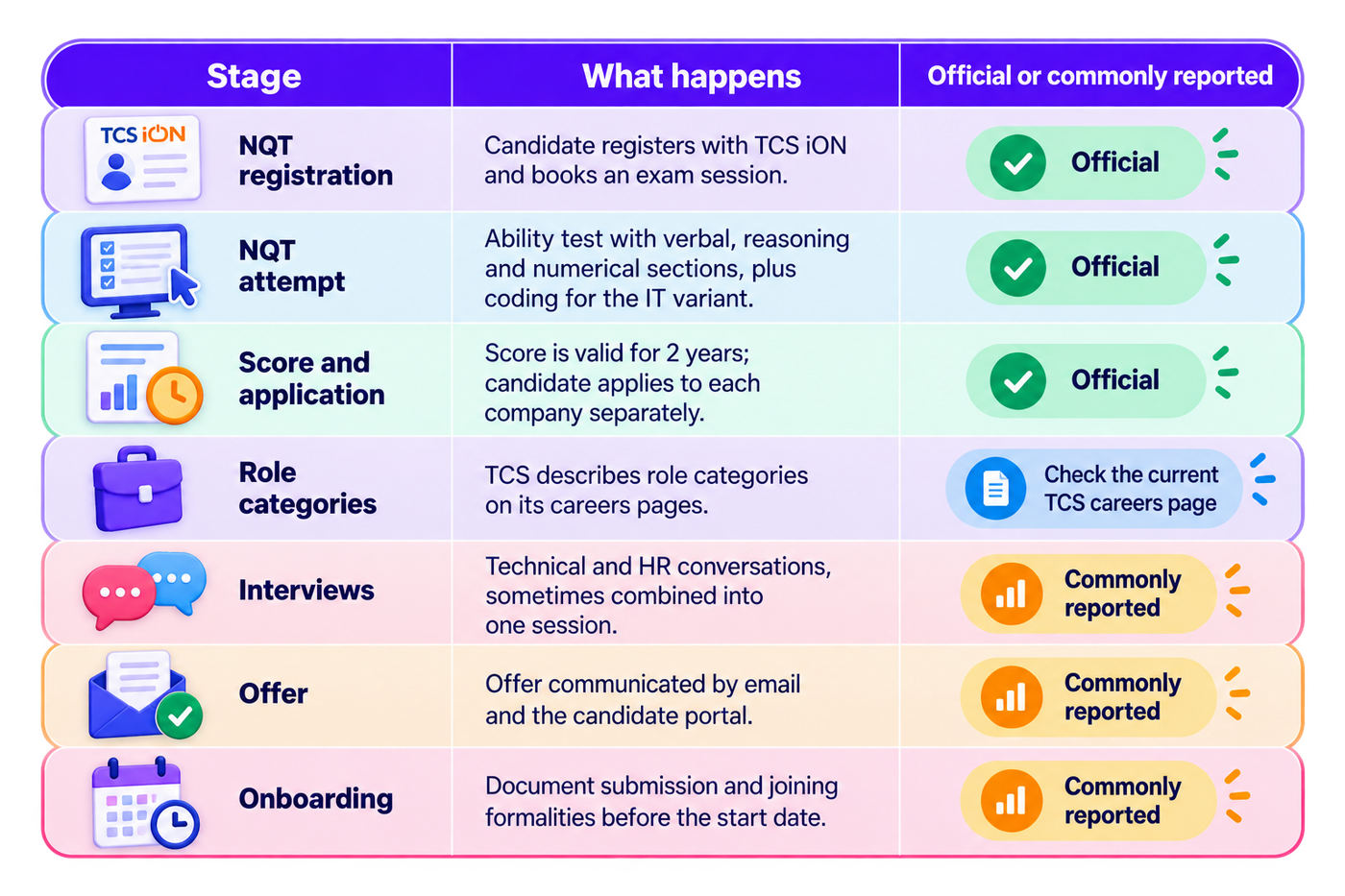
TCS iON’s NQT page covers the test and the score. After that, the number of interview rounds and the wait for an offer differ by role, category and hiring cycle.
How the Interview Rounds Usually Run
Candidates commonly describe a technical interview followed by an HR or managerial conversation. In some cycles the two happen back to back, and in others they are separate sessions. Round counts differ by role and batch, so plan for more than one conversation without assuming a number.
Technical questions tend to follow your résumé: projects, a programming language you listed, and core subjects from your degree. The HR conversation usually covers relocation, shifts and why you want the role. Our guides on fresher interview questions and HR interview questions cover both rounds.
TCS describes role categories on its careers pages. Which category you land in is TCS’s decision, so check the current TCS careers page for how it works for your drive.
Offer, Onboarding and the Bond Question
Candidates commonly report that the offer arrives by email and through the TCS candidate portal, followed by document submission before joining. How long the wait lasts varies a lot with batch size and business need. Do not plan around a figure from a forum.
Be careful with anything that asks for money. Fake job offers are common in Indian campus and fresher hiring, so verify any message against the TCS careers page before you reply or pay anything. Treat a request for a deposit or a hiring email from a free email address as a warning sign.
On bonds, this guide does not state a term, because it varies and TCS’s current terms were not available to check. Read your offer letter and any agreement before signing, and ask the TCS HR contact in writing about anything unclear. Employers also use pre-screening questions to check expectations such as location and joining dates early, so expect those topics to come up.
Why a Shared Test Suits High-Volume Hiring
A shared test gives every company a common first filter. Candidates test once and reuse the score across applications for 2 years, and employers do not have to build and run a separate first-round exam for each drive.
Large employers use a common test and standard stages for this reason, since handling every applicant manually would not hold up at volume. For candidates, a score opens a door without guaranteeing an interview, because each company still decides.
Experienced Hires and Other Routes
The NQT mainly serves early-career candidates. TCS iON states that candidates can also use its job listing portal, and that each company applies its own eligibility rules. Experienced candidates usually apply to specific openings on the TCS careers portal and go through role-based interviews.
Commonly reported experienced-hire steps are a recruiter call, one or more technical interviews and an HR discussion. The depth depends on the role and seniority, and no standard sequence is published.
What High-Volume Hiring Looks Like for Recruiters
A pipeline like this, with a shared test, large applicant numbers and fixed stages, is a common pattern in Indian bulk hiring. Recruiters spend most of their time on reach-outs, reminders, scheduling and document chasing. Our guide to bulk hiring in India walks through that flow from brief to joining.
This is where HireBound fits for employers. It engages candidates over WhatsApp, SMS, email and Voice AI in 14 Indian languages. HireBound’s India figures show a 64% WhatsApp response rate against about 12% for email, and recruiters handle 3x more candidates per day than with a manual process.
A human stays in the loop. Recruiters set the criteria, review shortlists, run the interviews and make every offer decision. HireBound does not run TCS’s process or any other company’s.
Running a high-volume hiring pipeline? See how HireBound’s AI agents handle outreach and scheduling while recruiters keep every decision: talk to the HireBound team.
TCS Hiring Process in Hindi
टीसीएस भर्ती प्रक्रिया में आमतौर पर पहले NQT नामक योग्यता परीक्षा होती है, फिर इंटरव्यू, ऑफर और ऑनबोर्डिंग। NQT का आयोजन TCS iON करता है, और स्कोर 2 साल तक मान्य रहता है। इंटरव्यू के राउंड और समय हर बैच में बदल सकते हैं, इसलिए TCS की करियर वेबसाइट और अपने ऑफर लेटर को ही अंतिम स्रोत मानें।


