Interview No-Shows: How to Reduce Them
 Tanmey Goswami
 ·Nov 26, 2026·8 min read

Key Takeaways
- 1An interview no-show is a scheduled interview where the candidate neither attends nor gives notice. Count late cancellations separately, or your fixes will target the wrong problem.
- 2No-show rate is no-shows divided by interviews scheduled, times 100. In the worked example below, 18 no-shows from 100 interviews is an 18% rate.
- 3Three touchpoints cover most cases: a confirmation request at booking, a reminder about 24 hours before, and a short reminder about 2 hours before.
- 4Ask for a reply, not a read receipt. A candidate who answers "Yes, I will attend" has made a small commitment that a silent reminder does not create.
- 5HireBound's India data shows a 64% response rate on WhatsApp against about 12% on email, which is why confirmations belong on the channel candidates actually open.
Interview no-shows are scheduled interviews where the candidate neither attends nor tells you. You reduce them by fixing four things: make the slot easy to choose, ask for a confirmation, send short reminders at set times, and give candidates a simple way to reschedule. Then measure the rate so you know which change worked.
This guide covers why candidates miss interviews in India, a reminder cadence you can copy, and a formula with a worked example. If you run many interviews a week, see how HireBound handles scheduling and follow-ups.
What Counts as an Interview No-Show
A no-show is a candidate who accepted a slot, did not attend and did not contact you before the start time. That is the number that costs you the most, because the interviewer's time is already gone.
Keep two other cases apart. A late cancellation is a candidate who tells you before the interview, even at short notice. A reschedule is a candidate who moves the slot. Both are better than silence, and both give you time to fill the gap.
If you lump all three into one figure, you cannot tell whether reminders are working. A rising count of late cancellations and a falling count of true no-shows is a good sign.
Why Candidates Miss Interviews in India
Most candidates who vanish are not rude. They are busy, unsure or already holding a better option. In India, long notice periods and parallel offers add to this.
A candidate serving a notice period may be interviewing with five employers at once. Ghosting is common enough that SHRM India has published guidance on preventing candidate ghosting from the employer side. The table below maps the usual causes to a first fix.
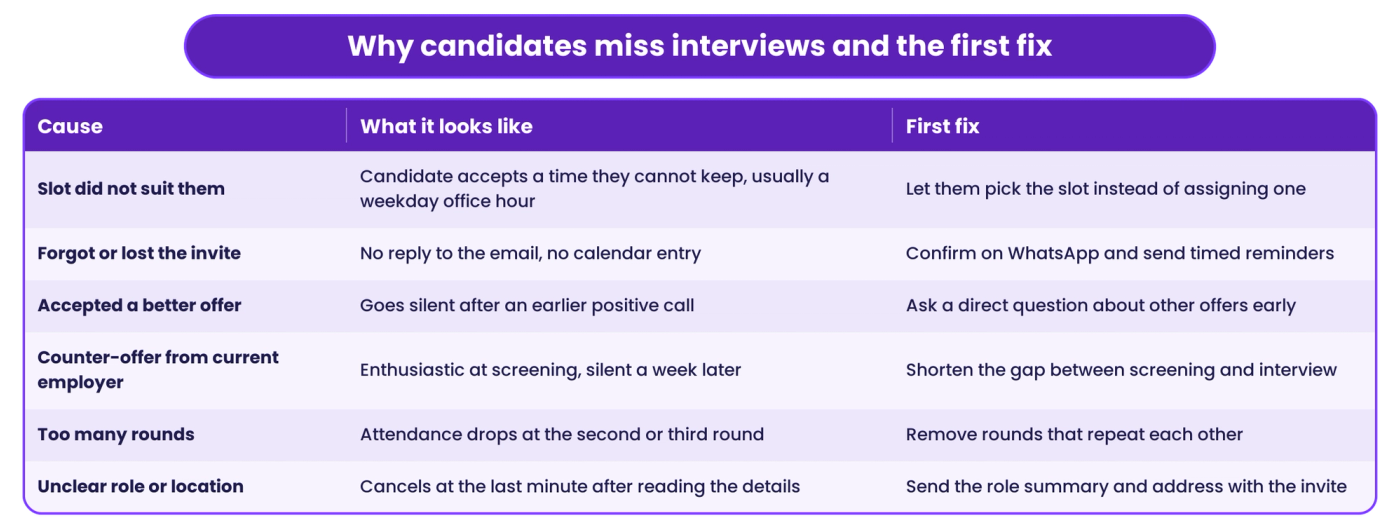
No fix removes all of these. The aim is to remove the causes that are yours to control, such as a bad slot or a missing reminder.
The order matters. Slot fit, reminders and rescheduling are cheap and sit inside your process. Counter-offers and competing offers are harder, and the only real answer is speed: the sooner a candidate moves from screening to interview to offer, the less time anyone else has to compete.
Fix the Slot Before You Fix the Reminder
A reminder cannot rescue an interview the candidate never wanted at that time. Start with the booking itself.
Self-scheduling is the simplest change. You share a set of open slots, the candidate picks one, and the calendar updates for both sides. The candidate owns the choice, which raises the odds that they keep it. Our guide to self-scheduling versus recruiter-scheduled interviews covers when each approach fits.
Three booking rules help in India:
- Offer slots outside office hours for employed candidates, such as early morning or after 6 pm.
- Keep the gap between screening and interview short. A candidate who waits two weeks has time to receive another offer.
- Put the format in the invite: video, phone or in person, with the link or address.
A Reminder Cadence That Works
Reminders work best when they are few, timed and useful. Send too many and candidates mute them. Send none and the interview slips from memory.
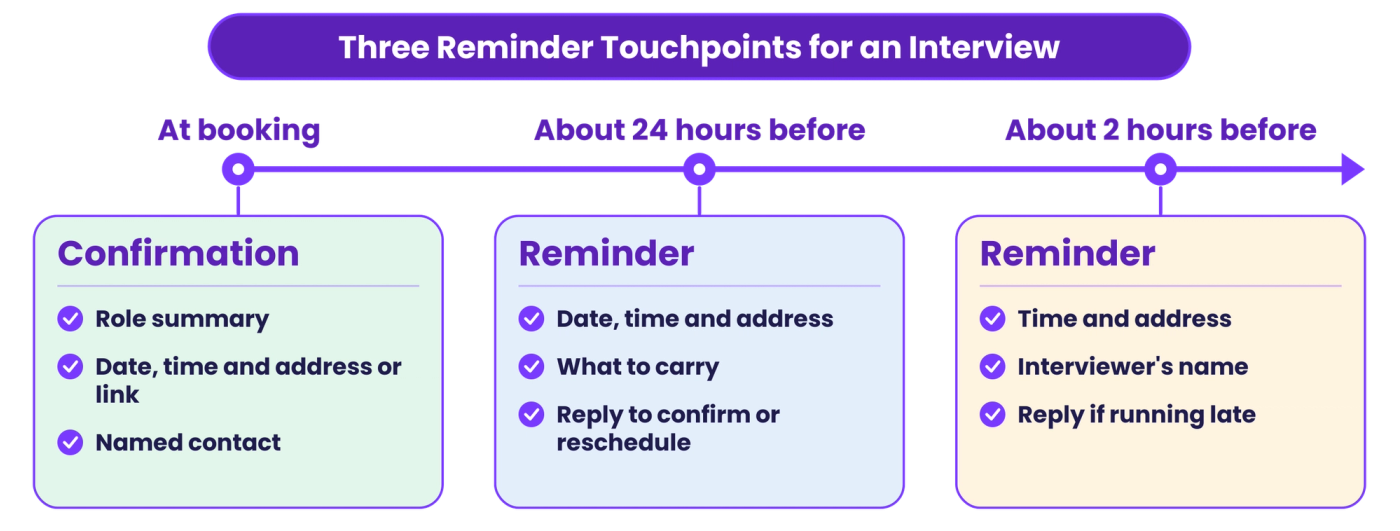
Use three touchpoints:
- At booking: a confirmation with the date, time, format, interviewer name and a one-line request to reply "Yes" or to reschedule.
- About 24 hours before: a reminder with the same details and the reschedule option. Ask for a reply here too.
- About 2 hours before: a short message with only the time and the link or address.
Adjust the timing for the role. A same-day interview needs only the first and third touchpoints. A final round for a senior role may justify a call from the recruiter the day before.
The 24-hour reminder is the useful one. If the candidate has not replied by then, you still have time to offer the slot to someone else or to call them.
Use WhatsApp for Confirmations
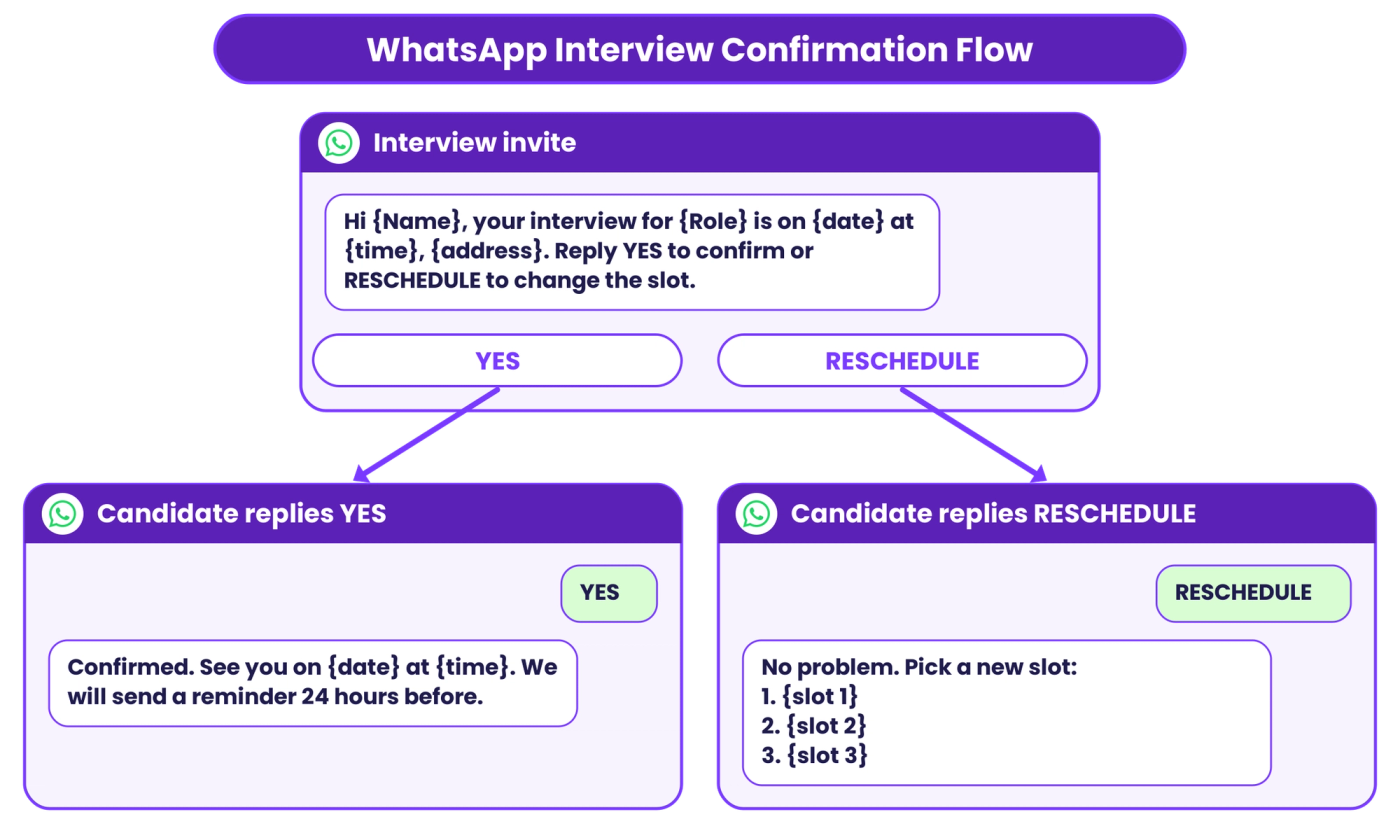
In India, the channel matters as much as the timing. A confirmation sent by email waits in an inbox. The same message on WhatsApp is far more likely to be seen quickly.
HireBound's India data shows a 64% response rate on WhatsApp against about 12% for email. That gap is why the confirmation step belongs on WhatsApp, with email as the record.
A good confirmation message is short:
- Hi Asha, your interview with the Pune team is on Thursday at 4 pm on video. Reply YES to confirm or RESCHEDULE to pick another time.
Two details make it work. The candidate can answer in one word, and a "RESCHEDULE" reply leads to new slots instead of an awkward conversation. Keep a single consent record for WhatsApp contact, since India's data protection rules apply to candidate messaging.
Rescheduling Rules, Buffers and Overbooking
Make rescheduling easy. A candidate who can move the slot in one tap is far less likely to vanish. State the rule in the invite: for example, "reschedule any time up to two hours before".
Set a limit so it does not become a loop. Most teams allow one free reschedule per round and then ask the recruiter to step in.
Buffers protect your interviewers. Leave a gap between interviews so one late candidate does not push the whole day back. For high-volume days, some teams book a small number of extra candidates per block, as airlines and clinics do. Use this carefully. Overbooking works only when you know your own no-show rate and can handle the day when everyone arrives.
For roles where a miss is costly, keep a standby candidate. A shortlisted second candidate who has agreed to be called at short notice turns a no-show into a rescheduled slot.
What Not to Do
Some well-meant habits increase no-shows or damage your name with candidates.
- Do not rely on one email. A single invite with no follow-up is the most common cause of forgotten interviews.
- Do not send a long reminder. If it needs scrolling, candidates will skip it.
- Do not threaten. Messages such as "no-shows will be blacklisted" push away good candidates and rarely change behaviour.
- Do not chase a silent candidate five times. Make one call, send one message and move on.
- Do not ignore the recruiter side. Late interviewers, changed panels and missing links also cause candidates to drop out.
Silent drop-off also happens earlier in the funnel. Our guide to candidate drop-off covers the stages before the interview.
What to Do When a Candidate Does No-Show
Even with good systems, some candidates will not turn up. Your response in the next few hours decides whether you lose the candidate or recover the slot.
Wait ten minutes past the start time, then send one message and make one call. Keep the tone neutral. A message like this works:
- Hi Asha, we missed you for the 4 pm interview today. If something came up, reply with a time that suits you this week and we will rebook. If you are no longer interested, a one-word reply helps us plan.
The last line matters. It gives the candidate an easy way to say no, and a quick "not interested" is more useful to you than silence. Candidates who are embarrassed about missing the slot often reply to a message that sounds kind.
Record the reason in your ATS or tracker. Use a short list: forgot, clash, other offer, lost interest, no reply. After a month, the pattern shows where to act. A cluster of "other offer" points to speed. A cluster of "forgot" points to reminders. A cluster of "clash" points to the slots you offer.
Treat repeat no-shows differently from one-off misses. One miss is usually a mistake. Two without contact is a signal about fit or intent, and you can pause that candidate without a long explanation.
Finally, tell the interviewer quickly. A panel member who learns at the start time wastes the slot. A short alert lets them use the time on other work.
How HireBound Helps With Scheduling and Confirmations
Most of the steps above are repetitive: send the slots, confirm, remind, re-offer. They are also the steps recruiters drop first when the week gets busy.
HireBound's AI interview scheduling lets candidates pick a slot, then sends confirmations and reminders over WhatsApp, SMS, email and Voice AI. Candidates who reply "reschedule" get new slots without a recruiter in the middle. Recruiters set the rules and keep every hiring decision.
Recruiters using HireBound handle 3x more candidates per day than with a manual process. You still own the criteria, the interview and the offer.
How to Measure Your Interview No-Show Rate
You cannot reduce a number you have not measured. The formula is simple:
No-show rate = no-shows divided by interviews scheduled, times 100.
Count only true no-shows in the top line. Report late cancellations and reschedules as separate rates.
Here is an illustrative example. The figures are assumptions, not a benchmark. A team schedules 100 first-round interviews in a month. 18 candidates do not attend and give no notice, 7 cancel before the start time, and 10 reschedule.
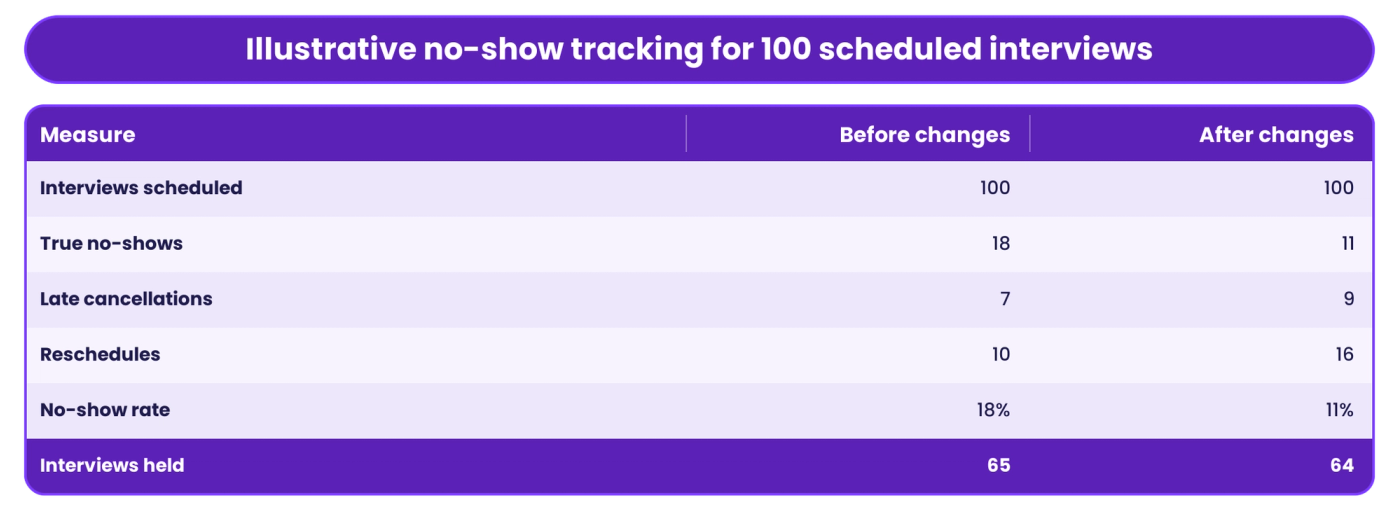
The no-show rate fell from 18% to 11%, while late cancellations and reschedules rose. That is the pattern you want: candidates who would have vanished now tell you. Interviews held stayed about level in this month. The gain is that more candidates are now in play instead of lost.
There is no single good number. Rates differ by role, seniority and market, and published figures mostly come from vendors with different definitions. Compare against your own baseline, by role and by channel, and track the trend monthly.
Review the numbers by source, role, interviewer and slot time. A pattern such as high no-shows on Monday mornings tells you more than the overall rate.
Running many interviews a week and losing slots to no-shows? See how HireBound's AI agents confirm and remind candidates while recruiters keep the decision: talk to the HireBound team.
A Quick Checklist You Can Use This Week
Pick three changes and start with the cheapest.
- Let candidates choose their own slot and offer at least two outside office hours.
- Send a confirmation at booking and ask for a reply on WhatsApp.
- Add a reminder about 24 hours before and a short one about 2 hours before.
- Put the reschedule rule in every message and make it one step.
- Track true no-shows, late cancellations and reschedules separately.
- Keep one standby candidate for senior or hard-to-fill roles.
Review the rate after a month. If late cancellations rise and no-shows fall, the system is working.


