Reference Checks in 2026: Are They Still Worth Doing, and How to Do Them Right
 Suvam Moitra
 ·Oct 19, 2026·12 min read

Key Takeaways
- 1Schmidt and Hunter (1998) put the validity of reference checks at 0.26, a modest predictor that adds most value alongside structured interviews and work samples.
- 2A structured telephone reference check predicted supervisor ratings at r = .25 uncorrected and .36 corrected, according to Taylor and colleagues (2004), so structure is what makes references useful.
- 3Most reference calls fail for three reasons: hand-picked referees, leading questions and former employers who confirm only dates and designation. Fixing all three costs nothing.
- 4The US Office of Personnel Management recommends a minimum of three contacts for a structured reference check; ask each the same six to eight job-related questions and score answers against a rubric.
- 5Under India’s DPDP Act, notified in November 2025 with main duties from May 2027, tell candidates and referees what data you hold and why.
A reference check is a structured conversation with people who have worked with a candidate, held to confirm what the candidate claimed and to learn how they actually performed. It verifies facts such as role, tenure and reporting line, and collects evidence on results and working style that an interview cannot show.
Reference checks are still worth doing, but only in a structured form. A casual call in which a friendly referee says “great guy, would hire again” tells you almost nothing. A set of identical, job-related questions asked of three people who saw the candidate work tells you a lot.
Hiring at volume and tired of chasing replies? See how HireBound runs candidate conversations on WhatsApp, Voice and email so hiring steps stop stalling. Explore HireBound →
What Is a Reference Check Actually Meant to Verify?
A reference check has two jobs, and most teams only do the first one. The first is verification: did the candidate hold the role, for the dates, with the scope and reporting line they claimed? The second is prediction: what did this person do in a real job, and how would the people around them describe the experience of working with them?
Verification is a yes-or-no exercise and can be done by an HR desk or a background verification vendor. Prediction needs a human who worked with the candidate, ideally a manager, and a conversation that goes past titles.
Keep the two apart in your process. A verification call to a former employer’s HR team confirms employment. A reference call with a former manager or peer gathers evidence. Treating the HR confirmation as a “reference” is the most common way teams believe they have done a check when they have not.
A reference check should also be checked against the role. For a frontline or BPO job, the useful question is usually attendance, reliability and how the person handled a difficult customer or shift. For a senior hire, it is scope of decisions, how the person handled conflict, and what their team looked like after they left.
Do Reference Checks Predict Job Performance?
Yes, modestly, and much better when structured. The evidence comes from two places.
First, the classic meta-analysis. Schmidt and Hunter (1998) reported a validity of about 0.26 for reference checks against job performance. On a scale where 0 is no better than guessing and 1 is perfect prediction, that puts references below structured interviews, work samples and cognitive tests, and above years of experience or education.
The US Office of Personnel Management describes reference checks in similar terms: useful for predicting performance, better than years of education or job experience, and less effective than cognitive ability tests.
Sackett, Zhang, Berry and Lievens (2022) later revised the validity of most selection tools downward, but they did not update the reference check figure, so 0.26 still comes from the older estimates. Read it as a rough guide for casual checks, not a ceiling for well-run ones.
Second, the studies of structured references. Taylor, Pajo, Cheung and Stringfield (2004) published a study in Personnel Psychology of a structured telephone reference check for entry-level customer-contact jobs: a 10 to 15 minute call in which referees rated the applicant on three job-relevant dimensions. Across 223 applicants, referees could distinguish between dimensions, and the ratings predicted later supervisor ratings of job performance at r = .25 uncorrected and .36 after correcting for range restriction and unreliability in the criterion. Untrained recruitment staff ran the calls.
Three practical points follow from this research:
- References add the most when they are combined with other evidence. A reference check will not rescue a weak interview process, but it can catch what interviews miss.
- Structure is the lever. The same questions, the same rating scale and the same number of referees for every candidate turn a chat into evidence.
- References answer different questions than assessments do. They tell you how someone behaved over months. Work samples tell you what someone can do on a given day. For the second, compare skills assessments, take-home tests and live coding.
Why Are Most Reference Checks Nearly Useless?
Most reference checks fail because of the process around them, not because references carry no signal. Five failures show up repeatedly.
- The candidate picks the referees. Nobody nominates a person who will say something negative. The sample is filtered before you make the first call. Ask for a manager and a peer, and ask for at least one referee the candidate did not choose, such as someone from the same team who can be named in a back-channel conversation only with the candidate’s knowledge.
- The questions are leading. “Would you say she was a strong performer?” invites a yes. “Was he reliable?” invites a yes. Closed, positive questions get polite answers.
- Former employers say almost nothing. Many organisations tell HR teams to confirm only dates of employment and designation, because saying more feels like legal risk. In Indian hiring, a call to a former employer’s HR desk often returns exactly that: joining date, last working day, last designation. That is verification, not a reference.
- Referees are loyal. People do not want to damage someone’s chances. Leniency is the norm, so a lukewarm answer from a referee carries more weight than a glowing one. The silence, the hedge and the “I would need to think about that” are the data.
- The check happens after the decision. When the reference call is a formality after the offer is made, no answer will change the outcome, and the recruiter knows it. A check that cannot change a decision is a ritual.
The fix for each is simple. Get three referees, at least two of them former managers or direct peers. Ask open, behavioural questions. Use the reference to confirm or challenge specific claims from the interview. Run the call before the offer is final. Score answers against the same rubric every time.
How Do You Choose Referees and How Many Do You Need?
Ask for three, and get them before the final interview round. The US Office of Personnel Management recommends a minimum of three contacts for a structured telephone reference check, which is a sensible floor for most professional roles. One referee gives you an opinion. Three give you a pattern.
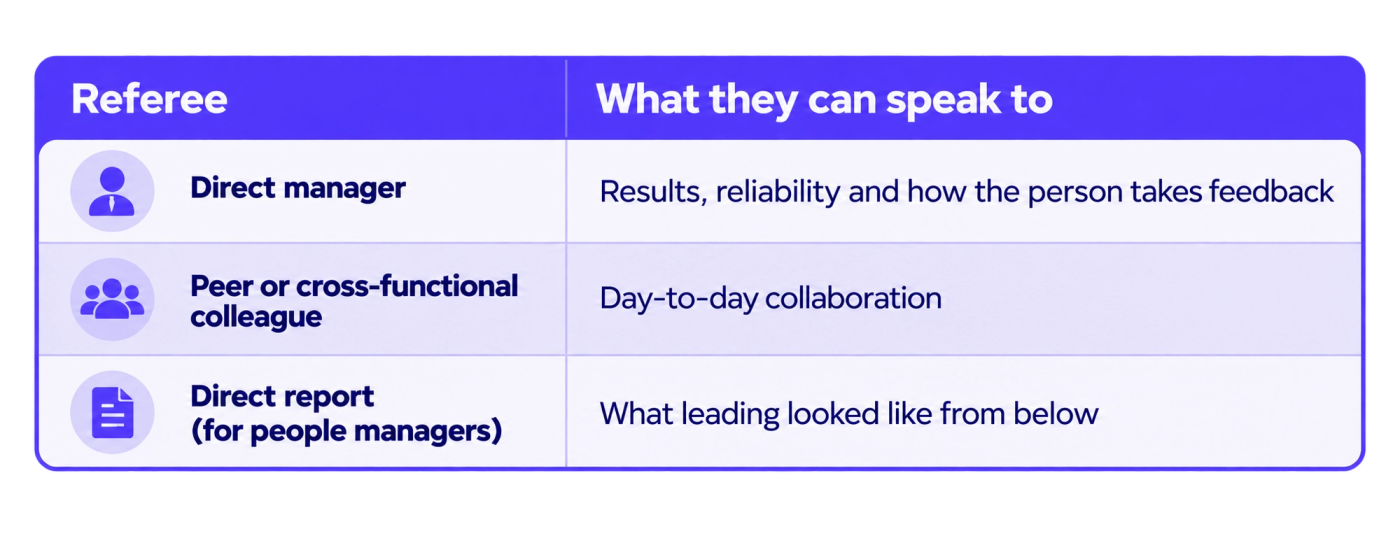
For frontline hiring, three full calls per candidate is not realistic. A better fit is one manager reference for shortlisted candidates only, run after a screening step so that you spend the time on people who are in contention. Screen first so the pool is small before references start.
Do not ask for current-employer references before the candidate is ready. Many candidates in India are serving a notice period or have not told their manager they are looking. Make the check conditional on the offer stage for current employers, and say so in writing.
What Questions Get Honest Answers From References?
Questions that ask for specific behaviour and comparison get honest answers. Questions that ask for a verdict get politeness. Build the call around the job’s real requirements, and ask every referee the same set.
Start with context, so the referee is relaxed and you know what they saw:
- How did you work with this person, for how long, and in what capacity?
- What was their role and what were they accountable for?
Then ask for evidence:
- Tell me about the most significant result this person delivered while working with you. What was their part in it?
- Describe a time when a project or a target went wrong. What did they do?
- How did they respond when you gave them critical feedback? What changed afterwards?
- Where did they need the most support or coaching?
Then ask for comparison and calibration:
- Compared with others in a similar role you have managed, where would you place them: top quarter, middle half or bottom quarter?
- On a scale of 1 to 5, how would you rate them on [the competency this role needs most]? What would move a 3 to a 5?
Then close with the two questions that separate a formality from a real check:
- Would you hire this person again for this kind of role? Why, or why not?
- Is there anything you would want their next manager to know that I have not asked about?
Three habits improve every call. First, let silence sit for a few seconds after each question, because referees often add the important qualifier in the gap. Second, ask “can you give me an example?” for every adjective, since “strong” and “dependable” mean nothing without an incident behind them. Third, note the referee’s tone as well as their words. Hesitation on a specific competency is worth following up with a second question.
For questions your interview panel should ask from the same competencies, use the structured interview scorecard template so the reference call tests the same criteria as the interview.
What Does a Structured Reference Check Template Look Like?
A structured template turns a chat into repeatable evidence. Use this five-step process for professional roles and shorten it for frontline roles.
- Set the criteria before you call. Pick three to five competencies from the job scorecard, for example ownership, reliability, communication, coaching and stakeholder handling. Write one behavioural question for each.
- Get consent and set up the call. Confirm with the candidate which referees you will contact and how. Tell each referee who you are, what role is involved, how long the call takes (15 minutes is enough) and that their answers will be recorded in your hiring notes.
- Verify the facts. Open by confirming the candidate’s role, dates, reporting line and team size against what they told you. Note any gap between claim and confirmation.
- Ask the competency questions and score them. Give each answer a rating from 1 to 5 against the rubric, using written anchors such as “1 = no evidence, 3 = met the expectation, 5 = clearly above peers, with an example.” Write down the example beside the score.
- Compare across referees and decide. Look for agreement and disagreement among the three referees. One negative signal on a critical competency is a reason to probe further, not an automatic rejection. Record the decision and the evidence for it.
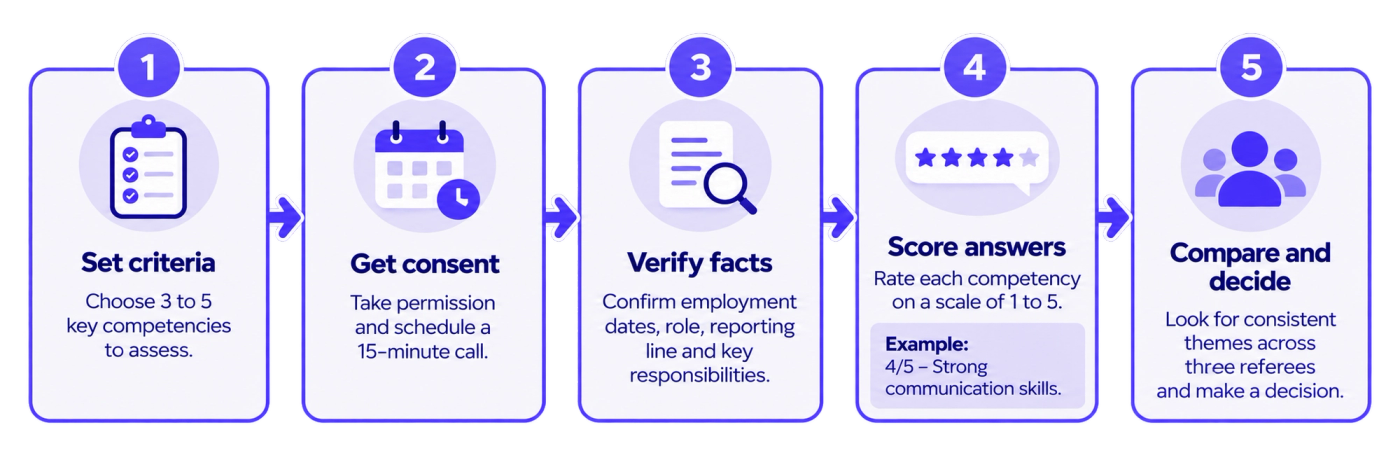
A record from a reference call should fit on half a page: referee name and relationship, verified facts, one score and one example per competency, and any concerns. If the note is just “positive reference,” the call was not structured.
Timing matters. Collecting a reference at the shortlist stage, rather than after the offer, lets it change the decision. Referees respond faster when the request is short and arrives on a channel they use, so offer a phone or WhatsApp slot instead of a long email form.
What Are the Legal and DPDP Considerations in India?
Reference checks involve personal data about two people, the candidate and the referee, and India’s Digital Personal Data Protection Act, 2023 applies to both. The Rules were notified on 13 November 2025, and most Data Fiduciary duties apply from May 2027. Build the habits now so that they are routine when the deadline arrives.
The practical rules are these:
- Tell the candidate. Before you contact anyone, say which referees you plan to call, what you will ask and how you will record and store the answers. Get this in writing, and keep it short.
- Tell the referee. Referees are third parties whose names and phone numbers you hold without any prior relationship. Say who you are, why you are calling and how their data will be used. Do not rely on an exemption for referee data. A one-line notice at the start of the call, or in the request message, is enough.
- Collect only what the decision needs. Ask about job performance and conduct. Do not ask about health, family circumstances, religion, caste or marital status, and stop a referee who volunteers them.
- Limit who sees the notes. Reference notes should sit in your ATS or a controlled folder, accessible to the hiring team only, not in personal WhatsApp chats or email threads.
- Set a retention period. Delete reference records for unsuccessful candidates on a schedule you define and can defend. For the full picture of how DPDP touches recruiters, see our DPDP Act compliance checklist for recruiters.
Two employment-law habits also protect you. Do not pass a referee’s negative comments back to the candidate in a way that identifies the source. And treat what a referee says as one input to a documented, job-related decision, not as the reason itself. That keeps decisions consistent and defensible if a candidate ever challenges a rejection.
Many employers restrict what their staff may say about former employees. If a manager tells you they can only speak in a personal capacity, respect that, note it and move on to the next referee.
How Do Reference Checks Fit With the Cost of a Bad Hire?
Reference checks are cheap insurance against expensive mistakes, and the case grows with seniority. A structured reference process costs a few hours of recruiter time per finalist. A mis-hire at leadership level can cost many multiples of annual salary once you count lost output, team disruption and replacement. Our analysis of the cost of a bad hire by seniority shows how that gap widens with level.
That is why the effort should scale with the role:
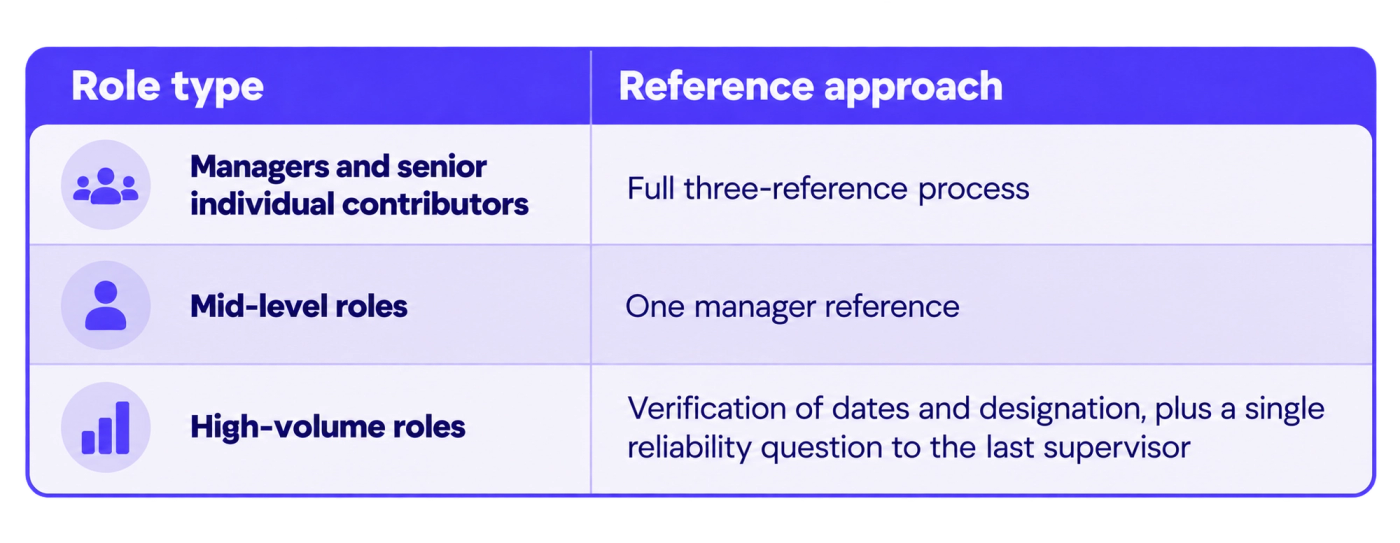
Verification of dates and designation, plus a single reliability question to the last supervisor
Want fewer hiring steps stuck waiting on replies? Talk to us about how HireBound handles candidate communication at scale. Book a free demo →
When Should You Skip Reference Checks Entirely?
Skip a reference check when it cannot change the decision or the cost of running it outweighs the risk it covers. There are four situations where that is the case.
- Very high-volume, low-risk roles. For roles where you hire hundreds of people in a month, with short training and easy replacement, verification of identity and employment dates is usually enough. A full reference call per candidate does not pay back.
- The candidate has no prior employer. Freshers and first-time workers have no manager to call. Use a work sample, a structured screening conversation or a college or internship supervisor if one exists, instead of forcing a reference.
- The referee is not in a position to know. A reference from a friend, relative or someone who never worked with the candidate is noise. Ask for a different referee or leave the check out.
- The decision is already made. If the offer is going out no matter what the referee says, do not go through the motions. Either allow the check to change the outcome or drop it.
Where a check does add value, run it early, structure it and record the evidence.


