New Gratuity Rules Under Labour Codes: What Changes for Employers
 Suvam Moitra
 ·Nov 19, 2026·7 min read

Key Takeaways
- 1The gratuity new rules took effect on 21 November 2025, when the Code on Social Security, 2020 replaced the Payment of Gratuity Act, 1972.
- 2Fixed-term employees now qualify for gratuity after one year of service under the contract, instead of five years, according to the Press Information Bureau.
- 3Gratuity wages now add back excluded allowances above 50% of remuneration, which raised the payout by about 67% in our low-basic illustration.
- 4The five-year rule for permanent staff, the 15 days' wages rate and the 30-day payment deadline are unchanged from the 1972 Act.
- 5The Ministry of Labour puts the gratuity ceiling at Rs 20 lakh, so employers should re-estimate provisions and review offer letters.
The gratuity new rules apply from 21 November 2025, when the Code on Social Security, 2020 replaced the Payment of Gratuity Act, 1972. Two things changed for employers. Fixed-term employees now qualify after one year of service, and the wage base used to calculate gratuity is wider. The five-year rule for permanent staff, the rate of 15 days' wages and the 30-day payment deadline stayed.
This explainer sets out what changed and what to do about it, as the law stands on 16 November 2026. It is written for HR, payroll and finance teams, with employees as a second audience.
Hiring fixed-term or permanent staff in India? See how HireBound's AI recruiting agents source, screen and schedule candidates →
Gratuity New Rules: What Changed Under the Labour Codes?
Gratuity is now governed by Chapter V of the Code on Social Security, 2020, sections 53 to 58. Section 164 of the Code repealed the 1972 Act. The Press Information Bureau announced on 21 November 2025 that all four labour codes were in force from that day. For the full background on coverage and payment, read our pillar guide to gratuity in India.
The Code kept most of the old scheme. Section 53 still pays 15 days' wages for each completed year, normally after five years, and requires payment within 30 days. The table shows where the changes sit.
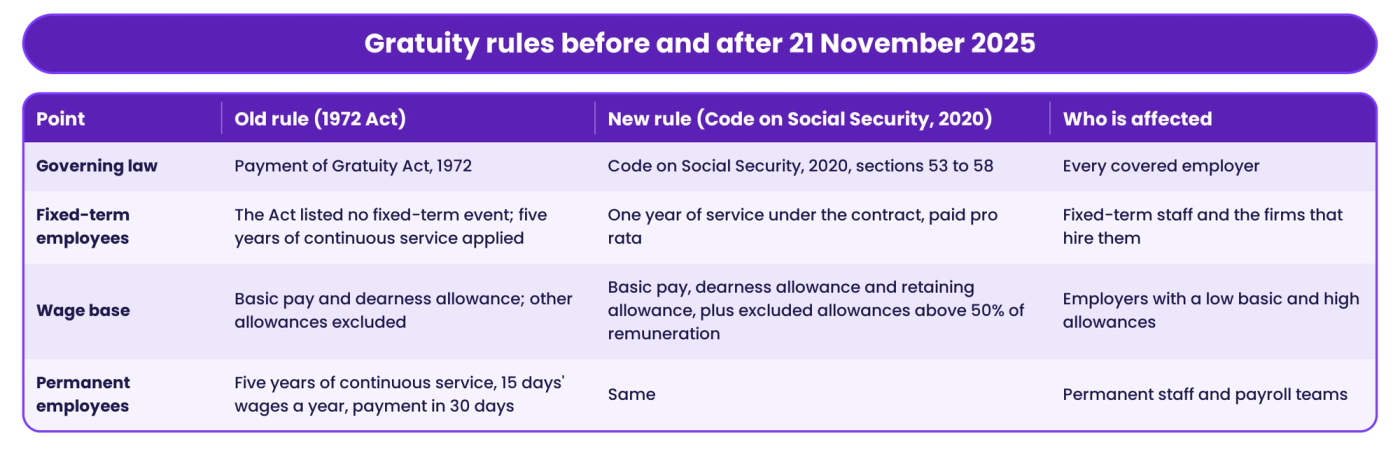
For most permanent employees the entitlement is the same, but the amount can differ because the wage base is wider.
What Is the New Gratuity Rule for Fixed-Term Employees?
A fixed-term employee now becomes eligible for gratuity after one year of service under the contract. The Press Information Bureau's 21 November 2025 release describes this as gratuity eligibility after one year, instead of five. Section 53 of the Code waives the five-year condition on expiry of a fixed-term contract and says the payment is pro rata.
The Social Security (Central) Rules, 2026, notified on 8 May 2026, fix the threshold. Rule 33 says a fixed-term employee is eligible if he or she serves at least one year under the contract. A period of more than six months beyond a full year is rounded up to one additional year.
The Ministry of Labour's additional FAQs of 16 March 2026 add two points. Fixed-term employment covers employees engaged directly by the employer, and the one year runs from the start of the contract. A contract that ends before one year therefore carries no gratuity under these rules.
How Does the New Wage Definition Raise Gratuity?
The Code defines wages as basic pay, dearness allowance and retaining allowance. Section 2(88) excludes items such as house rent allowance, conveyance allowance, overtime and commission. A proviso then adds back any excess when those excluded payments exceed one-half of total remuneration.
Under the 1972 Act, section 2(s) counted basic pay and dearness allowance only. A salary with a small basic and large allowances therefore produced a small gratuity. The 50% rule limits that effect. The Ministry's 30 December 2025 FAQs on the labour codes say gratuity and retrenchment compensation are left out of the 50% test.
Here is a worked illustration. Assume a monthly remuneration of Rs 1,00,000, a basic of Rs 30,000 with no dearness allowance, and Rs 70,000 in excluded components such as house rent and conveyance allowance. Assume 8 completed years of service and monthly-rated pay, where section 53 divides monthly wages by 26 and multiplies by 15.
- Old wage base: Rs 30,000. Gratuity is Rs 30,000 × 15/26 × 8, or Rs 1,38,462.
- New wage base: the excluded Rs 70,000 exceeds the 50% limit of Rs 50,000 by Rs 20,000. Wages become Rs 30,000 plus Rs 20,000, or Rs 50,000.
- New gratuity: Rs 50,000 × 15/26 × 8 comes to Rs 2,30,769, which is Rs 92,308 (about 67%) more.
The assumptions are ours, not an official case. The Ministry's own FAQ example uses the same method, adding Rs 2,000 to a Rs 20,000 base. Our guide to gratuity calculation covers rounding and edge cases.
Do the New Labour Codes Change Gratuity for Past Service?
For any exit on or after 21 November 2025, yes. The Ministry's 30 December 2025 FAQs say the Code applies to gratuity from 21 November 2025, the date of enforcement. Its additional FAQs of 16 March 2026 say the employee is then paid on the wages last drawn at exit, under the Code.
Section 53 computes gratuity on the rate of wages last drawn. The 30 December FAQ adds that establishments may make provision as per accounting norms. Check with your payroll or legal team before you apply this to a specific case.
The figure below shows the wage-base effect in the illustration above.
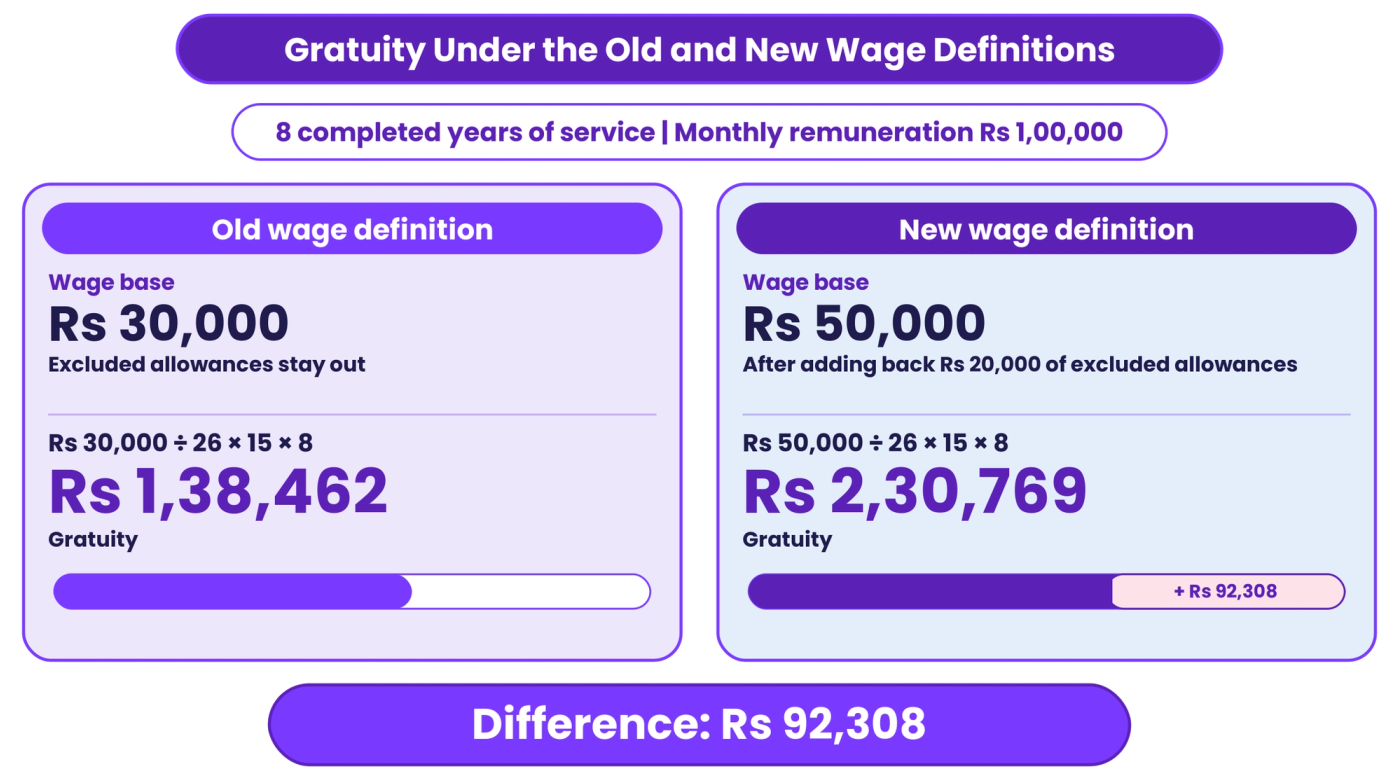
The same service and the same pay can yield a very different payout depending on how the salary is structured.
What Did Not Change in the New Labour Code Gratuity Rule?
Most of the scheme is the same, so policies built on it still work.
- Five-year rule: Section 53(1) still requires five years of continuous service for superannuation, retirement or resignation. Working journalists need three.
- Rate: Section 53(2) pays 15 days' wages a year, with a part-year over six months counted as a full year. Monthly wages are divided by 26 and multiplied by 15.
- Death and disablement: No minimum service applies, as before.
- Payment deadline: Section 56 requires payment within 30 days of the amount falling due.
- Ceiling: The Ministry's FAQs say the maximum gratuity is as notified by the Central Government, currently Rs 20 lakh.
Contract labour is a separate case. The Ministry's FAQs of 16 March 2026 say the contractor pays gratuity after five years of continuous service at 15 days' wages a year.
How Do the New Gratuity Rules Affect Employer Costs?
The effect is higher liability in two places, and the size depends on your workforce. A wider wage base raises gratuity for employees whose pay is mostly allowances. Fixed-term employees now earn an entitlement after one year of service.
Employers should therefore revisit the provision. A provision built at 4.81% of basic pay is a common convention, from 15 days out of 26 spread over 12 months, and it is not a statutory figure. If wages are now larger than basic, the base for that arithmetic changes. The Ministry's FAQ leaves the accounting treatment to each establishment's accounting norms, so finance and auditors should agree the method.
The offer letter is the other cost lever. A candidate comparing CTC across employers may see a different gratuity line for the same basic pay. Recruiters hiring in India should be ready to explain how the wage definition affects the figure.
Which Gratuity Rules Apply: Central or State?
The Social Security (Central) Rules, 2026 were published on 8 May 2026 under G.S.R. 344(E). They apply where the Central Government is the appropriate government. Other employers follow the rules their state government notifies.
Until final rules were notified, the Ministry's FAQs said old rules continued in force to the extent they matched the Code. Under the central rules, an employee applies in Form IV, ordinarily within 30 days of gratuity becoming payable. The employer replies in Form V.
Check your state's notified rules for forms and timelines, since they may differ from the central ones. The timeline below shows how the pieces arrived.
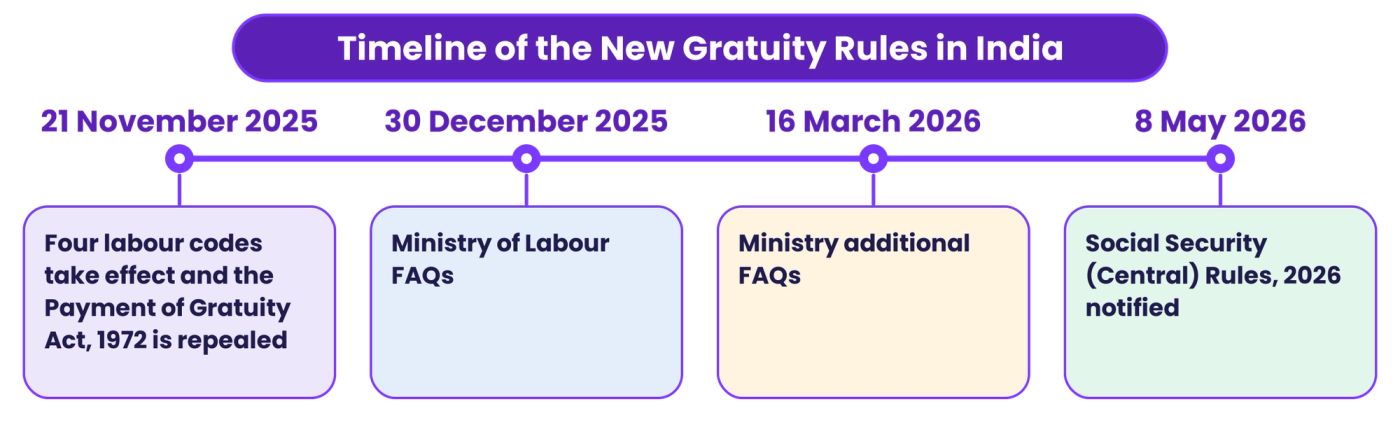
The Code applies everywhere from the same date, and only the procedure depends on who the appropriate government is.
What Do Staffing Firms and Fixed-Term Workforces Need to Know?
Staffing firms feel the fixed-term change first. Workers on a firm's own fixed-term contracts qualify after one year, and the firm must carry that liability. HireBound's staffing agency platform helps agencies run mandates, pipelines and recruiter workflows, so contract end dates and placements stay visible to the team.
Categories matter. The Ministry's FAQs say fixed-term employment covers directly engaged employees, while contractors pay gratuity for contract labour after five years. Map each worker to the right category with your legal team. Our guide to contract staffing in India explains how these arrangements work.
What Should HR and Payroll Teams Do Now?
Six steps cover most of the work.
- Identify which rules apply: central or your state's notified rules.
- Rebuild the wage base using the Code's definition, and test the 50% rule on each salary structure.
- Re-estimate the gratuity provision with finance and your auditors.
- List fixed-term contracts and flag those that reach one year of service.
- Update offer letters and appointment templates to state the gratuity position clearly.
- Collect nominations, and brief the team that answers exit and settlement queries.
Planning a hiring push under the new labour codes? Talk to HireBound about sourcing, screening and scheduling for your next batch of hires →
Conclusion: The Gratuity New Rules in Brief
Since 21 November 2025, the Code on Social Security, 2020 has governed gratuity. Fixed-term employees qualify after one year, and a wider wage base can raise the payout. The five-year rule, the 15 days' rate and the 30-day deadline are unchanged.
For employers, the work is to test salary structures against the 50% rule, update the provision and keep fixed-term contract dates under watch.


