Recruitment Process: Steps and Stages From Requisition to Joining
 Suvam Moitra
 ·Nov 6, 2026·10 min read

Key Takeaways
- 1The recruitment process has nine stages: requisition, job description, sourcing, screening, interviews, assessment, offer, background verification and joining. Each stage needs one named owner and one clear output.
- 2Sackett and colleagues (Journal of Applied Psychology, 2022) ranked structured interviews as the top selection procedure, so score every interview against the same criteria.
- 3India's Labour Codes, effective 21 November 2025 according to the Press Information Bureau, make appointment letters mandatory, so the offer stage now ends in a written letter.
- 4In the illustrative funnel, 120 applications produce one joiner. The late stages lose as many candidates as the early ones, so measure every handoff.
- 5HireBound's India data shows a 64% WhatsApp response rate against about 12% for email, which helps at the screening and offer stages. Recruiters keep every decision.
The recruitment process is the set of steps a company follows to fill a job, from approving the vacancy to the candidate's first day. Most Indian teams run nine stages: requisition, job description, sourcing, screening, interviews, assessment, offer, background verification and joining. Each stage has an owner and a point where candidates drop out.
This guide explains the stages one by one, shows where candidates are lost in an Indian hiring flow, and covers what to measure and what to automate.
Hiring in India? See how HireBound supports each stage: explore the HireBound platform.
What Is the Recruitment Process?
The recruitment process is the end-to-end workflow that turns an approved vacancy into a person at a desk. It starts when a manager asks for a hire. It ends when the new employee joins and starts work.
"End to end" matters because candidates are lost at both ends. Many teams watch the middle (interviews) and ignore the start (unclear approvals) and the finish (joining no-shows).
What Are the Nine Stages of the Recruitment Process?
Each stage below names its owner, its output and the usual way it fails. Small teams merge some stages, and some firms count seven or eight. The sequence stays the same.
1. Requisition and Approval
The hiring manager raises a request, and HR and finance approve headcount and budget. The output is an approved requisition with level, location and salary band. It fails when a role opens without an agreed budget, and the search restarts later.
2. Job Description and Intake
The recruiter and hiring manager agree what the job needs. The output is a job description and a short list of must-have skills. It fails when someone copies last year's description. HireBound's guide to writing job descriptions that attract candidates covers this stage in detail.
3. Sourcing
The recruiter builds a pool from job boards, referrals, the internal database, social channels and campuses. The output is a pool of applicants and sourced candidates. It fails when a team relies on one channel and the same names keep appearing.
4. Screening
The recruiter checks basics: skills, location, expected pay and notice period. The output is a shortlist with notes. It fails on speed. A candidate who waits days for a reply often accepts another job first. Ask about notice period and buyout here, because the answer changes the joining date and the backup plan.
5. Interviews
The hiring manager and panel assess fit. The output is scored feedback from each interviewer. It fails when interviews are unstructured. Sackett and colleagues revisited the evidence in the Journal of Applied Psychology (2022) and ranked structured interviews as the top selection procedure. Ask each candidate the same questions and score them on the same scale.
6. Assessment
Some roles add a skills test, case exercise, typing test or work sample. The output is a scored result tied to the job. It fails when the task is long or unrelated to the role, and good candidates withdraw.
7. Offer
The recruiter and hiring manager agree pay, the HR team approves it, and the candidate receives a written offer. The output is a signed offer letter. It fails on pay mismatch or a counter-offer from the current employer. HireBound's guides on the sample offer letter and CTC explain what the letter should contain.
8. Background Verification
HR or a verification partner checks identity, education and employment history. The output is a verified report. It fails on missing documents and slow responses from past employers. HireBound's guide to background verification in India explains the checks and consent.
9. Joining
The recruiter, HR operations and the manager prepare for day one. The output is a joined employee and the start of onboarding. It fails when the candidate does not show up, usually after a long notice period or a competing offer. Weekly contact, a clear day-one plan and a named buddy on the team all make a no-show less likely.
Recruitment, Selection and Hiring: What Is the Difference?
The three words overlap, and textbooks define them slightly differently. A working split helps teams talk clearly.
- Recruitment attracts and gathers candidates. It covers stages 1 to 4, roughly requisition through screening.
- Selection chooses among them. It covers interviews, assessment and the offer decision, stages 5 to 7.
- Hiring is the whole outcome, including verification and joining.
So a company can recruit well and select badly, or select well and still fail to hire because the candidate never joins.
Who Owns Each Stage and Where Do Candidates Drop Out?
The table below summarises owner, output and the typical drop point for each stage. It reflects common practice in Indian hiring teams, not a statutory process.
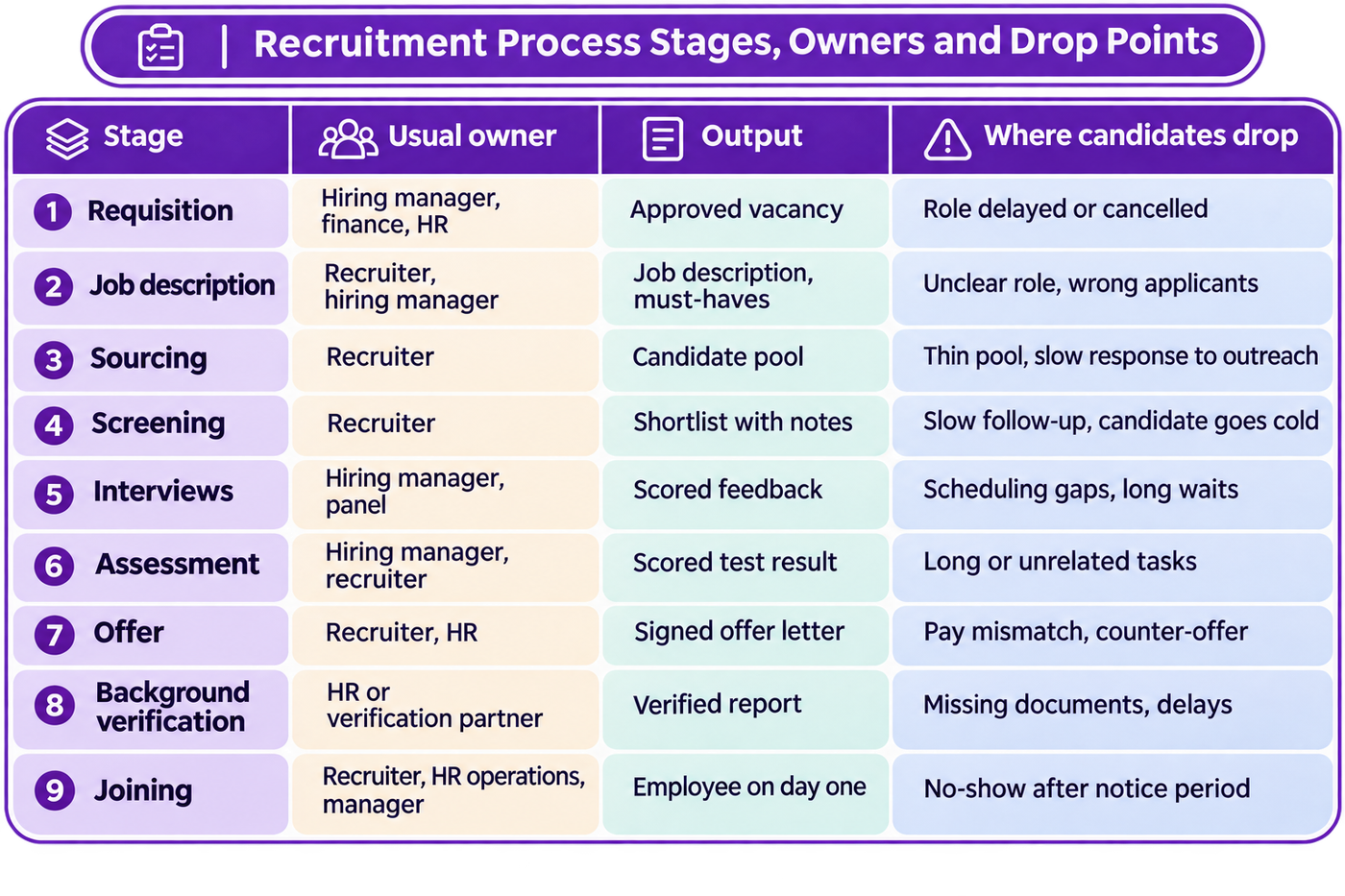
- 1. Requisition. Usual owner: Hiring manager, finance, HR; Output: Approved vacancy; Where candidates drop: Role delayed or cancelled.
- 2. Job description. Usual owner: Recruiter, hiring manager; Output: Job description, must-haves; Where candidates drop: Unclear role, wrong applicants.
- 3. Sourcing. Usual owner: Recruiter; Output: Candidate pool; Where candidates drop: Thin pool, slow response to outreach.
- 4. Screening. Usual owner: Recruiter; Output: Shortlist with notes; Where candidates drop: Slow follow-up, candidate goes cold.
- 5. Interviews. Usual owner: Hiring manager, panel; Output: Scored feedback; Where candidates drop: Scheduling gaps, long waits.
- 6. Assessment. Usual owner: Hiring manager, recruiter; Output: Scored test result; Where candidates drop: Long or unrelated tasks.
- 7. Offer. Usual owner: Recruiter, HR; Output: Signed offer letter; Where candidates drop: Pay mismatch, counter-offer.
- 8. Background verification. Usual owner: HR or verification partner; Output: Verified report; Where candidates drop: Missing documents, delays.
- 9. Joining. Usual owner: Recruiter, HR operations, manager; Output: Employee on day one; Where candidates drop: No-show after notice period.
Candidates are lost at every row, so review the whole table, not just interviews.
How Does the Process Change for Volume, Lateral and Leadership Hiring?
The stages stay the same, but the weight shifts. Choose the version that fits the role.
- Volume hiring (BPO, retail, logistics): sourcing and screening carry the load. Speed and language matter most, and assessments are short.
- Lateral hiring (mid-level professionals): interviews, offer negotiation and notice period matter most. Candidates usually hold other offers.
- Leadership hiring: requisition, intake and references take the time. Searches are small, personal and slow, and background checks are deeper.
One template rarely fits all three. Keep one core flow and change the stage rules by role family.
Take a worked example with stated assumptions. A retail chain needs 50 store associates in one city. Screening and a short interview happen on the same day, there is no assessment, and verification runs while the candidate completes joining forms. The whole flow is built for speed, because candidates for these roles often hold several offers at once.
Now take a lateral hire, such as a senior accountant. Here the recruiter spends the effort on a structured interview, a pay conversation and weekly contact through a long notice period. Same nine stages, different weight.
What Is Different About the Recruitment Process in India?
Four features of Indian hiring shape the late stages.
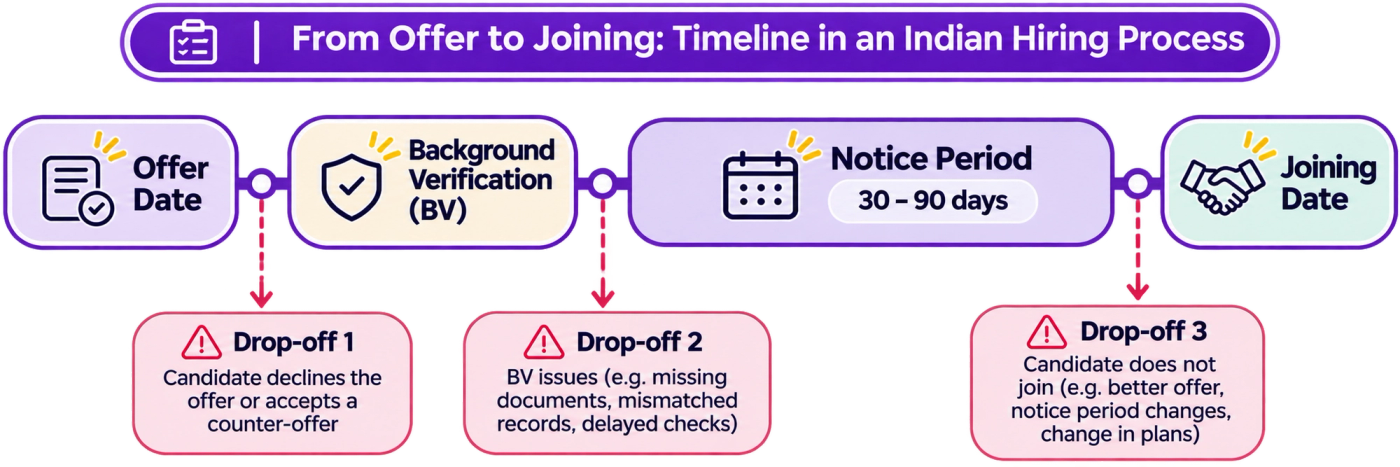
First, notice periods. Resignation notice of 30, 60 or 90 days is common, so a candidate may join months after the offer. HireBound's guide to the notice period in India explains buyout and negotiation.
Second, written terms. The Press Information Bureau reported on 21 November 2025 that the four Labour Codes took effect, including mandatory appointment letters for all workers. Rules under the codes were still settling at the time of writing, so confirm current requirements with your HR or legal team. This is general information, not legal advice.
Third, background verification. It adds days before joining and needs candidate consent.
Fourth, language. Many frontline and regional candidates are more comfortable in Hindi, Tamil or another local language than in English, so screening in their language often keeps them engaged.
What Should You Measure at Each Stage?
Measure conversion between stages first, then time at each stage. Three metrics cover most teams.
- Time to hire: days from application or approval to offer acceptance, depending on your definition. Write the definition down so numbers stay comparable.
- Stage conversion: the share of candidates who move from one stage to the next.
- Offer acceptance and joining rate: the share of offers accepted, and of acceptances that actually join.
HireBound's time-to-hire benchmarks guide covers definitions. The post on candidate drop-off shows where the losses happen.
Set a time limit for every handoff, and name who is responsible for it. As an illustration, a team might agree that a screened candidate hears back within one working day, that interview feedback is logged within a day of each interview, and that an offer goes out within two days of the final round. These are example targets, not benchmarks. Pick numbers your team can actually meet, then track misses.
Below is an illustrative funnel for one opening, with invented numbers to show the arithmetic. It is not a benchmark.
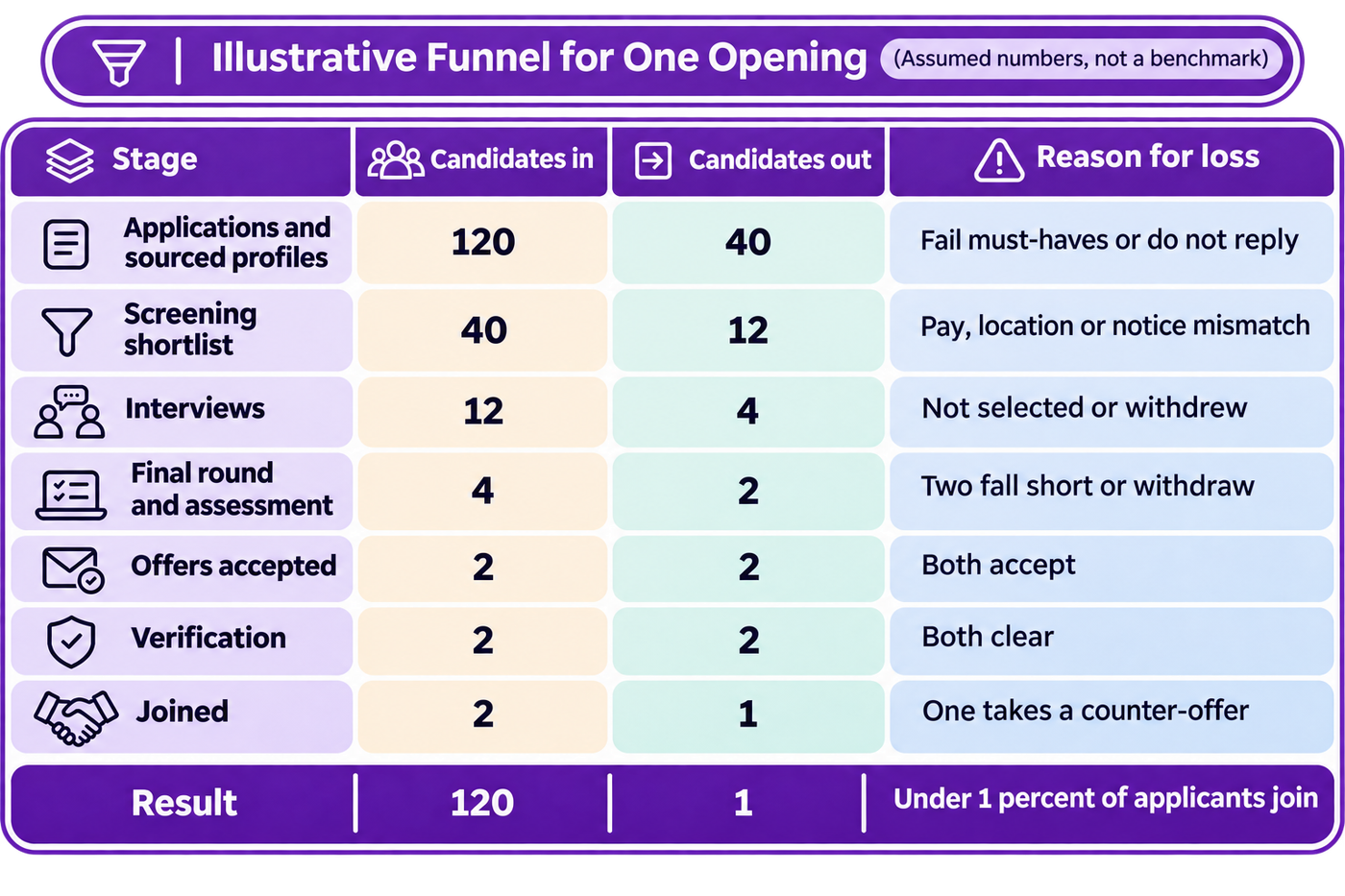
- Applications and sourced profiles. Candidates in: 120; Candidates out: 40; Reason for loss: Fail must-haves or do not reply.
- Screening shortlist. Candidates in: 40; Candidates out: 12; Reason for loss: Pay, location or notice mismatch.
- Interviews. Candidates in: 12; Candidates out: 4; Reason for loss: Not selected or withdrew.
- Final round and assessment. Candidates in: 4; Candidates out: 2; Reason for loss: Two fall short or withdraw.
- Offers accepted. Candidates in: 2; Candidates out: 2; Reason for loss: Both accept.
- Verification. Candidates in: 2; Candidates out: 2; Reason for loss: Both clear.
- Joined. Candidates in: 2; Candidates out: 1; Reason for loss: One takes a counter-offer.
- Result. Candidates in: 120; Candidates out: 1; Reason for loss: Under 1 percent of applicants join.
Here, one of the two accepted offers fell away after acceptance. That loss sits after the stages most teams track, so a joining-rate metric catches it.
What Can You Automate and What Should Stay Human?
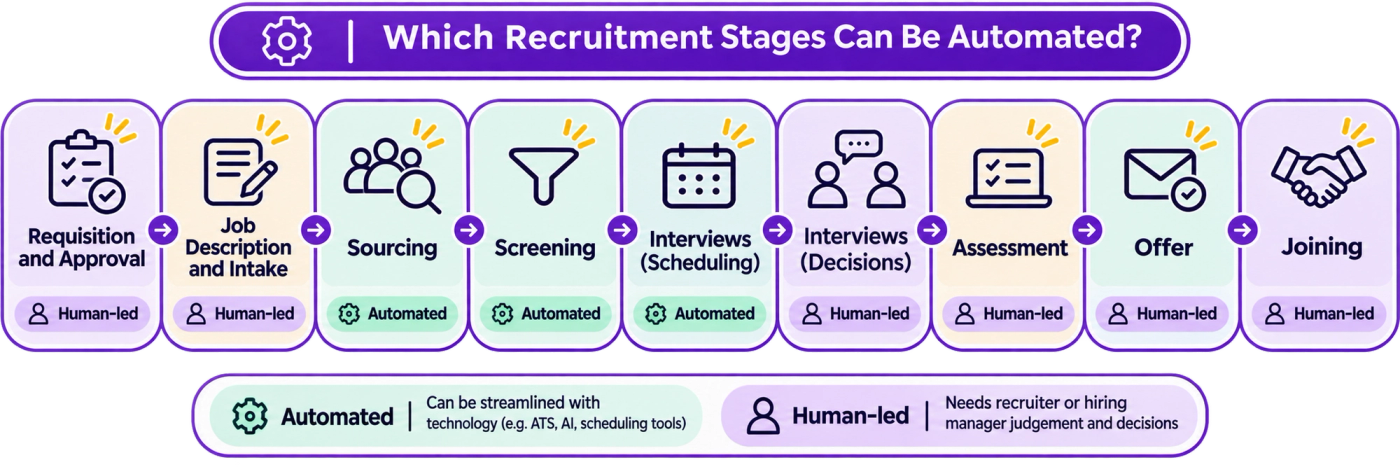
Automate the repeatable work: sourcing searches, first-round questions, reminders, scheduling and status updates. Keep judgement with people: deciding who to shortlist, who to hire, what to offer and how to handle a counter-offer.
Automation helps most where candidates wait. The usual waits are a reply after screening, an interview slot and contact during the notice period. It helps least where conversation decides the outcome, such as senior offers.
A faster process that screens badly only delivers poor shortlists sooner, so review samples of automated screening regularly.
Where Does HireBound Fit in the Recruitment Process?
HireBound is an agentic AI recruitment automation platform. Its agents map to stages 3, 4 and 5: sourcing, screening and scheduling. HireBound has powered 8 million+ candidate conversations on WhatsApp, Voice, SMS and email.
In India, HireBound's data shows a 64% WhatsApp response rate against about 12% for email. That matters for screening and for staying in touch during a notice period. Voice AI screens in 14 Indian languages, and recruiters using HireBound handle 3× more candidates per day than with a manual process.
For corporate teams, the permanent hiring platform page shows how this fits in-house hiring. A human reviews the shortlist, and recruiters own every offer and hiring decision. HireBound does not guarantee hiring outcomes or joining dates.
Want to see how this works across your hiring stages? Talk to the HireBound team.
Recruitment Process Checklist
Use this list to audit your own process. Each "no" marks a place candidates are likely leaking.
- Does every requisition have an approved budget and an owner before sourcing starts?
- Does the job description list must-haves that screening can test?
- Do you use more than one sourcing channel?
- Do screened candidates get a reply within a day or two?
- Does every interviewer score against the same criteria?
- Is each assessment short and tied to the job?
- Does the offer letter state pay, joining date and notice terms in writing?
- Do you collect consent and documents for verification early?
- Does someone contact candidates every week or two during notice?
Start with the stage where you lose the most candidates. Fix one handoff, measure it for a month, and move to the next.


