Types of Recruitment Process: Methods and When to Use Each
 Suvam Moitra
 ·Nov 6, 2026·7 min read

Key Takeaways
- 1Recruitment comes in two types, internal and external, and external hiring uses three method families: direct, indirect and third-party.
- 2India's Labour Codes took effect on 21 November 2025, per the Press Information Bureau, and make appointment letters mandatory, which affects contract and fixed-term hiring.
- 3Match the method to the role: referrals and internal moves suit known profiles, campus and walk-in drives suit volume, and agencies or RPO suit scarce skills.
- 4Past applicants are an underused internal pool; HireBound has powered 8 million+ candidate conversations, and a recruiter still reviews every shortlist.
The types of recruitment process are internal recruitment, where a vacancy is filled from people already in the organisation, and external recruitment, where it is filled from outside. External hiring uses direct, indirect or third-party methods. The right choice depends on the role, the volume and the time you have.
Most guides list methods without saying when each one fails. This guide covers both, with examples from Indian hiring. To see how HireBound supports external sourcing, explore the HireBound platform.
What Are the Main Types of Recruitment Process?
Recruitment is the work of attracting and identifying candidates for a vacancy. Selection, the step after it, is choosing among them. The two get mixed up, but recruitment ends when you have a qualified pool.
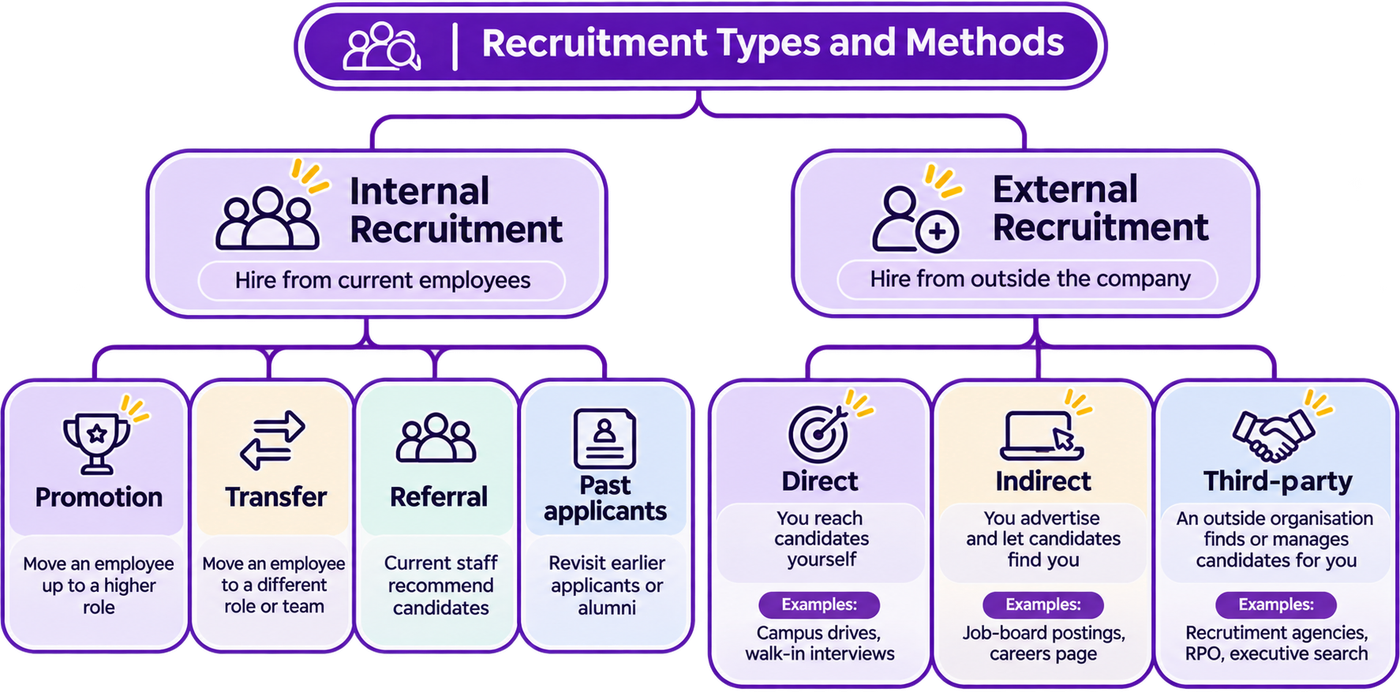
There are two types. Internal recruitment fills a role from current employees, through promotion, transfer or an internal job post. External recruitment brings in people from outside the company.
Recruitment process methods sit under the types. A method is the route you use to reach candidates, such as a referral, a campus drive or an agency. One type can use many methods.
Internal vs External Recruitment: How Do They Compare?
Internal hiring is faster and carries less risk because you already know the person. External hiring brings new skills and fresh views but takes longer. The table compares them on the points that usually decide the choice.
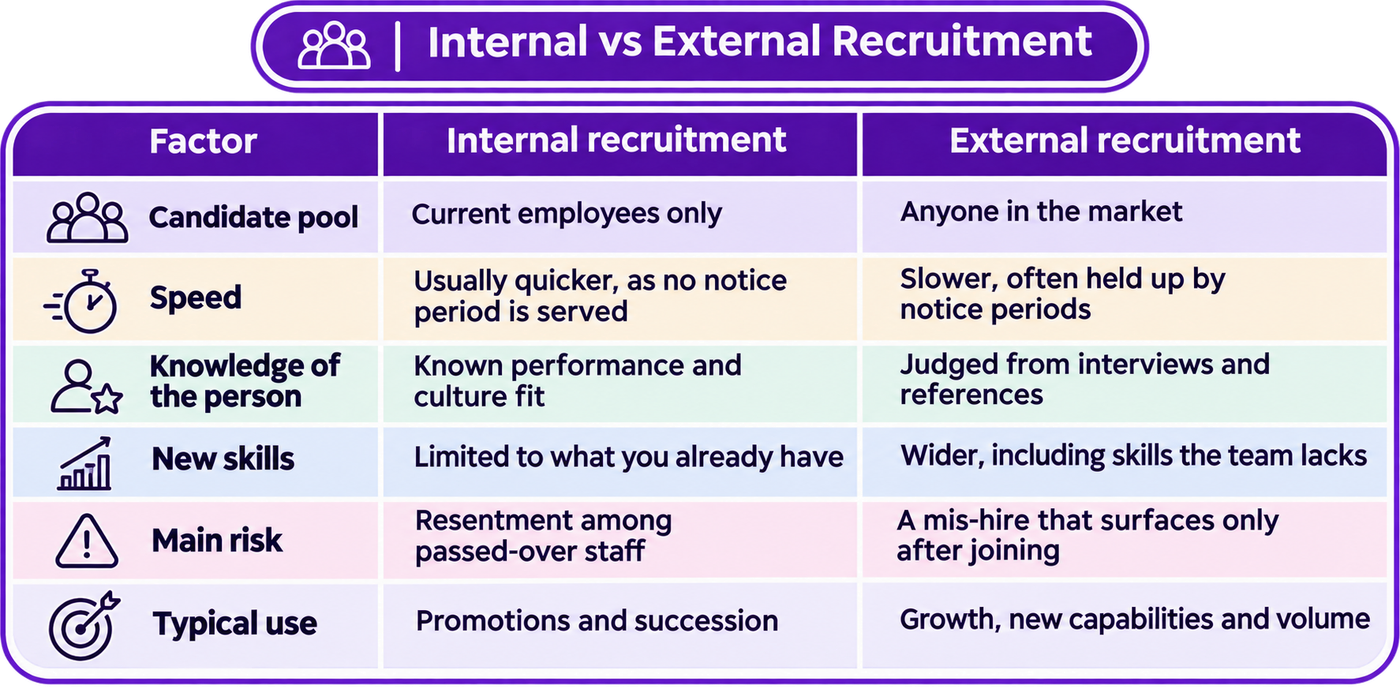
- Candidate pool. Internal recruitment: Current employees only; External recruitment: Anyone in the market.
- Speed. Internal recruitment: Usually quicker, as no notice period is served; External recruitment: Slower, often held up by notice periods.
- Knowledge of the person. Internal recruitment: Known performance and culture fit; External recruitment: Judged from interviews and references.
- New skills. Internal recruitment: Limited to what you already have; External recruitment: Wider, including skills the team lacks.
- Main risk. Internal recruitment: Resentment among passed-over staff; External recruitment: A mis-hire that surfaces only after joining.
- Typical use. Internal recruitment: Promotions and succession; External recruitment: Growth, new capabilities and volume.
Neither type is better in general. Ask first whether the skill exists inside the company at all. HireBound's guide to internal mobility vs external hiring goes deeper on that trade-off.
What Are the Internal Methods of Recruitment?
Internal methods draw on people and records you already hold. They cost little and show staff a path to grow, but the pool is small.
- Promotions and transfers: move an employee up or sideways into the open role.
- Internal job posting: announce the vacancy to staff and let them apply.
- Employee referrals: current staff recommend people they know. Strictly, the candidate is external, but the route is internal, so many teams treat it here. See HireBound's guide to employee referral programs.
- Past applicants and alumni: earlier applicants, silver medallists and former employees who left on good terms.
Past applicants are an easy source to overlook. A resume database that nobody searches is a pool you already paid to build.
What Are the External Methods of Recruitment?
External methods split into direct, indirect and third-party. Direct means you reach candidates yourself. Indirect means you advertise and let them find you. Third-party means someone else runs the search, covered in the next section.
Direct methods
You contact the candidate or meet them in person. Examples include campus drives, walk-in interviews, job fairs and proactive sourcing, where a recruiter approaches people who have not applied. Direct methods give control over who you reach, but they need recruiter time.
Indirect methods
You publish a vacancy and wait for responses. Examples are job-board postings, your careers page, social media posts and print or newspaper ads. They reach many people cheaply, although many applicants are a poor fit and screening takes time.
E-recruitment
E-recruitment is hiring through digital channels: job boards, career sites, social platforms, messaging apps and applicant tracking systems. In India, the government runs its own: the National Career Service portal, an initiative of the Ministry of Labour and Employment that offers job matching and lets employers register. According to the portal, its services are free of charge. For tactics by channel, see HireBound's guide to candidate sourcing channels.
What Is Third-Party Recruitment?
Third-party recruitment means an outside organisation finds or manages candidates for you. It suits roles where you lack the reach, the time or the specialist knowledge.
- Recruitment agencies: search for a role and usually charge a fee on placement. They suit senior or niche hires.
- Executive search firms: approach senior leaders who are not looking, often on a retained basis.
- Recruitment process outsourcing (RPO): a provider runs all or part of your recruiting function. HireBound's comparison of RPO vs in-house recruiting sets out when that pays off.
- Freelance and contract recruiters: used for short bursts, such as a single hiring drive.
Third-party routes trade control for capacity. You gain reach and capacity, but you depend on the partner's quality and on how well they understand your culture.
Which Recruitment Methods Are Used in India?
Several methods are especially common in Indian hiring, particularly for volume roles.
- Campus hiring: recruiters visit colleges and technical institutes for freshers, often months before graduation.
- Walk-in drives: candidates arrive on a set day for same-day screening, often used for BPO, retail and logistics roles.
- Referrals: widely used, particularly for frontline and technical roles.
- Job boards and WhatsApp: boards for reach, and WhatsApp for follow-up, since many candidates already use it.
- Contract and fixed-term staffing: staffing firms supply workers on a fixed duration or project.
The legal side changed recently. The Press Information Bureau reported on 21 November 2025 that the four Labour Codes took effect. It lists mandatory appointment letters for all workers. For fixed-term employees, it lists benefits equal to permanent staff and gratuity after one year. It says the principal employer provides health and social security benefits to contract workers. Confirm how these apply to your establishment before choosing a contract route. This is general information, not legal advice.
How Do You Choose a Recruitment Method?
Start from the role. Three questions narrow it quickly: how many people you need, how scarce the skill is, and how soon the role must be filled. The table maps common scenarios to a first choice. These pairings are illustrative guidance, not benchmarks.
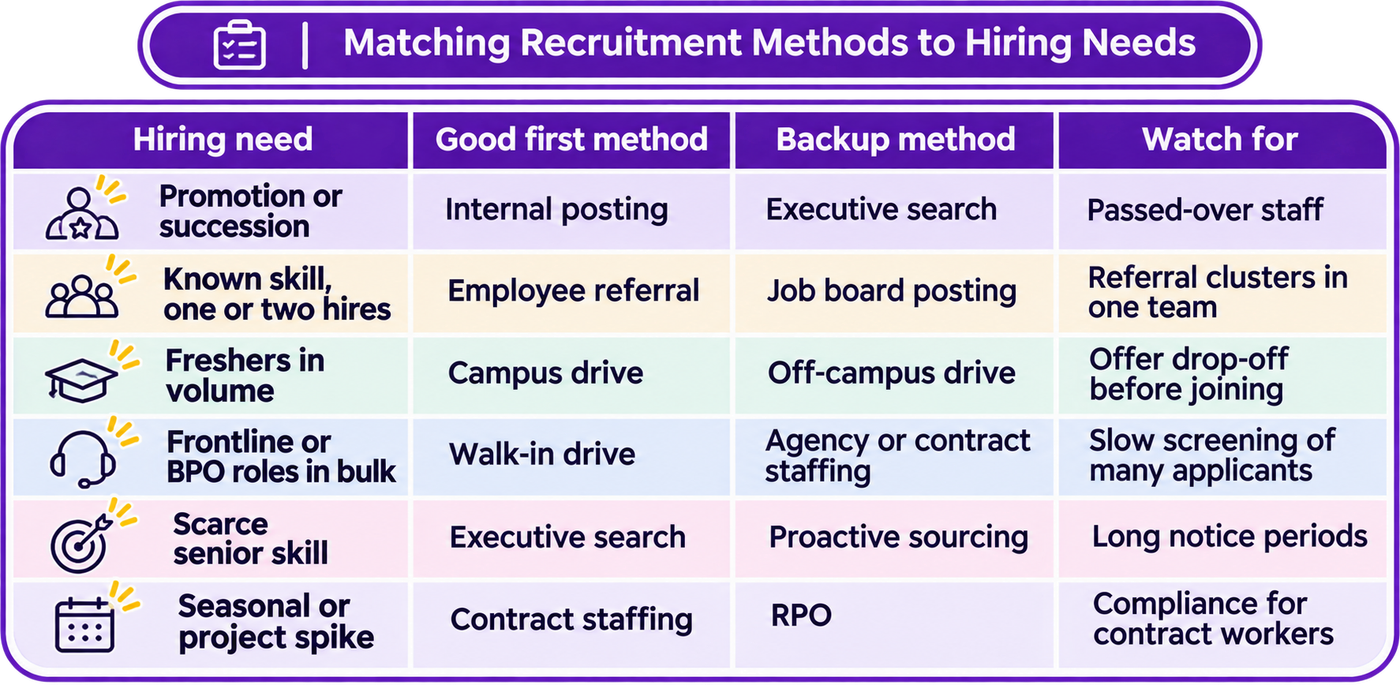
- Promotion or succession. Good first method: Internal posting; Backup method: Executive search; Watch for: Passed-over staff.
- Known skill, one or two hires. Good first method: Employee referral; Backup method: Job board posting; Watch for: Referral clusters in one team.
- Freshers in volume. Good first method: Campus drive; Backup method: Off-campus drive; Watch for: Offer drop-off before joining.
- Frontline or BPO roles in bulk. Good first method: Walk-in drive; Backup method: Agency or contract staffing; Watch for: Slow screening of many applicants.
- Scarce senior skill. Good first method: Executive search; Backup method: Proactive sourcing; Watch for: Long notice periods.
- Seasonal or project spike. Good first method: Contract staffing; Backup method: RPO; Watch for: Compliance for contract workers.
Teams often mix methods. One pattern is to check internal candidates and past applicants first, then open the role externally, and call an agency only if the pool stays thin after a few weeks.
When Does a Recruitment Method Fail?
Each method has a typical failure point.
- Internal hiring fails when the skill is not in the building. Promoting the nearest person then leaves a weak fit and an unfilled backfill.
- Referrals fail when networks are similar. You keep hiring the same profile and the pool narrows.
- Job ads fail for niche roles, where the right person is not searching.
- Campus drives fail when offers wait too long, and candidates accept elsewhere.
- Agencies fail when the brief is vague, so you receive profiles that do not match.
A clear role definition, agreed with the hiring manager before sourcing starts, improves every method.
How Does HireBound Fit Into These Methods?
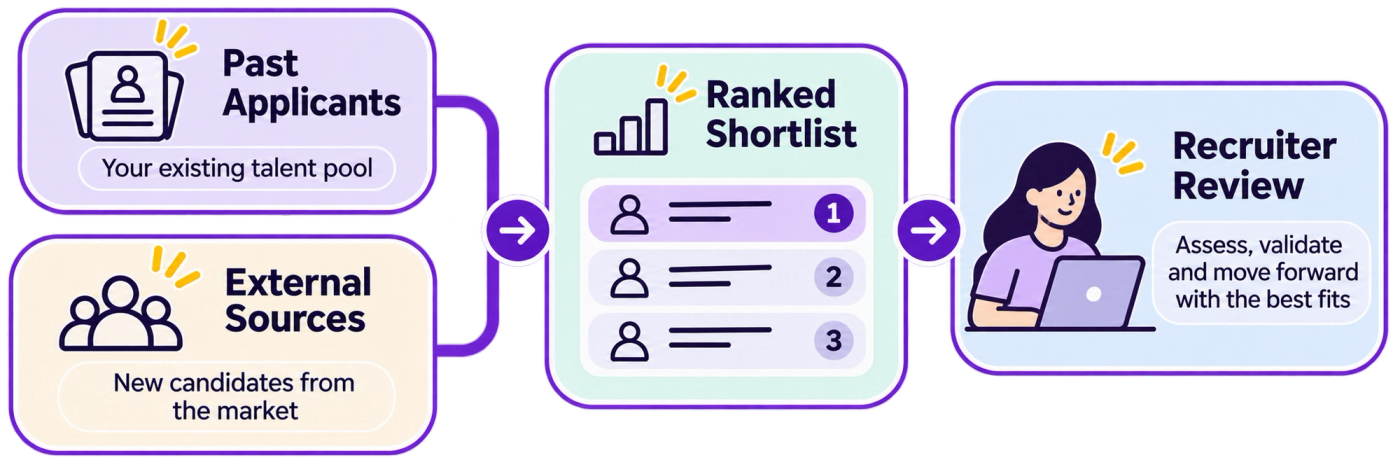
HireBound supports the external and rediscovery side, where the manual work piles up. Its AI Discovery turns a role brief into a ranked shortlist and can resurface past applicants in your own database before you search outside.
HireBound has powered 8 million+ candidate conversations. In India, its data shows a 64% WhatsApp response rate against about 12% for email. Voice AI screens candidates in 14 Indian languages, and recruiters using it handle 3× more candidates per day than with a manual process.
A human reviews the shortlist, and recruiters own the interviews, offers and final decisions. HireBound does not pick the method for you or guarantee a hire. It speeds up the sourcing and screening steps within whichever method you choose.
Unsure which method fits your next hiring drive? Talk to the HireBound team.
A Simple Rule for Choosing Your First Method
Check inside first, then go outside. If an internal candidate or a past applicant can do the job, hire from there. If not, pick the external method that matches your volume and the scarcity of the skill, and add a third party only when the pool stays thin.


