How to Build a Talent Acquisition Strategy That Holds Up
 Tanmey Goswami
 ·Nov 10, 2026·10 min read

Key Takeaways
- 1A talent acquisition strategy connects a 12-month workforce plan to role priorities, a sourcing mix, a hiring process, five or six metrics and a quarterly review.
- 2ManpowerGroup's 2026 survey found 82% of employers in India struggle to find the skilled talent they need, so plans that rely on job posts alone fall short.
- 3In India, open searches for mid-level and senior roles 90 to 120 days before the start date, because notice periods of 60 to 90 days are common.
- 4SHRM's 2026 benchmarking puts median time-to-fill at 39 days for nonexecutive roles, yet SHRM's 2025 data shows only 20% of organisations measure quality of hire.
- 5Sort roles into three tiers by business impact and scarcity, and give every Tier 1 role a warm pipeline before the requisition opens.
A talent acquisition strategy is a written plan for how a company will find, attract and hire the people it needs over the next 12 to 24 months. It links business goals to a workforce plan and ranks roles by priority. It also sets the sourcing mix and process, and names the metrics the team reviews each quarter.
Most teams already have recruiting habits. Few have a plan that survives a hiring freeze, a sudden growth target or the loss of a key recruiter. This guide walks through seven steps, then gives you a fill-in template and a worked example you can adapt.
Talent is hard to find. ManpowerGroup's 2026 Global Talent Shortage Survey found that 82% of employers in India are struggling to find the skilled talent they need. If your team runs high-volume or multi-channel hiring, see how HireBound's AI recruiting platform handles sourcing, screening and scheduling.
What Is a Talent Acquisition Strategy?
A talent acquisition strategy is the long-range plan behind your hiring. Recruiting strategies are the tactics you use to fill a role that is open today: a job post, a referral push, a search on a job board. The strategy decides which roles matter most, where those people come from and how you will know the plan is working.
It has three layers. The top layer is the workforce plan, which says how many people the business needs and when. The middle layer is the set of hiring and recruiting strategies for each role family.
The bottom layer is the process, tools and metrics that make the work repeatable.
The seven steps below follow that order. You can run them in a two-day planning session for a team of up to 50 hires a year, or over a month for a larger organisation.
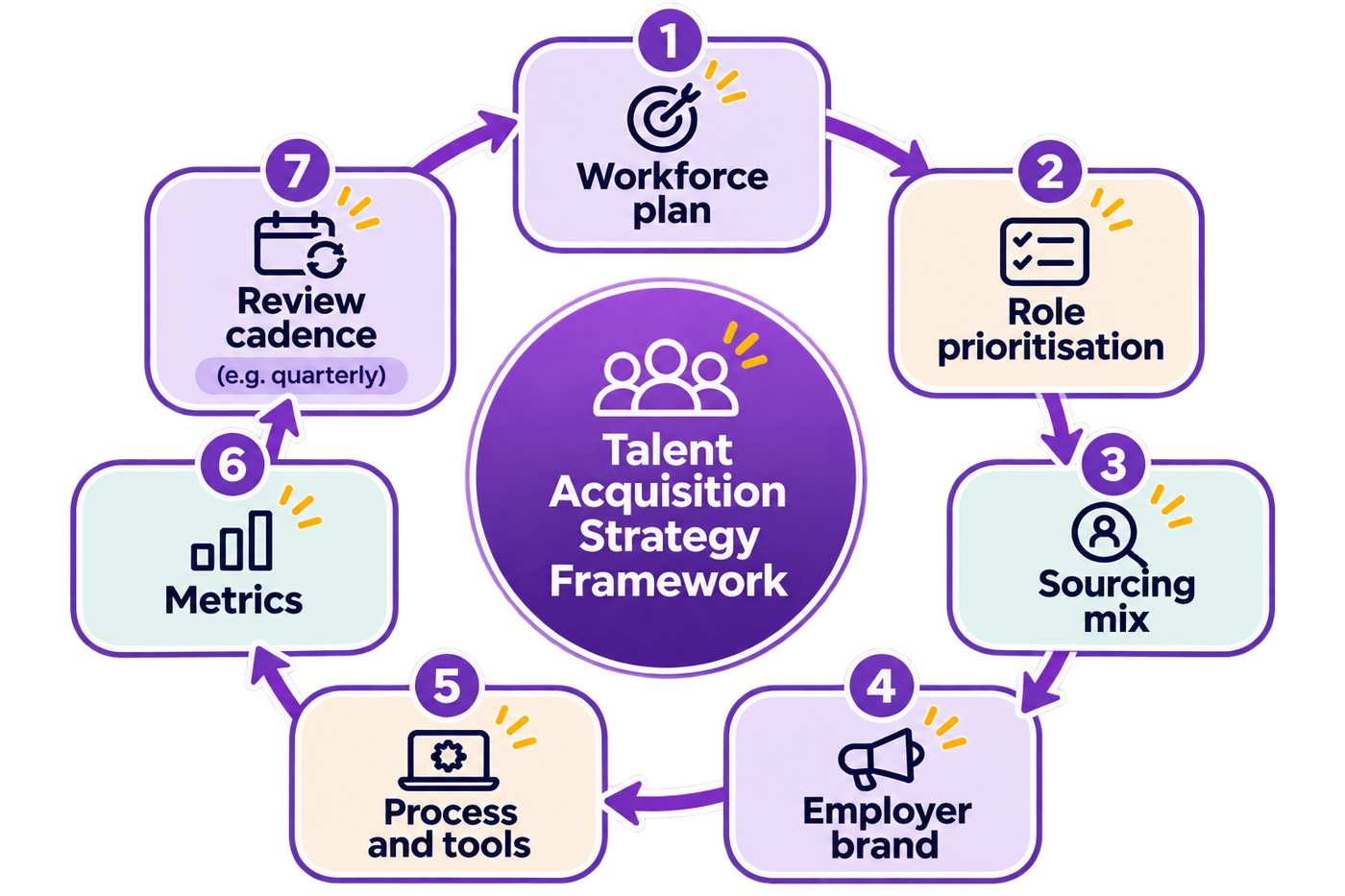
The loop matters because a strategy that is never reviewed turns back into a set of habits.
Why Do Most Hiring and Recruiting Strategies Break Down?
Most hiring and recruiting strategies fail for one of four reasons. First, the plan starts from open requisitions instead of business goals.
Second, every role gets the same process, whether it is a sales hire or a principal engineer. Third, sourcing depends on one channel. Fourth, nobody looks at the results until something goes wrong.
The skills gap makes each of these worse. The World Economic Forum's Future of Jobs Report 2025 surveyed more than 1,000 employers. It found that 63% see skills gaps as the main barrier to transforming their business. The same report expects nearly 40% of the skills used on the job to change by 2030.
Hiring takes time as well. SHRM's 2026 Recruiting Executives Benchmarking, which covers more than 4,600 organisations, puts the median time-to-fill for nonexecutive roles at 39 days. That is more than five weeks with a seat empty, before any notice period starts.
Step 1: Start With a 12-Month Workforce Plan
The workforce plan answers one question: how many people, in which roles, by when? Start with the business plan, not last year's requisitions. Ask each department head for three things: planned new roles, expected attrition and skills the team lacks today.
Build the plan by quarter. For each role, record the target start date, the location, the level and whether the role is new or a backfill. Add an expected attrition line for large teams, because replacements often outnumber new roles.
Then check which roles can be filled from inside. SHRM's 2025 benchmarking found that only 7% of US nonexecutive positions were filled internally, which leaves most companies relying on the external market. Our guide to internal mobility vs external hiring explains when promoting from within is the better route.
Plan Around India's Notice Periods
In India, the start date in your plan is rarely the date a search can begin. Notice periods of 60 to 90 days are common for mid-level and senior roles, especially in IT and services. A role you need filled by 1 July often has to be offered by early April.
Work back from the start date. Add the notice period, two to four weeks for interviews and offer, and two to three weeks for sourcing. That puts the search start 90 to 120 days ahead for most experienced roles.
Plan for drop-off too. Long notice periods leave time for counter-offers and competing offers. Many Indian teams keep a backup candidate warm until the joining date, and some offer a buy-out of part of the notice period for priority roles.
Step 2: Prioritise Roles by Business Impact and Scarcity
Not every role deserves the same effort. Score each role in the workforce plan on two factors: business impact if the seat stays empty, and how scarce the skills are in your market. Use a simple 1 to 3 scale for each.
The scores sort roles into three tiers. Each tier gets a different sourcing approach, owner and time budget.
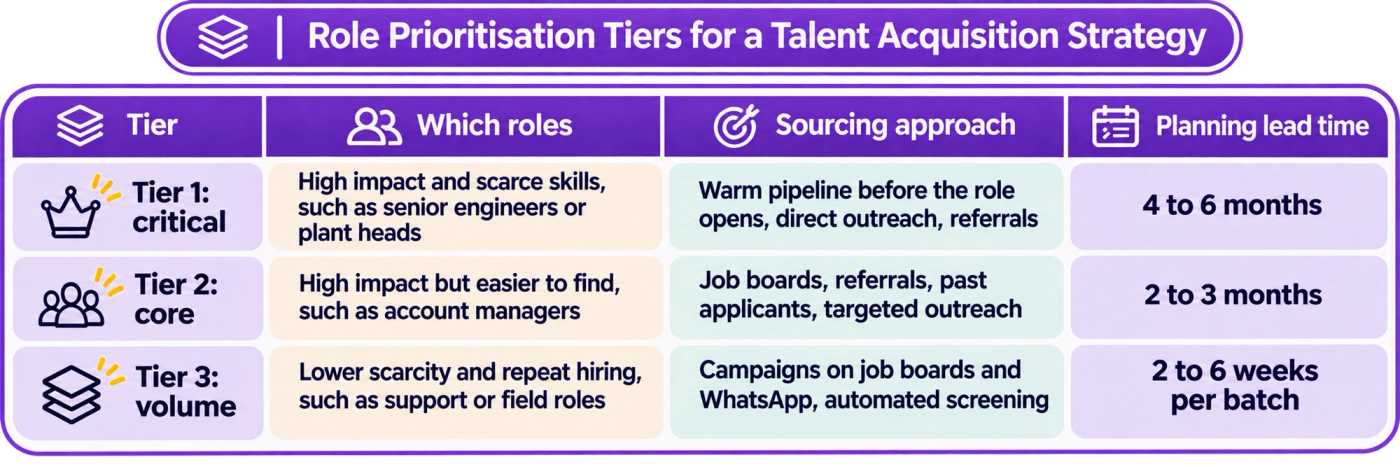
Tier 1 is usually the shortest list but takes most of the senior recruiters' time. That trade works as long as Tier 3 runs on a repeatable process.
Step 3: Set the Sourcing Mix
The sourcing mix is the share of hires you expect from each channel. Typical channels are internal moves, employee referrals, past applicants, job boards, direct outreach, campus hiring and agencies. Set a target share for each tier, not one mix for the whole company.
Start with the cheapest channel you already own: your existing candidate database. Past applicants who reached a final round are often worth a call before any new search. Then add referrals, which tend to suit Tier 1 and Tier 2 roles.
For Tier 1 roles, build the pipeline early. Our guide on how to build a talent pipeline covers how to find and keep in touch with people before a role exists.
For Tier 3, reach candidates where they already are. In India, that usually means job boards and WhatsApp.
Step 4: Make the Employer Brand Specific to Each Role Family
Employer brand in a talent acquisition strategy is narrower than a careers page. It is the short list of reasons a specific candidate group would choose you. A backend engineer and a delivery associate care about different things.
For each role family, write down three facts candidates care about. These might be the tech stack, the shift pattern, the learning budget, the commute, or the growth path. Stick to facts a candidate can check.
Put those facts where candidates will see them: the job description, the first outreach message and the screening call. Ask recent hires what made them accept. Their answers are better material than anything written in a workshop.
Step 5: Design the Process and Pick the Tools
Map the hiring process for each tier, from intake to joining. Write down every stage, who owns it and the target time between stages. A Tier 3 process might have three stages, and a Tier 1 process six.
Make the screening criteria explicit before the role opens. Agree on the four to six skills that predict success and how each will be checked. Our guide to skills-based hiring shows how to test what someone can do beyond what their CV says.
Then choose tools that remove the slow steps. In most teams, the delays sit in screening calls, chasing replies and scheduling interviews. These are the steps worth automating first, while recruiters keep the intake meeting, final interviews and offer conversations.
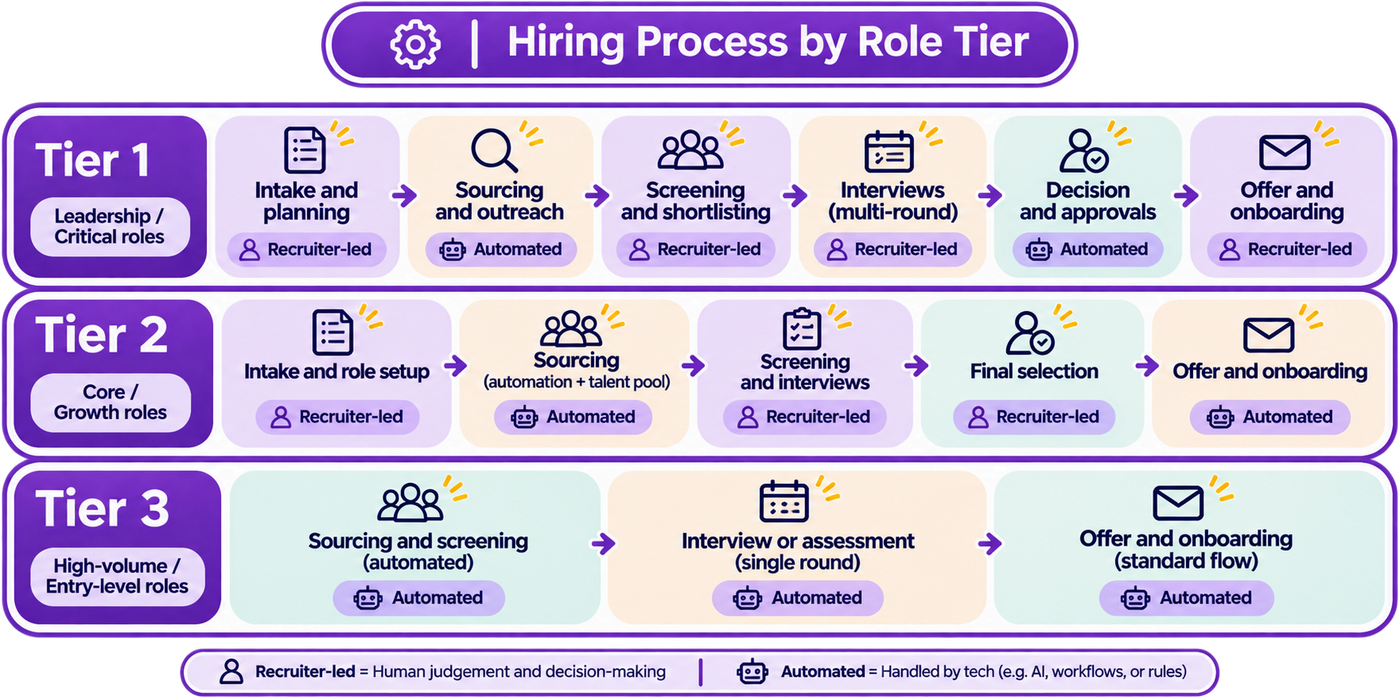
The lanes show why one process for every role wastes time on volume hiring and cuts corners on critical roles.
Step 6: Choose Five or Six Metrics You Will Review
Pick a small set of metrics and review them every month. A longer list tends to go unread. A practical starting set covers speed, quality, cost of effort and candidate response.
- Time-to-fill by tier, from requisition approval to offer accepted.
- Pipeline coverage for Tier 1 roles: qualified candidates in the pipeline per open role.
- Offer acceptance rate, and in India, offer-to-joining rate.
- Source of hire, compared with the target sourcing mix.
- Quality of hire, using 90-day performance ratings and first-year retention.
- Candidate response rate to first outreach, by channel.
Quality of hire is the one most teams skip. SHRM's 2025 benchmarking found that only 20% of organisations use quality-of-hire measures, down from 27% in 2022. Without it, a team can hit every speed target and still make poor hires.
Step 7: Set a Review Cadence
A talent acquisition strategy needs three review rhythms. Recruiters and hiring managers review open roles each week, and the talent team reviews the metrics each month. Leadership reviews the whole plan each quarter.
The quarterly review is where the strategy changes. Compare actual hires against the workforce plan, and check whether the sourcing mix matched the target. Move roles between tiers if the market has shifted.
Keep a short log of each change and the reason for it. After a year, that log tells you more about your hiring than any benchmark.
A Fill-In Talent Acquisition Strategy Template
Use this talent acquisition strategy template to put the seven steps on one page. Fill one row per step, and keep each entry to a sentence or two.
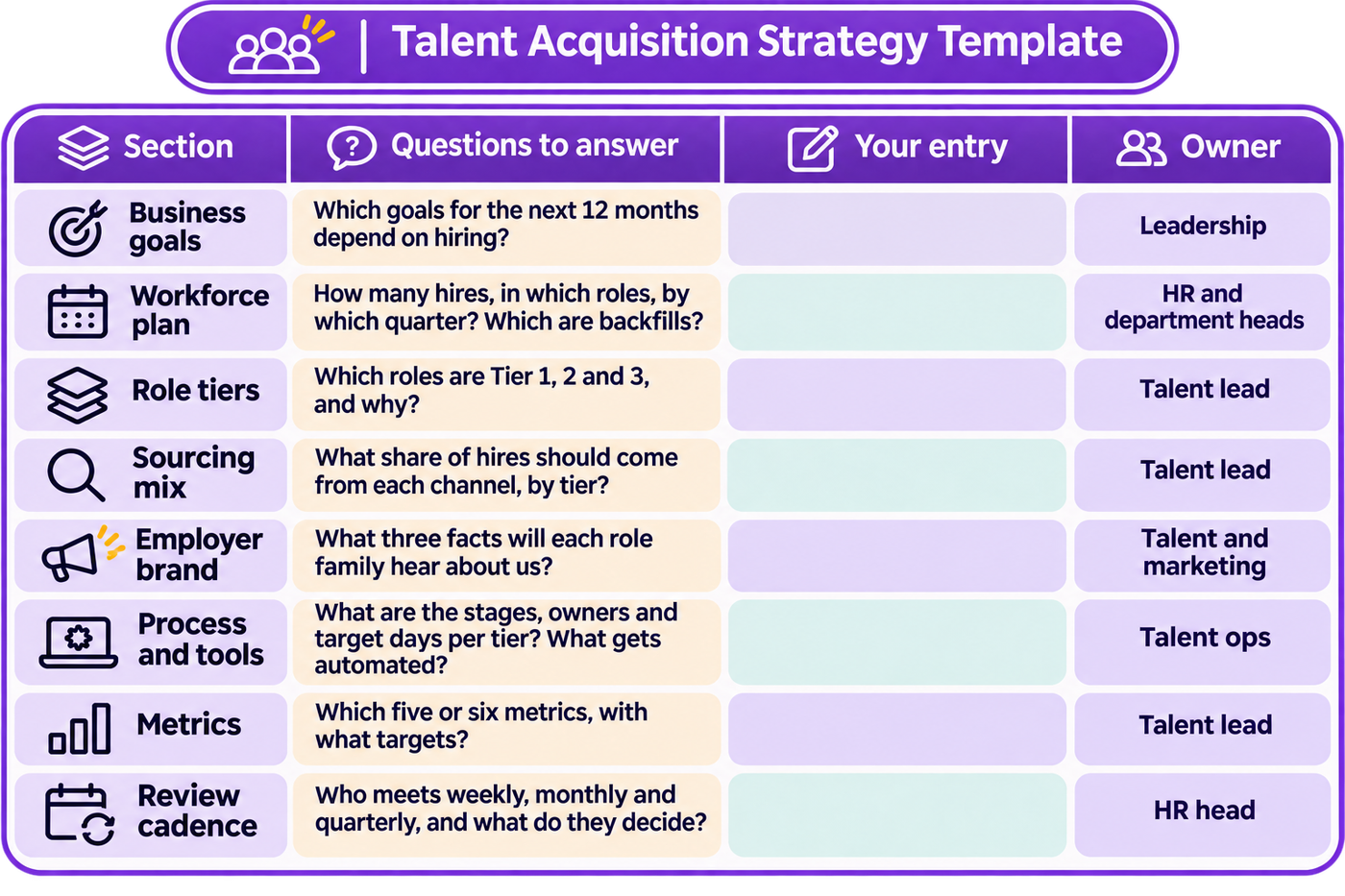
A blank row is a gap in the strategy. Fill it before the next quarterly review.
A Talent Acquisition Strategy Example
Here is a worked talent acquisition strategy example. The company and figures are illustrative assumptions, not a real customer. Assume a 300-person software company in Bengaluru that plans 60 hires over the next 12 months.
For the workforce plan, the 60 hires include 15 engineers, 20 customer support associates, 10 sales roles, 5 managers and 10 backfills for expected attrition. Most hiring falls in the first two quarters to support a product launch.
On role tiers, the five managers and four senior engineers are Tier 1. The other engineers and sales roles are Tier 2. The support associates are Tier 3, hired in two batches of ten.
For the sourcing mix, the team aims to fill two of the five manager roles internally. For Tier 1, it targets half of hires from referrals and direct outreach. Support associates come from job boards, WhatsApp campaigns and past applicants.
On timing, because senior engineers usually serve 60 to 90 days of notice, the team starts those searches in the quarter before the launch. Each Tier 1 role carries a backup candidate until the joining date.
Tier 3 runs a three-stage process: automated screening, one interview and an offer. The team tracks time-to-fill, offer-to-joining rate, source of hire and 90-day quality of hire. Leadership reviews the plan each quarter and moves two sales roles to Tier 1 after a slow first quarter.
Where HireBound Fits in a Talent Acquisition Strategy
HireBound covers the execution layer of the strategy: steps 3 and 5. Its AI agents handle sourcing, screening, scheduling and evaluation, so recruiters spend their time on intake, final interviews and closing. The Smart CRM works alongside an existing ATS, so the strategy does not need a new system of record.
For in-house teams, HireBound's recruitment software for permanent in-house hiring pairs these agents with human screening for priority roles.
For sourcing, HireBound searches across 500M+ profiles and can rediscover past applicants in your own pool before a new search starts. For Tier 3 volume roles, its agents screen candidates over WhatsApp, voice, SMS and email. Voice AI runs screening calls in 14 Indian languages.
Channel choice affects the response-rate metric in step 6. HireBound has powered 8 million+ candidate conversations, and in India it sees a 64% response rate on WhatsApp against about 12% for email. Recruiters using HireBound handle 3× more candidates per day than with a manual process.
Want to see how this would work for your hiring plan? Book a demo with HireBound
Putting Your Talent Acquisition Strategy to Work
Start small. Run steps 1 and 2 this month, even if the rest of the plan is rough. A ranked list of roles with realistic start dates already changes how a team spends its week.
Then fill the template one row at a time. Set the metrics before the next quarter starts, so the first quarterly review has data to look at. Each review that changes the plan, and records why, makes the next quarter easier to staff.


