Best Interview Scheduling Tools for Recruiters
 Tanmey Goswami
 ·Nov 13, 2026·12 min read

Key Takeaways
- 1The best interview scheduling tool removes the slowest handoff in your process. For panel-heavy teams that is interviewer coordination. For volume teams it is getting the candidate to reply.
- 2Cronofy's 2024 survey of 12,000 candidates found 42% had left a hiring process because scheduling took too long.
- 3Interview scheduling tools fall into four types: booking links, coordinator platforms, conversational assistants and agents that book during screening. Pick the type before the vendor.
- 4HireBound data shows a 64% WhatsApp response rate in India against about 12% for email, so the channel a tool books on matters as much as its calendar logic.
- 5Test any tool on one live role for two weeks and track hours from shortlist to confirmed slot, reschedules handled without a recruiter, and no-show rate.
Interview scheduling tools are software that book interviews between candidates and interviewers without the email back-and-forth. They read calendars, offer open slots, confirm a time, send reminders and handle reschedules. The best one for your team is the one that removes your slowest handoff.
This guide compares seven options: Calendly, GoodTime, Cronofy, ModernLoop, Paradox, the schedulers built into applicant tracking systems, and HireBound. The order is not a ranking.
HireBound is one of the options compared. Details for the others come from each vendor's own website, checked on 13 November 2026, and are attributed to the vendor.
Want interviews booked while candidates are still in the screening conversation? See how HireBound works →
The diagram below groups the seven by how each one books an interview.
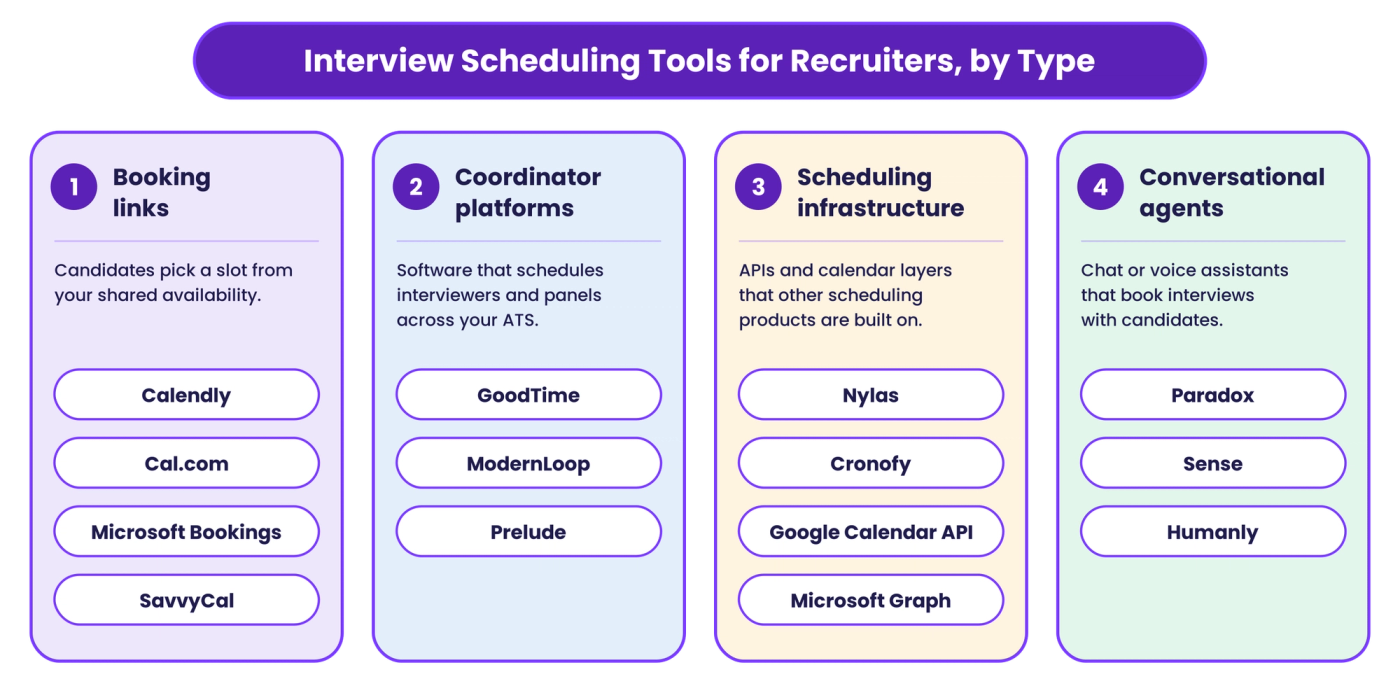
Find the type that matches your bottleneck first, then compare vendors inside it.
What Do Interview Scheduling Tools Do?
Every interview scheduling tool does three jobs. It finds time that works for the interviewers, gets the candidate to agree to one slot, and keeps that slot alive until the interview happens.
Tools differ in which of those jobs they automate. They fall into four types:
- Booking links. The recruiter sends a link, and the candidate picks a slot from live calendar availability. This works well when candidates check email and act on it.
- Coordinator platforms. These handle the interviewer side: multi-person panels, interviewer load, training rules and rescheduling inside an enterprise applicant tracking system.
- Scheduling infrastructure. Calendar sync and booking logic that other recruiting products build into their own screens.
- Conversational assistants and agents. These start the conversation, read the candidate's reply in plain language, and book the slot over text, WhatsApp, chat or voice.
The first three types wait for the candidate or a coordinator to act, while the fourth reaches out and follows up. Our guide to AI interview scheduling walks through the seven steps an agent runs, from reading calendars to recovering no-shows.
Why Does Interview Scheduling Speed Matter?
Slow scheduling costs you candidates. In Cronofy's Candidate Expectations Report 2024, a survey of 12,000 candidates in seven countries, 42% said they had left a hiring process because an interview took too long to schedule.
The same report found that 48% would be less likely to recommend or engage with an employer whose scheduling was not up to par. It also found that 57% would prefer an automated system that books interviews over long back-and-forth messages.
The survey did not cover India, so treat it as general evidence.
Scheduling also sits inside a longer clock. SHRM's 2026 recruiting benchmarking data, drawn from more than 4,600 organisations, puts the median time-to-fill for nonexecutive roles at 39 calendar days. Every day a shortlisted candidate waits for a slot is a day on that clock.
Before you look at vendors, measure the hours between "shortlisted" and "interview confirmed" for twenty recent candidates. That number shows how much time a tool can save you.
How We Chose the Criteria for This Comparison
We picked criteria that describe a recruiter's scheduling week, with extra weight on volume hiring and on hiring in India. Vendor claims come from each vendor's homepage, product pages or help centre, accessed on 13 November 2026.
These are the seven criteria:
- Who starts the booking. Does the candidate have to click a link, or does the tool reach out and follow up?
- Candidate channels. Which of email, SMS, WhatsApp, chat and voice does the vendor list for scheduling messages?
- Panel and interviewer handling. Can it book several interviewers at once and spread the load fairly?
- Reschedules and reminders. Can candidates and interviewers move a slot without a recruiter stepping in?
- Calendar and ATS fit. Which calendars and applicant tracking systems does it connect to?
- Volume. How does it cope with hundreds of candidates for one role in the same week?
- India fit. Regional languages, WhatsApp and phone as booking channels, and consent records.
Weight the list to your hiring: panel handling first for four-round tech loops, channels and volume first for frontline roles.
How Do the Interview Scheduling Tools Compare at a Glance?
The table sets each vendor's own description next to how it books an interview.
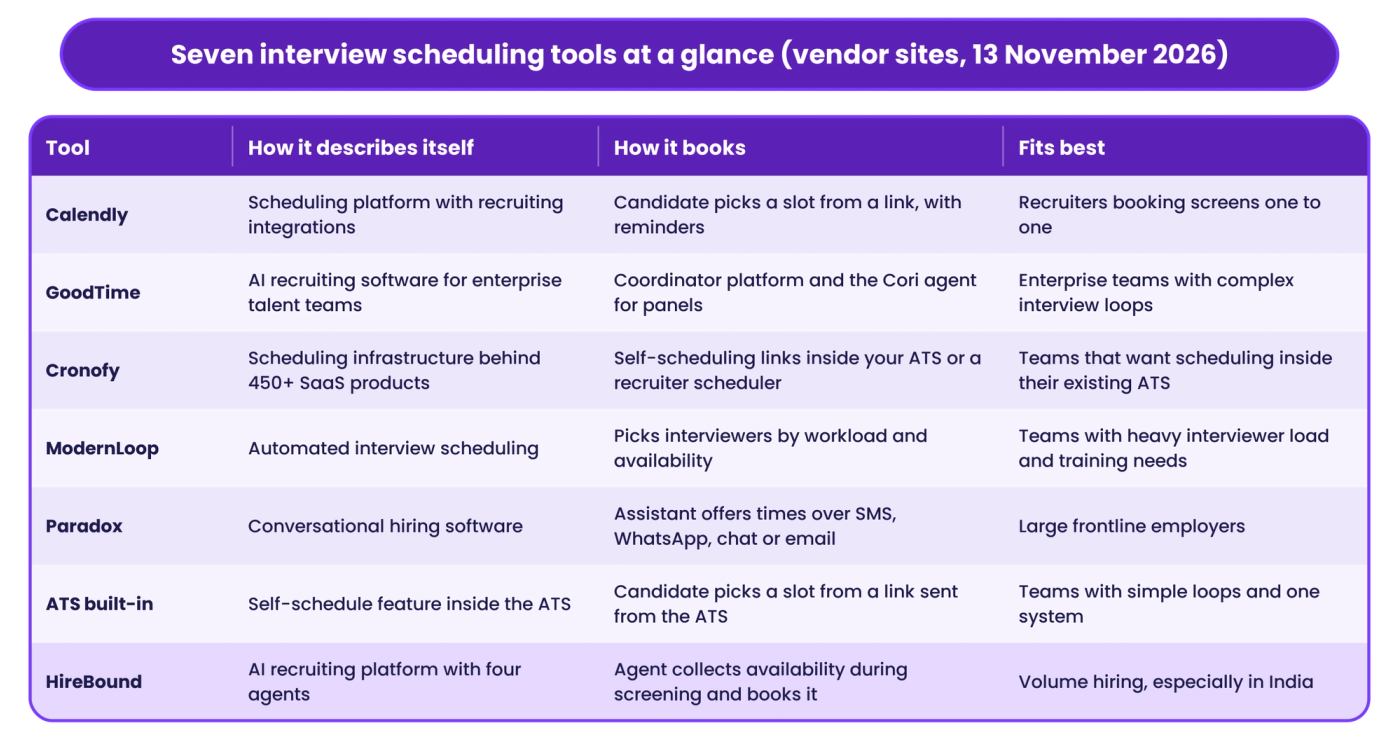
Read the third column first. It shows whether the candidate has to act before anything is booked.
The Best Interview Scheduling Tools, Reviewed
Each review draws on the vendor's own website.
Calendly
Calendly is the best-known interview scheduling app for booking links. Its recruiting page says it connects with applicant tracking systems and other recruiting tools, naming Greenhouse, JazzHR and Zoho Recruit among them (vendor site, 13 November 2026).
Recruiters can set up "automatic pre-interview reminders and confirmations," which Calendly says reduce no-shows. Its help centre describes Round Robin events, which rotate meetings between several hosts, and Collective events, which show only the times when every selected host is free.
Best for: Recruiters and hiring managers who book screens one to one and want candidates to pick their own slot.
GoodTime
GoodTime calls itself AI recruiting software for enterprise talent teams that "automates complex interview scheduling" (vendor site, 13 November 2026). It says it can "coordinate every interview, from 1:1 screens to complex multi-day panels."
Its AI agent, Cori, schedules and reschedules interviews, resolves conflicts and follows up. Interviewers get a portal, reminders, load balancing and AI-assisted scorecards, and candidates get branded self-scheduling. GoodTime lists integrations with Workday, SuccessFactors, iCIMS, Greenhouse, SmartRecruiters, Lever and Jobvite, among others.
It cites Canva at 84% faster interview scheduling.
Best for: Enterprise talent teams running multi-round panels across many interviewers.
Cronofy
Cronofy describes itself as "the infrastructure behind 450+ SaaS products," and says 100+ HR tech products run on it (vendor site, 13 November 2026). Recruiting products such as Teamtailor and Pinpoint appear on its site as customers, so some teams already use Cronofy inside their applicant tracking system.
For hiring teams, Cronofy says candidates can "self schedule with no logins or extra tools required." It supports panel interviews and round-robin logic, adjusts for time zones, and offers built-in rescheduling and cancellation with real-time calendar updates. It works with Google, Outlook, Exchange and iCloud calendars.
Its case study headline says Wise cut interview scheduling "from 6 days to 90 minutes."
Best for: Teams that want reliable calendar logic inside the applicant tracking system they already use.
ModernLoop
ModernLoop calls itself automated interview scheduling software (vendor site, 13 November 2026). It syncs calendars, compares interviewer workload and availability, and selects an interviewer for each candidate.
It also covers the interviewer side of hiring. It offers structured interviewer training programs and says it helps teams "balance schedules, manage interviewer load, prevent burnout."
ModernLoop quotes Instacart: "ModernLoop allowed us to triple our interview volume without adding more recruiting coordinators."
Best for: Fast-growing tech teams where interviewer load and training are the real constraint.
Paradox
Paradox describes itself as "conversational hiring software that gets work done for you," built around an assistant called Olivia (vendor site, 13 November 2026). Its scheduling page says the assistant "sends qualified candidates open interview times via SMS, Whatsapp, chat, or email."
The assistant sends interview reminders and helps managers or candidates reschedule. It syncs with recruiters' and hiring managers' calendars. Paradox says its Conversational ATS is "mobile-first automation for frontline workers and managers" and that it can respond in 100+ languages.
Its scheduling page claims a 40% decrease in interview no-shows and over 30 million interviews scheduled every year.
Best for: Large frontline and hourly employers that hire through text and chat.
Schedulers Built Into Your ATS
Many applicant tracking systems include a self-scheduling feature, so check yours before buying another tool. In Greenhouse, for example, a recruiter sends a self-schedule request from the candidate's profile (Greenhouse support, 13 November 2026). The candidate picks a time from the interviewers' availability, and the interview is booked and sent to everyone.
Greenhouse's support pages say self-schedule requests suit stages with a single interview, such as a hiring manager screen. Candidates can reschedule from the reminder email if the team turns that on. Workable says on its site that candidates can book their own interview slots.
Using the built-in scheduler keeps every booking in one system, with no extra login for recruiters or interviewers.
Best for: Teams with simple interview loops who want everything in the system of record.
HireBound
HireBound is an AI recruiting platform with four agents: Sourcing, Screening, Scheduling and Evaluation. Scheduling is one step in a connected flow, so the interview is booked inside the same conversation that qualified the candidate.
The Screening Agent talks to candidates over Voice, WhatsApp, SMS and email, against your criteria. During that conversation, the Scheduling Agent collects the candidate's availability and books the interview with your team. It sends reminders automatically, with no email back-and-forth, and hands over a confirmed slot plus the calendar or meeting details.
Because the agent asks for availability while the candidate is already replying, there is no separate link to chase. Voice AI runs in 14 Indian languages, so a candidate who prefers Tamil or Marathi books the slot in Tamil or Marathi. HireBound's interview scheduling agent page shows the full flow.
Bookings land in the Smart CRM, where agent activity moves candidates between pipeline stages with an attributed activity log. The CRM can sync with an existing applicant tracking system in supported workflows, so teams keep their system of record.
HireBound has powered 8 million+ candidate conversations, and recruiters using it handle 3× more candidates per day than with a manual process. One of India's largest recruitment firms, with 150+ recruiters, cut its sourcing-to-scheduling time by 40% on HireBound.
Best for: Teams hiring at volume, where getting candidates to reply and book takes more recruiter hours than the calendar maths.
Self-Scheduling Links or Agent-Run Scheduling?
A self-scheduling link and an agent solve different problems. A link removes the back-and-forth once the candidate engages. An agent also handles the part before that: getting the candidate to engage.
Links work best when candidates are motivated and read email, such as senior applicants or referrals. Our comparison of self-scheduling vs recruiter-scheduled interviews looks at where each model holds up.
An agent asks for availability in the conversation the candidate is already in. If the reply is "after 6 pm on weekdays," it reads that, checks calendars and confirms a slot. If there is no reply, it follows up on another channel.
With links, a recruiter still chases non-responders. With an agent, the recruiter sees confirmed interviews and a short list of exceptions.
Here is a quick way to decide:
- Fewer than 20 interviews a week with engaged candidates: a booking link or your ATS scheduler is usually enough.
- Multi-round panels with many interviewers: a coordinator platform earns its place.
- Hundreds of candidates a week, many on mobile: an agent that books inside the conversation saves the most hours.
What Changes When You Schedule Interviews in India?
Scheduling at volume in India changes three things: the channel candidates reply on, the language of the conversation, and how consent is recorded.
The first is the channel. Many candidates, especially for frontline and early-career roles, reply on WhatsApp or pick up the phone long before they open an email. The chart below shows the gap in HireBound's data.
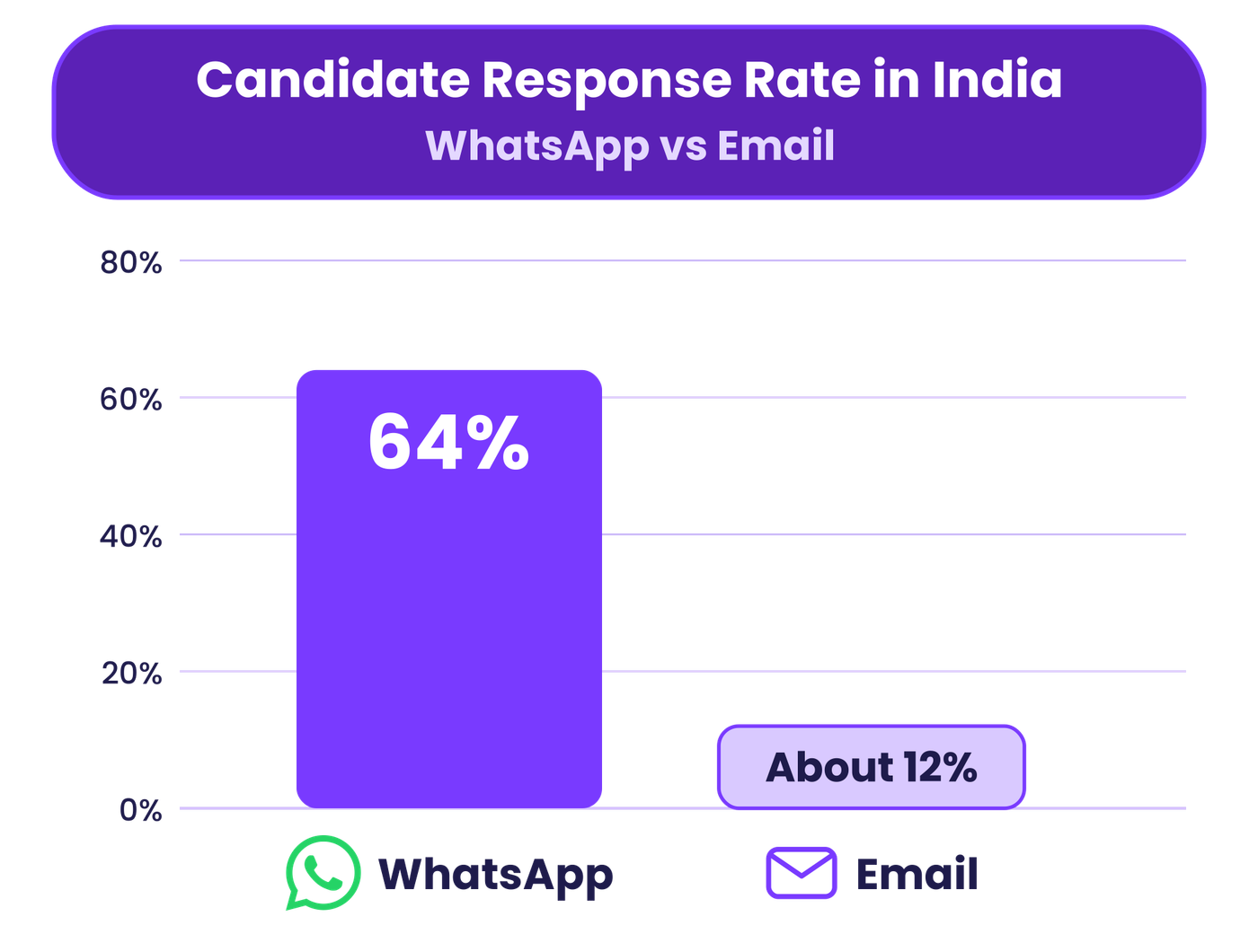
A booking link sent by email reaches far fewer candidates than the same request on WhatsApp.
As an illustration with assumed numbers, booking 400 shortlisted candidates at the rates above would draw about 256 WhatsApp replies against about 48 by email. Treat it as a sizing guide, not a forecast.
The second is language. A candidate in Coimbatore or Nagpur may be more at ease confirming a slot in Tamil or Marathi than in English. A tool that only books in English loses some of those candidates before the interview.
The third is consent. India's Digital Personal Data Protection Act, 2023 sets rules for how candidate data is collected and processed. Ask every vendor how each channel records consent, and where messages and call recordings are stored.
Who Should Pick Something Else?
An agent that books during screening is one route among several. Many teams get more from one of the other tools, because those tools lead on strengths their hiring depends on.
- Calendly suits recruiters who book one-to-one screens with engaged candidates and want a familiar link.
- GoodTime is built for enterprise teams whose hardest job is coordinating multi-day panels across many interviewers.
- Cronofy suits teams that want dependable calendar logic inside the ATS they already run.
- ModernLoop fits tech teams where interviewer load and interviewer training are the bottleneck.
- Paradox suits large frontline employers that already hire through text and chat at scale.
- Your ATS's built-in scheduler is often enough for teams with simple loops and modest volume.
If one of these describes your team, start your shortlist there.
What Should You Ask Any Interview Scheduling Vendor?
Put the same questions to every vendor and write the answers down. A vague answer in a demo often becomes a manual workaround once the tool is live.
- What happens when a candidate does not reply? Ask to see the follow-up sequence, the channels it uses, and when a recruiter is pulled in.
- Which channels can book a slot? Ask to see WhatsApp, SMS or a phone call confirm a real booking, not a slide.
- How are panels handled? Ask how the tool finds a slot for four interviewers and what it does when one declines.
- Who can reschedule, and how? Ask whether candidates and interviewers can move a slot themselves, and how the calendar updates.
- Which languages does it book in? For hiring in India, ask to read a booking conversation in Hindi or another regional language.
- What do the messages say? Ask to edit the confirmation and reminder text. Our interview invitation email templates give you wording to compare against.
Log the answers in one sheet to compare vendors after the demos.
How Do You Test an Interview Scheduling Tool Before You Commit?
A two-week test on one real role tells you more than a month of demos. Run it like this.
- Pick one live role with volume. Choose one with at least 50 shortlisted candidates, so automation effects show.
- Record a baseline. Note the hours from shortlist to confirmed slot, the reschedules a recruiter handled, and the no-show rate.
- Run the same role on the new tool. Keep the recruiter, interviewers and interview format the same.
- Compare three numbers: hours from shortlist to confirmed slot, reschedules handled without a recruiter, and no-show rate.
- Check the records. Confirm calendar invites, reminders, consent and the booking history all look right before you scale.
If the new tool does not beat your baseline on at least two of the three numbers, keep looking.
Which Interview Scheduling Tool Fits Which Team?
Match the tool to your constraint rather than a ranking. The table pairs common team situations with the option that usually suits them.
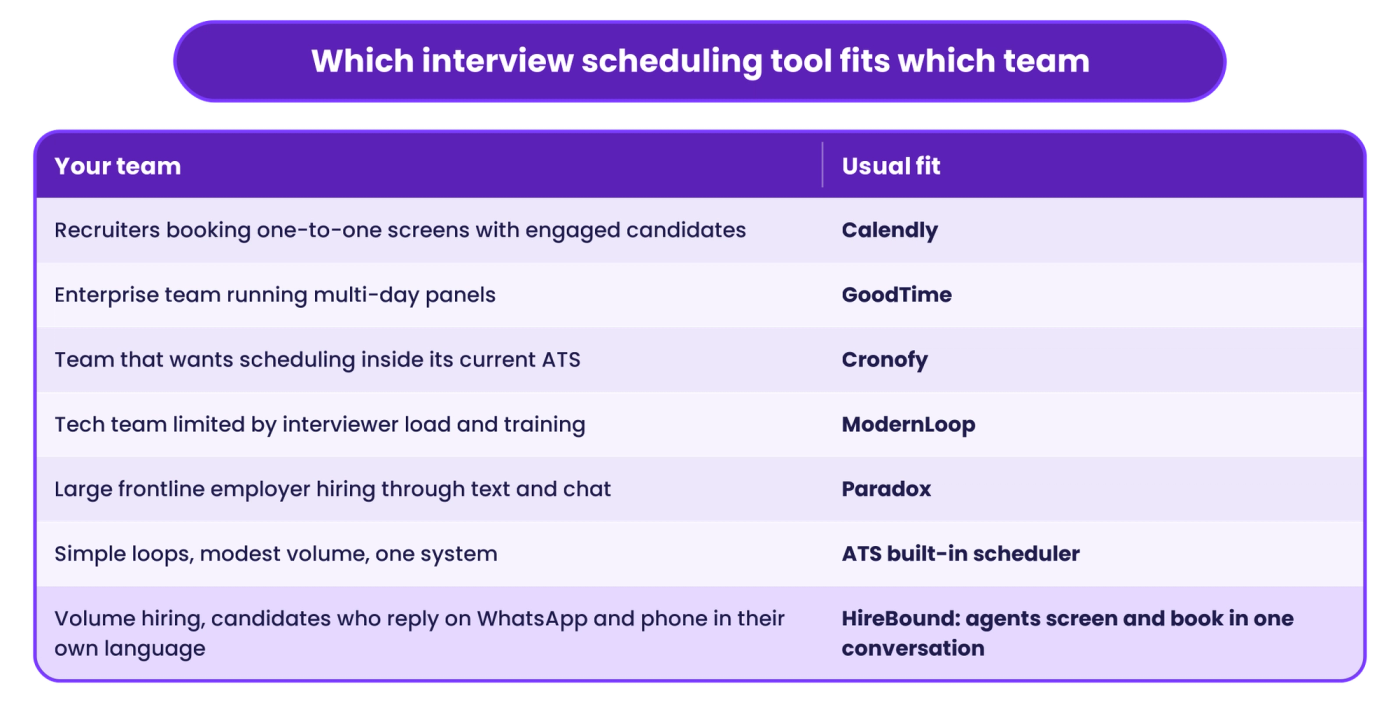
Most teams fit more than one row, so a company can run senior panels and volume roles through different tools.
Spending more hours chasing replies than booking interviews? Talk to HireBound about a one-role pilot →
Our Recommendation
All seven belong on a shortlist of online interview scheduling tools, and the right one is built around your slowest handoff. Calendly leads on simple links, GoodTime and ModernLoop on panels and interviewer load, Cronofy on calendar infrastructure, Paradox on frontline chat, and your ATS on keeping everything in one place.
Apply one decision rule. Look at where your scheduling hours go in a normal week.
If most of them go on finding a slot for four busy interviewers, start with a coordinator platform. If most of them go on getting candidates to reply, confirm and turn up, across WhatsApp and the phone, put the booking inside the screening conversation and test HireBound on one live role.


