Types of Interviews: Formats, Rounds and How to Prepare for Each
 Tanmey Goswami
 ·Nov 5, 2026·7 min read

Key Takeaways
- 1A job interview can be classified four ways: by format, by number of people, by structure and by purpose. Every real interview combines one choice from each.
- 2The US Office of Personnel Management says higher-structure interviews show higher validity and rater reliability, so structure is the evidence-backed default for employers.
- 3Indian employers often chain formats: Capgemini lists a group discussion for select roles, and HCLTech lists tests, then technical and HR interviews, for campus hires.
- 4Prepare by type, not in general: practise STAR stories for behavioural rounds, reasoning aloud for case rounds, and short direct answers for phone or automated calls.
- 5Many first screens are now phone, WhatsApp or voice AI calls, and a recruiter still reviews the shortlist and makes the decision.
The different types of interviews are the formats employers use to assess candidates: by medium (phone, video, in person), by number of people (one-on-one, panel, group), by structure (structured or unstructured), and by purpose (screening, technical, HR). This guide covers job interviews, not research interviews.
If you hire for a living, see how HireBound automates the first screening call: explore the AI recruiting platform.
What Are the Different Types of Interviews?
Most interviews fit four axes at once. A single round might be a video call (format), with two interviewers (panel), using set behavioural questions (structure), for a technical check (purpose). Naming each axis helps candidates prepare and helps recruiters design the process.
- Format: phone, video, in person, or asynchronous (recorded or AI voice).
- People: one-on-one, panel or group.
- Structure: structured, unstructured, behavioural, situational or case.
- Purpose: screening, technical, managerial, HR or stress.
A candidate rarely faces only one type. Most hiring processes chain three or four rounds, each with a different job to do. The sections below take each axis in turn.
Types of Interviews by Format
Format is how the conversation happens. It changes what you can show and what you must prepare.
- Phone interview: a short call used to screen. You have no visual cues, so clear, direct answers matter most.
- Video interview: a live call on a meeting tool. Test your connection, camera and lighting, and look at the camera when you speak.
- In-person interview: a face-to-face meeting at the office or a walk-in venue. Body language, punctuality and presentation count.
- Asynchronous interview: you answer recorded questions, by video or voice, at a time that suits you. A recruiter or system reviews the answers later.
Employers mix these freely. EY’s India careers site says your interview may be a combination of in-person, phone and video. Capgemini’s careers FAQ says the interview could be in person, on video or by phone, and that the recruitment team tells you in advance.
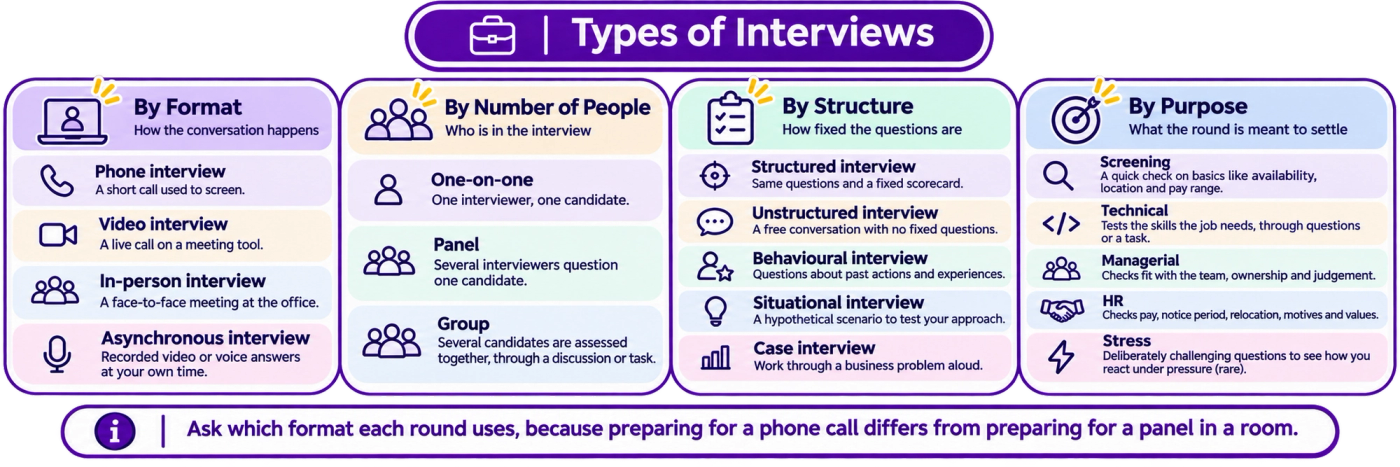
Ask which format each round uses, because preparing for a phone call differs from preparing for a panel in a room.
Types of Interviews by Number of People
- One-on-one: one interviewer, one candidate. It allows depth and rapport, but it depends on a single person’s judgement.
- Panel: several interviewers question one candidate. It spreads judgement across people and suits senior or cross-functional roles.
- Group: several candidates are assessed together, through a discussion or task. It tests communication and teamwork under observation.
Choosing between a panel and one-on-one rounds is a common hiring decision. HireBound compares them in panel interview vs one-on-one interview, so this post stays brief.
For candidates, the main change is who you address. In a panel, answer the person who asked but make eye contact with everyone.
Types of Interviews by Structure
Structure is how fixed the questions and scoring are.
- Structured interview: every candidate gets the same job-related questions and is scored on the same scale. The US Office of Personnel Management (OPM) defines it as a method that measures job-related competencies by asking about past behaviour or proposed behaviour in hypothetical situations.
- Unstructured interview: a free conversation with no fixed questions or scoring. It feels natural, but the questions and standards change with each interviewer.
- Behavioural interview: questions about past actions, such as “Describe a situation where you handled a difficult customer.” SHRM describes it as focusing on past experiences to predict future behaviour.
- Situational interview: a hypothetical scenario, such as “What would you do if two deadlines clashed?” SHRM describes it as giving the candidate a hypothetical situation to respond to.
- Case interview: you work through a business problem aloud, showing how you reason. It is common in consulting and analyst roles.
According to OPM’s structured interviews guidance, interviews with a higher degree of structure show higher validity, rater reliability and rater agreement, and less adverse impact. That is the case for fixed questions and scorecards. HireBound’s structured interview scorecard template shows how to build one.
OPM also notes that structured interviews are usually scored by a panel, where each member rates answers individually and then discusses large gaps. Behavioural questions have shown higher validity for complex professional and managerial work, per the same OPM page. For the SHRM definitions, see SHRM’s interview question tool.
Types of Interviews by Stage and Purpose
Purpose describes what the round is meant to settle. Roles with more than two rounds usually move through these in order.
- Screening: a quick check on basics such as availability, location, pay range and communication. A recruiter or an automated call often runs it.
- Technical: tests the skills the job needs, through questions, a live exercise or a task. See how assessment formats differ in skills assessment vs take-home vs live coding.
- Managerial: the hiring manager checks fit with the team, ownership and judgement.
- HR: a recruiter or HR lead checks pay, notice period, relocation, motives and values.
- Stress: deliberately challenging questions to see how you react under pressure. It is rare, and a well-run process uses it only where the job truly demands it.
The HR round has its own preparation. See the HireBound guides on common interview questions for the core answers, and HireBound’s separate HR round and BPO interview question guides.
Interview Types in India: Group Discussions, Walk-Ins and Client Rounds
Indian hiring adds a few formats that global guides skip. Company careers pages show how they are chained.
- Group discussion: Capgemini India’s recruitment page lists it for select roles in its fresher process and says it tests communication, teamwork and analytical thinking. Its stages are an online aptitude test, a coding or technical assessment, the group discussion, a technical interview and an HR interview.
- Test-led campus rounds: HCLTech’s campus hiring page describes the Ascend test as a cognitive test, a coding test and a Versant English speaking and listening test. Candidates who clear those move to technical and HR interviews.
- Behavioural interviews at professional-services firms: EY’s India careers page says it leans on behavioural interviewing, with questions that start with “Give an example of” or “Describe a situation when”.
- Walk-in drives: common in BPO and frontline hiring. Screening, a communication check and an HR chat may happen on one day, often face to face.
- Client round: in IT services, some roles add a round where the client’s manager meets the shortlisted candidate. Treat it as a technical and communication check from someone who will depend on you. Rules vary by client.
Check your invitation for the exact stages. Companies change them by role, level and year.
How to Prepare for Each Type of Interview
Match your preparation to the type. The table lists what each round assesses and one prep tip.
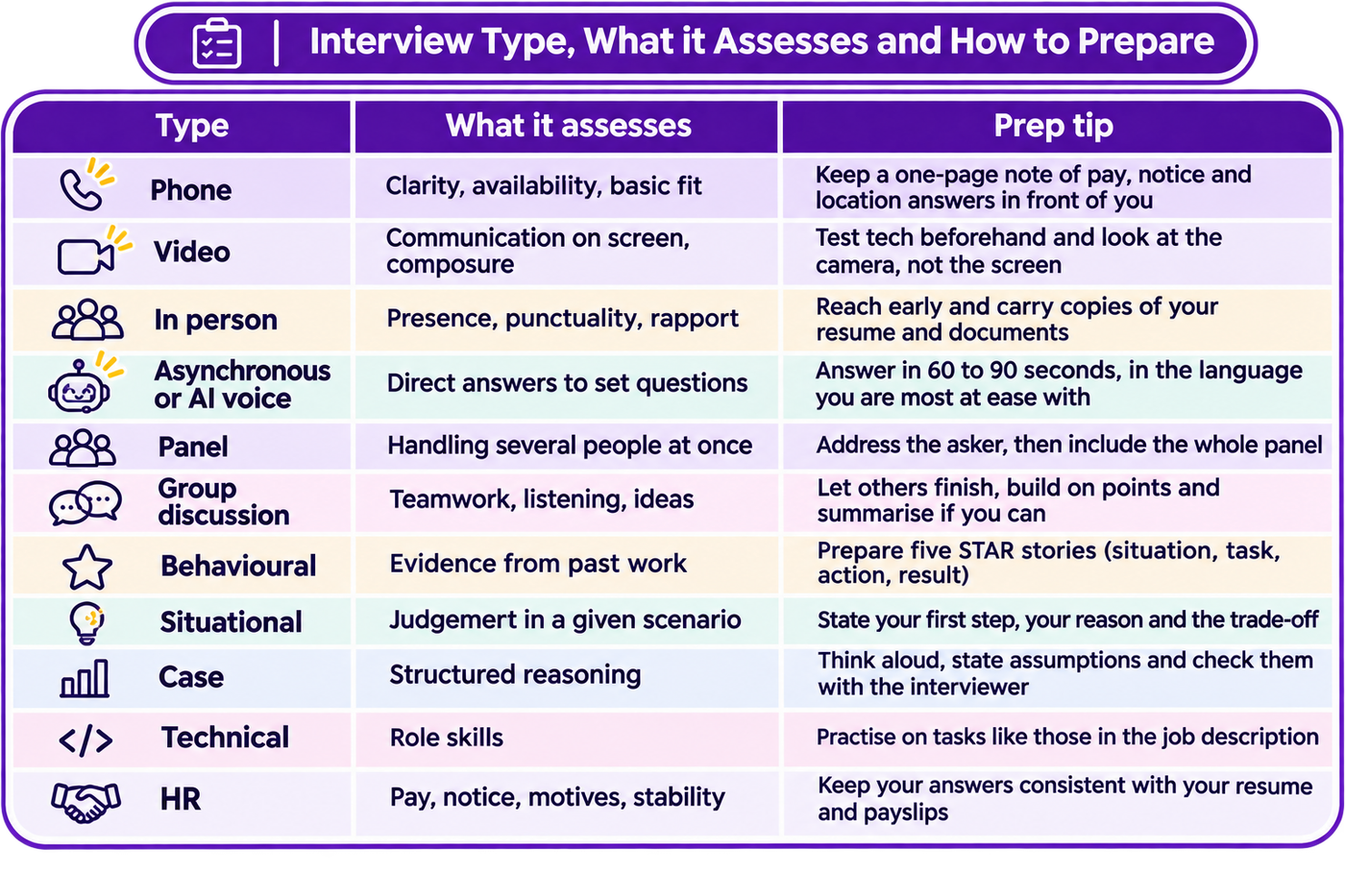
Whatever the type, give a specific example, tie it to the role and keep it short.
How Do Employers Choose Which Interview Types to Use?
Employers should start from the decision each round must support, then pick the cheapest format that can support it. A screening call does not need a panel. A senior hire probably does.
A sensible default for most roles is a short screen, a structured round on job skills, and a final conversation with the hiring manager. Add a group or case round only where the job needs it, such as sales or consulting. Keep the same questions and scale for every candidate in a given round.
Volume changes the choice. A BPO hiring hundreds of agents a month cannot run a human phone screen for each applicant. It needs a first round that scales, and then human time where judgement matters.
Structure raises consistency but does not remove bias, and scores are only as good as the questions behind them. A rigid script can also miss a strong candidate whose answer does not fit the form, so keep room for follow-up questions.
Where Automated Voice Screening Fits
The newest first-round format is an automated call or recorded interview that collects the same answers from every candidate. It suits high-volume roles where recruiters otherwise spend their day on repeat questions.
HireBound’s Voice AI screening calls run in 14 Indian languages and ask role-specific questions on pay, notice period, location and skills. HireBound has powered more than 8 million candidate conversations, and recruiters using it handle 3x more candidates per day than with a manual process. Across India, HireBound sees a 64% WhatsApp response rate against about 12% for email, so some teams open on WhatsApp and move to a call.
A recruiter reviews the shortlist and makes every hiring decision. The automated round collects and scores answers. People run the managerial, panel and final rounds. HireBound’s scheduling agent also books the later rounds, so candidates are not chasing slots by email.
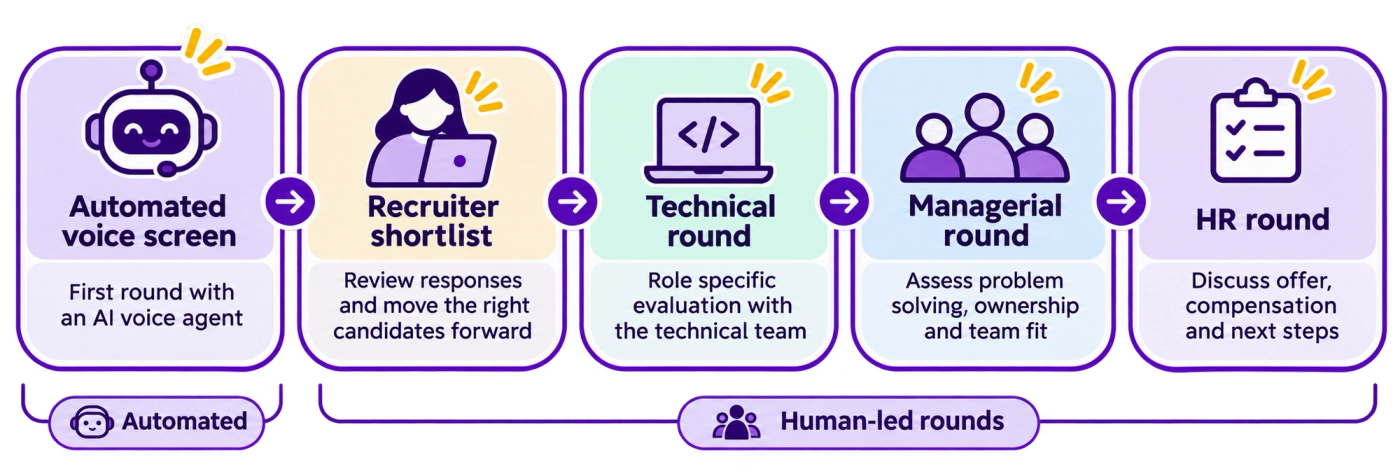
Running first-round screens for hundreds of candidates? See how HireBound’s AI agents handle the first call while your recruiters keep the decisions: talk to the HireBound team.


