Employer Branding for Recruiting: A Working Guide
 Tanmey Goswami
 ·Nov 13, 2026·10 min read

Key Takeaways
- 1Employer branding for recruiting means making a few true, checkable claims about working at your company and repeating them at every point a candidate meets you.
- 2In Cable and Turban's 2003 study of 339 job seekers, people were willing to accept lower pay to join employers with a good reputation.
- 3Build the employer value proposition from 10 to 15 interviews with recent joiners, leavers and hiring managers, then keep three to five pillars.
- 4Van Hoye and Lievens (2009) linked positive word of mouth early in recruitment to actual application decisions among 612 potential applicants.
- 5Measure the brand by hiring outcomes: qualified applicants per role, offer acceptance rate and referral share, reviewed every quarter.
Employer branding for recruiting is the work of shaping what candidates believe about working at your company, so the right people apply and accept. It starts with an honest employer value proposition. It then shows up in proof points, employee stories, reviews and the hiring process itself.
Most companies already have an employer brand, whether they manage it or not. Candidates form a view from job ads, a friend's comment, a slow reply to their application and an interviewer who arrived late. The steps below make that view accurate and useful to you.
Hiring at volume and want every candidate to get a fast, consistent reply? See how HireBound's AI recruiting agents work
What Is Employer Branding in Recruiting?
Employer branding is the reputation your company has as a place to work. Tim Ambler and Simon Barrow introduced the term in the Journal of Brand Management in 1996. They described the employer brand as the package of functional, economic and psychological benefits that comes with working for a company.
In recruiting terms, the functional benefits are the work, the tools and the growth path. The economic benefits are pay, bonuses and job security. The psychological benefits are pride, belonging and the people you work with.
Employer branding is different from recruitment marketing. The brand is what people believe. Recruitment marketing is how you put that message in front of the right candidates through channels, campaigns and a funnel. Our guide to recruitment marketing covers the channels. This guide covers the message and the evidence behind it.
The diagram shows how the parts of an employer brand stack up.
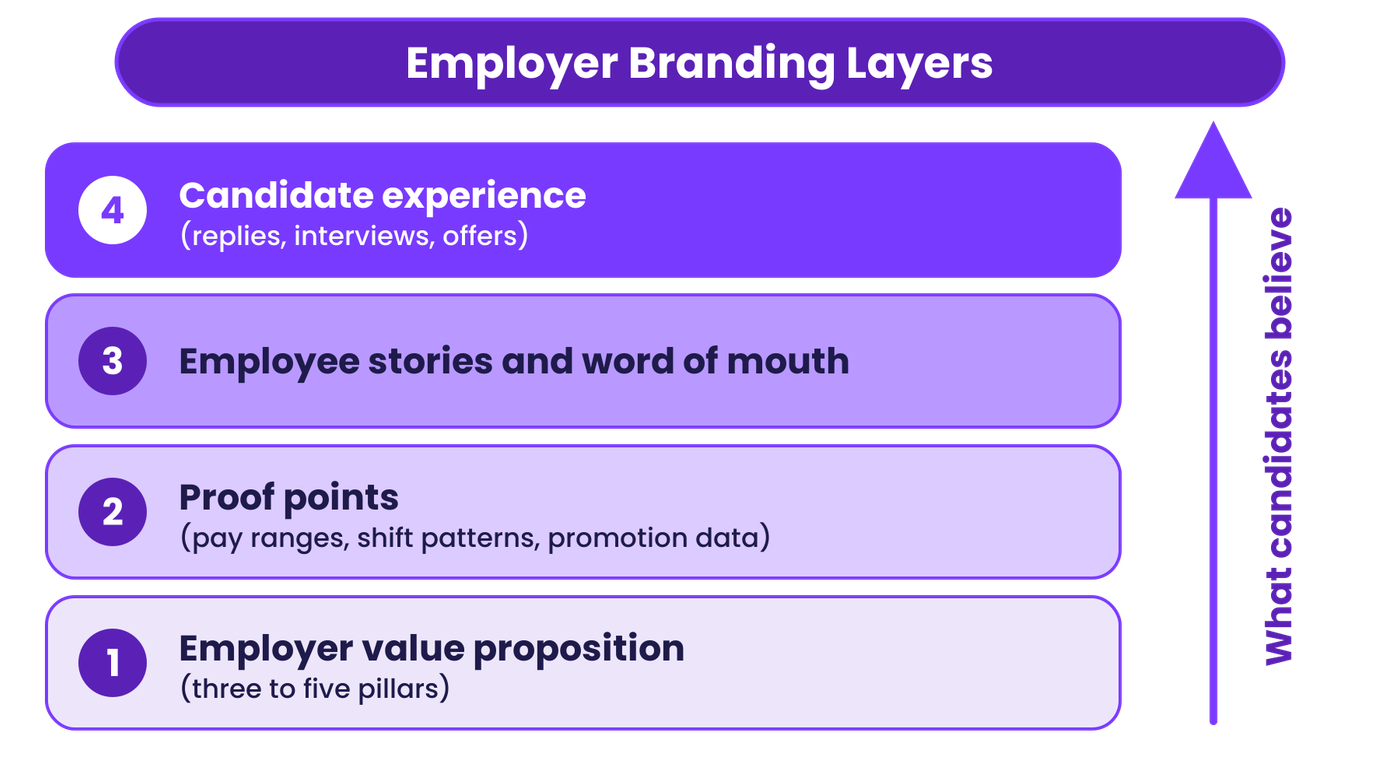
Each layer depends on the one below it. A polished candidate experience cannot rescue a value proposition that employees do not recognise.
Why Employer Branding Matters for Talent Acquisition
Employer branding matters for talent acquisition because reputation affects who applies, what pay people will accept and whether they say yes to an offer. Daniel Cable and Daniel Turban studied 339 job seekers for a 2003 paper in the Journal of Applied Social Psychology. Reputation shaped whether people pursued a job, because they used it as a signal about the job and expected to feel proud working there. People were also willing to accept lower pay to join firms with a positive reputation.
The hiring process counts as part of the brand. A 2005 meta-analysis by Chapman and colleagues in the Journal of Applied Psychology pooled 71 studies. Applicant attraction was predicted by job and company characteristics, recruiter behaviour, how candidates saw the process and their sense of fit. Recruiter demographics did not predict it.
Then there is the time cost of a weak brand. SHRM's 2026 benchmarking puts the median time-to-fill at 39 days. A brand that brings fewer qualified applicants, or more declined offers, adds days to that figure. In India, ManpowerGroup's 2026 Global Talent Shortage Survey found that 82% of employers struggle to find the skilled talent they need. When talent is scarce, candidates compare employers more carefully.
Strategic employer branding for talent acquisition treats all of this as hiring work, with a goal, an owner and a metric for each activity.
How to Build an Employer Value Proposition
An employer value proposition (EVP) is a short statement of what people get in return for working at your company, and who it suits. A good one is true, specific and a little selective. It should put some people off.
Build it from what employees tell you. Senior leaders guessing in a workshop tend to produce the same five words every company uses.
- Interview 10 to 15 people. Talk to recent joiners, people who left in the past year and hiring managers. Ask why joiners said yes and why leavers went.
- Collect the exact words. Note the phrases people repeat, such as "I shipped in my first month" or "my manager actually trains me". These become your copy.
- Group them into three to five pillars. Typical pillars are growth, the work itself, pay and stability, people and flexibility. Keep only the ones employees genuinely recognise.
- Write one line per pillar per role family. "Growth" means different things to a delivery driver, a BPO team lead and a backend engineer, so make each line specific to the role.
- Name the trade-off. Say what the job asks in return, such as night shifts, a fast pace or field travel. Candidates who self-select out save you a screening call.
- Test it with current employees. If they would not say it to a friend, rewrite it.
The finished EVP fits on one page. Every job ad, careers page and recruiter message should draw from it.
Proof Points: Turn Claims Into Facts Candidates Can Check
A proof point is a fact that backs up an EVP pillar. "Great culture" is a claim. "Seven of our last ten team leads were promoted from the floor" is a proof point. Candidates discount claims and believe proof points.
Pay is the proof point job ads most often leave out, and in the EU it is becoming a legal duty. Article 5 of Directive (EU) 2023/970 gives applicants the right to know the starting pay or its range, for example in the job ad or before the interview. Employers may not ask about pay history. Even where no law requires it, stating a CTC or salary range filters out mismatches early.
This table shows how common claims turn into proof points.
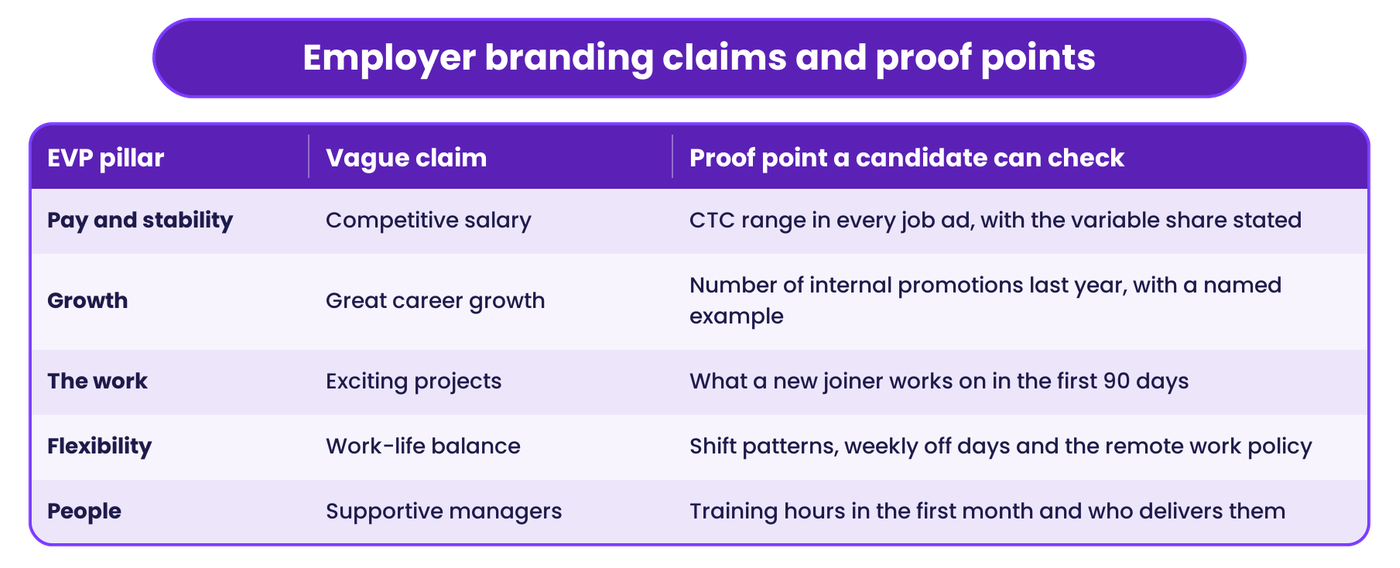
Pick one proof point per pillar per role family, and check each one with the team that owns it before it goes into a job ad.
How to Use Employee Stories in Employer Branding
Employee stories put a face on the proof points. They work best when they are specific, unpolished and about one person's actual job.
The format of a story changes how candidates read it. In a 2007 study of potential applicants for a head nurse role, Greet Van Hoye and Filip Lievens found that testimonials about individual employees attracted people more than testimonials about the organisation. Information from independent sources still beat company testimonials, mainly because it seemed more credible.
So build stories that read like a person talking:
- Keep each story to one role, one person and one moment. "What my first week on the night shift looked like" beats "Life at our company".
- Use real numbers, such as the shift length, the team size and the time it took to get promoted.
- Include a hard part. A story that admits the job is demanding is easier to believe than one that is all praise.
- Let employees post on their own profiles. The post reaches their network and reads as their own view.
Former employees can carry the brand too. People who left on good terms often refer candidates and sometimes return. Our guide to employee and alumni network sourcing shows how to keep that network active.
How to Handle Reviews and Word of Mouth
Word of mouth is the part of your employer brand you control least. Van Hoye and Lievens surveyed 612 potential applicants in a 2009 study in the Journal of Applied Psychology. Positive word of mouth received early in recruitment was linked to how attractive people found the employer and to whether they actually applied.
Anonymous employee review sites are one form of word of mouth. You cannot delete criticism there, but you can respond well:
- Read every review monthly. Tag each one by theme, such as pay, managers, shifts or the interview process.
- Reply to the specific point. Thank the reviewer, say what changed or what you are looking into, and skip the defensive tone.
- Fix the underlying problem. Three reviews about late salary credits point to a payroll problem that a better reply will not solve.
- Bring interview complaints to recruiting. Reviews about the hiring process are the easiest to act on, because recruiters control that experience.
- Never post fake reviews or pressure staff to write good ones. Candidates notice, and it damages trust in every other claim you make.
Over time, reviews follow the experience. Changing what employees and candidates go through is what changes what they write.
Your Hiring Process Is Part of the Employer Brand
Every candidate who applies gets a direct sample of how you treat people. If you reply in two weeks, skip the rejection email or reschedule an interview three times, that becomes your brand for that candidate. They may also tell others.
Most of the brand damage in hiring comes from a few touchpoints. The diagram maps them.
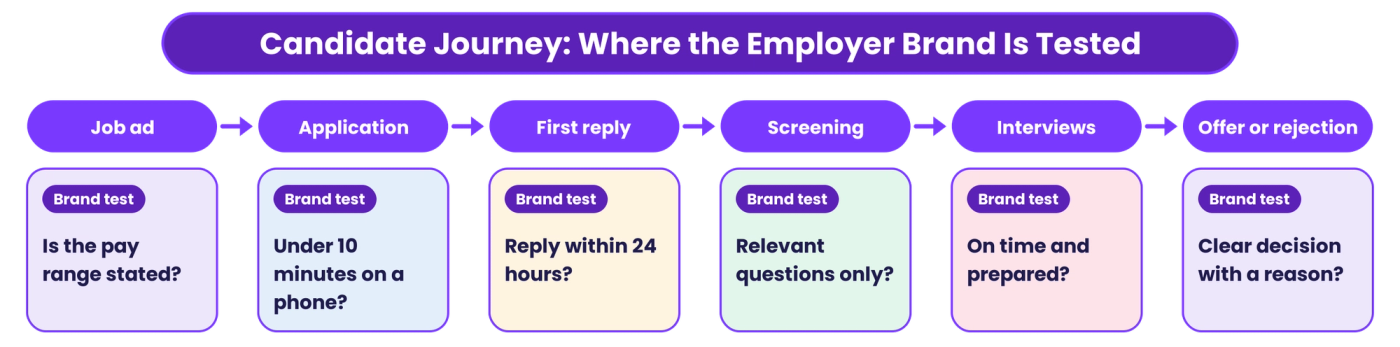
Audit the first reply and the rejection first, because candidates remember how long they waited and how they were turned down.
Recruitment and employer branding meet here. A candidate who reads about "supportive managers" and then waits ten days for a reply will believe the wait. Our guide on how to improve candidate experience covers each hiring stage in detail.
Three fixes protect the brand cheaply. Reply to every applicant within a day, even if the reply only confirms the next step. Tell candidates the stages and the timeline at the start. Close every process with a clear decision, including the people you did not hire.
Employer Branding in India: What Changes
Start with the channel. Many Indian candidates, especially in frontline, retail, logistics and BPO roles, read WhatsApp before email. HireBound sees a 64% response rate on WhatsApp in India against about 12% for email. An employer brand that only lives on a careers page and in email misses most of these candidates.
A job ad or employee story in Hindi, Tamil or Marathi speaks to candidates that English-only content does not reach, especially outside the big metros. HireBound's Voice AI screens candidates in 14 Indian languages, so the first conversation can happen in the language the candidate prefers.
India's Digital Personal Data Protection Act, 2023 governs how organisations process personal data. Get written consent before you publish an employee's name, photo or story, and take it down if they ask. Apply the same care to candidate data collected through your careers page.
In India, stating the CTC range, the fixed and variable split and the notice period you can buy out also answers the questions candidates otherwise ask on the first call.
A 90-Day Employer Branding Strategy
An employer branding strategy does not need a big team. One recruiter and one marketer can run this plan in a quarter.
- Weeks 1 to 3: Research. Run the joiner, leaver and hiring manager interviews. Pull your current offer acceptance rate, source of hire and review themes as a baseline.
- Weeks 4 to 5: Write the EVP. Draft three to five pillars, test them with employees and write one line per pillar for each priority role family.
- Weeks 6 to 8: Build proof. Add pay ranges to job ads, collect five employee stories and rewrite the careers page around the pillars.
- Weeks 9 to 10: Fix the process. Set a one-day reply standard, publish your hiring stages and write rejection templates that sound human.
- Weeks 11 to 13: Measure and adjust. Compare the metrics with your baseline and drop anything that did not move.
How to Measure Employer Branding
Employer branding is measurable if you track hiring outcomes rather than likes and impressions. Pick four or five metrics, set a baseline before you start and review them every quarter.
This table lists the metrics that show whether the brand is working.
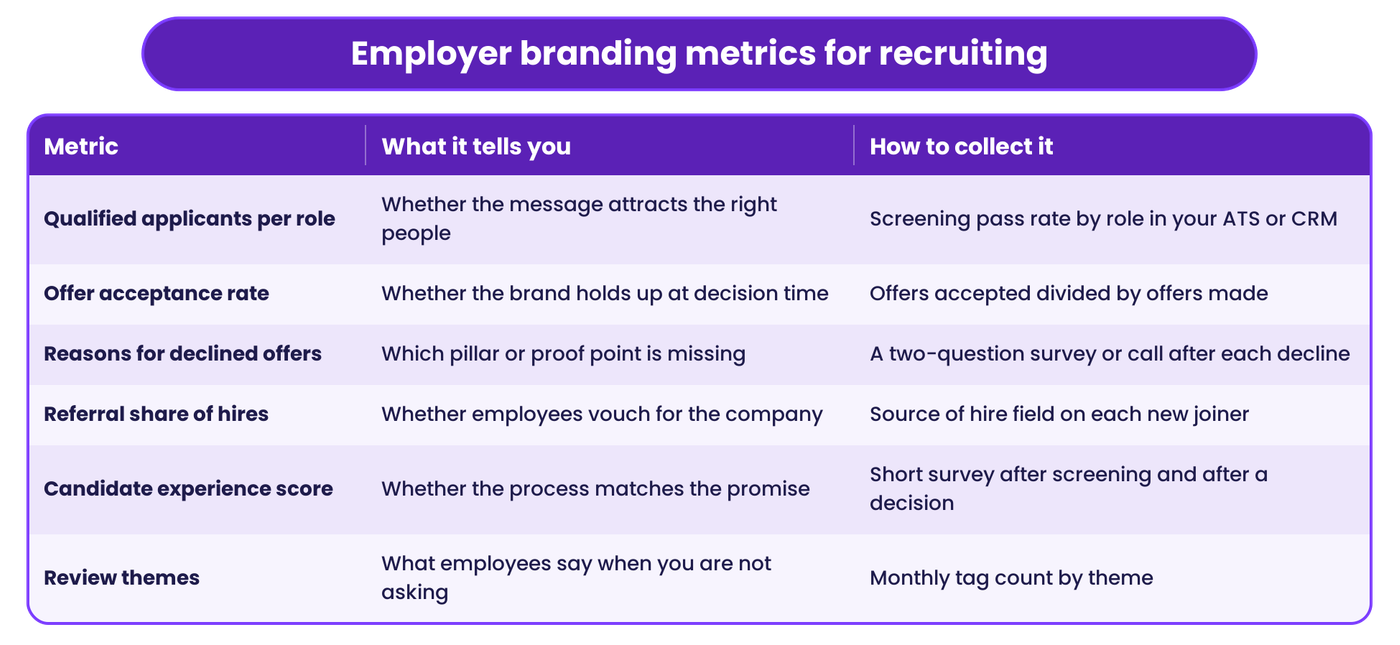
Offer acceptance and declined-offer reasons usually move first. In our experience, referral share and review themes take longer, sometimes two to three quarters.
Where HireBound Fits
An employer brand is tested hardest in the first few days after someone applies. HireBound's agents handle sourcing, screening, scheduling and evaluation, so candidates get a reply and a next step quickly instead of waiting in a queue.
Outreach runs over WhatsApp, voice, SMS and email, with Voice AI in 14 Indian languages. HireBound has powered 8 million+ candidate conversations. Its Smart CRM with a branded career page lets candidates apply through a form, WhatsApp or a QR code into one pipeline. Recruiters see every reply, screen and score in one place.
Recruiters then spend their time on interviews and offer conversations, which is where candidates judge the brand most closely.
Want every applicant to hear back the same day? Book a demo with HireBound
Start With What Employees Already Say
The fastest route to a credible employer brand is to listen first. Interview recent joiners this month, write down their exact words and turn three of them into proof points in your next job ads. Then fix the first reply, because it is the first thing every applicant experiences.


